


New Jersey CDL Class B Practice Test (NJ) 3

4.9 out of 5 (129 votes)
80% Passing score
20 Questions
4 Mistakes allowed
As a New Jerseyan seeking a Class B CDL, you understand the importance of thorough preparation. Our third NJ CDL practice test offers an unparalleled learning experience, tailored specifically for you. With 20 comprehensive written test questions, this DMV practice test demands a minimum score of 16 to pass, ensuring you have a solid grasp of the necessary knowledge. This NJ class B CDL practice test is crafted to cater to Class B CDL applicants in 2026, providing a deep dive into crucial subjects relevant to your upcoming DMV written test. It covers everything from pre-trip vehicle inspection to mastering vehicle control, gear shifting, and managing different driving scenarios like hills and steep downgrades. Moreover, it emphasizes the importance of effective communication with other road users, speed control, and awareness of drug and alcohol regulations. What sets our New Jersey CDL class B practice test apart is the meticulous crafting of sample written test questions by professional driving instructors, who bring decades of teaching experience. These experts have guided thousands to successfully acquire their licenses, ensuring the questions are not only accurate but also practical. We believe in learning from real-life situations, so some of the NJ permit test questions mimic scenarios you might encounter on the road, blending theoretical knowledge with practical application. Best of all, this rich learning resource is entirely free. Despite being a no-cost option, it rivals paid NJ DMV practice tests in terms of features and educational value. It's a full-fledged preparation tool at your fingertips, without any hidden costs. Our dedication to your success is unwavering. Remember, every time you take this NJ CDL practice test, the same set of written test questions and answers will challenge you, enabling you to gauge your progress and areas needing improvement. It's more than just a practice test; it's a stepping stone towards your goal of obtaining a New Jersey Class B CDL in 2026!
FREE CDL Practice Test App
Pass your New Jersey CDL General Knowledge test with the NextDoorDriving app. Real questions and answers—100% free and ad-free.
Download on the App Store

Sample New Jersey CDL Test Questions - General Knowledge

Question 1

After the initial 50-mile cargo check, when must cargo be reexamined if no duty-status change occurs first?

  1. A After 1 hour or 50 miles, whichever occurs first
  2. B After 3 hours or 150 miles, whichever occurs first
  3. C After 6 hours or 300 miles, whichever occurs first
  4. D Only after reaching the destination

Correct answer: B – After 3 hours or 150 miles, whichever occurs first

Cargo and its securement devices must first be inspected within 50 miles after beginning the trip. Additional reexaminations are required when the driver changes duty status or after driving for three hours or 150 miles, whichever occurs first. Necessary securement adjustments must be made during these checks.

Source: New Jersey Commercial Driver’s License Manual — § 3.1.2, “Cargo Inspection”, 49 CFR § 392.9(b)(2)–(3) — Inspection of cargo, cargo securement devices and systems
Question 2

Which combination satisfies the standard emergency-equipment requirements for a CMV power unit?

  1. A A flashlight and tire-sealant foam
  2. B A first-aid kit and pain reliever
  3. C A properly rated fire extinguisher and three approved reflective triangles
  4. D A cell phone and wheel chock

Correct answer: C – A properly rated fire extinguisher and three approved reflective triangles

Federal equipment rules require a properly rated, charged, accessible, and securely mounted fire extinguisher on a CMV power unit. One permitted warning-device option is three bidirectional emergency reflective triangles meeting the applicable standard. Items such as a cell phone, tire sealant, or pain reliever do not satisfy these requirements.

Source: 49 CFR § 393.95(a), (f) — Emergency equipment on all power units

Question 3

Which factors listed below affect a person’s blood alcohol concentration?

  1. A The amount of alcohol consumed
  2. B How quickly the alcohol is consumed
  3. C The person’s body weight
  4. D All of the above

Correct answer: D – All of the above

BAC is affected by the amount of alcohol consumed, the rate at which it is consumed, and body weight. Drinking more or drinking faster generally produces a higher BAC. A smaller person can reach the same BAC after consuming less alcohol than a larger person.

Source: New Jersey Commercial Driver’s License Manual — § 2.22.1, “What Determines Blood Alcohol Concentration?”

Question 4

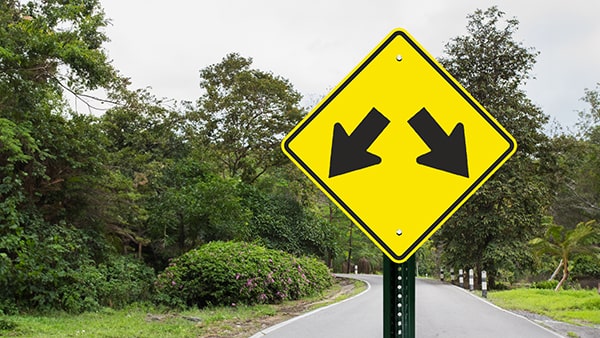
What does a PASS EITHER SIDE sign indicate?

This sign indicates that _____________.
  1. A Traffic must turn left at the next intersection
  2. B Traffic must keep to the right of the obstruction
  3. C Traffic may travel on either side of an island or roadway obstruction
  4. D All turning movements are prohibited

Correct answer: C – Traffic may travel on either side of an island or roadway obstruction

A PASS EITHER SIDE sign allows traffic to proceed on either side of an island or other roadway obstruction. Unlike a KEEP RIGHT or KEEP LEFT sign, it does not limit traffic to only one side. Drivers in New Jersey should follow the arrow corresponding to the available lane while maintaining proper clearance.

Source: Manual on Uniform Traffic Control Devices for Streets and Highways, 11th Ed. with Revision 1 — Ch. 2B, “PASS EITHER SIDE Sign (R4-9)”

Question 5

A CMV driver should use low-beam headlights at all times when driving at night.

  1. A True
  2. B False

Correct answer: B – False

Always using low beams unnecessarily reduces how far a driver can see ahead. High beams should be used when it is safe and legal and when they will not create glare for another driver. The driver must switch to low beams when required by traffic conditions and applicable lighting rules.

Source: New Jersey Commercial Driver’s License Manual — § 2.11.5, “Night Driving Procedures”

Question 6

Using the CDL following-distance rule, how much space should a 40-foot vehicle leave at 50 mph under good conditions?

  1. A 3 seconds
  2. B 4 seconds
  3. C 7 seconds
  4. D At least 5 seconds

Correct answer: D – At least 5 seconds

The CDL rule calls for at least one second of following distance for every 10 feet of vehicle length at speeds below 40 mph. A 40-foot vehicle starts with four seconds. Because the vehicle is traveling faster than 40 mph, one more second is added, producing a minimum of five seconds under good conditions.

Source: New Jersey Commercial Driver’s License Manual — § 2.7.1, “Space Ahead”