


New Jersey Permit Practice Test

4.5 out of 5 (1756 votes)
80% Passing score
20 Questions
4 Mistakes allowed
Getting ready for the New Jersey permit test is mostly about knowing what the MVC actually expects, not what people vaguely remember from a few practice questions passed around online. The real New Jersey knowledge test is based on the state driver manual and covers traffic laws, safe-driving rules, road signs, signals, GDL restrictions, DUI laws, vehicle operation, and all those small driver-responsibility details that sound obvious until the answer choices start looking annoyingly similar. There are 50 multiple-choice questions on the official exam, and you need 40 correct to pass. That is 80%, with room for only 10 missed questions. This NJ permit practice test gives you a focused way to work through the material without pretending that “reading the manual” automatically means “remembering the manual.” It uses 20 multiple-choice questions and keeps the same 80% passing standard, so you will need 16 correct answers here. The questions are built around the same core topics New Jersey applicants should expect: right-of-way, traffic signals, road signs, stopping rules, school bus laws, alcohol-related rules, and the practical stuff about being a legal, safe driver in a state where one wrong assumption can turn into a very real problem. The road-sign material deserves its own attention, but not because New Jersey treats it as a separate test with a separate score. It does not. Road signs are folded into the same knowledge test, which means they count right alongside the law questions, safety questions, and GDL questions. So, yes, you should know the sign shapes and colors, but you should also understand what they are telling you to do when you meet them in traffic. That is usually where the test gets a little less forgiving. The licensing details matter, too. A 16-year-old on the Special Learner’s Permit path goes through a high school or licensed driving school program and must complete 6 hours of behind-the-wheel instruction before supervised practice begins. Applicants 17 and older generally use an Examination Permit. First-time drivers 21 and older still have to pass the knowledge and vision tests, complete at least 3 months of supervised driving, pass the road test, hold a probationary license for 1 year, and then upgrade. At the end of this New Jersey MVC practice test, you can review what you missed and see the correct answers. That review is the useful part, honestly. It tells you whether you are ready — or whether you should fix a few weak spots before showing up with your 6 Points of ID and finding out the hard way that a failed knowledge test means waiting 7 days to retest.
FREE DMV Practice Test App
Study for your New Jersey permit test or driver’s license with the NextDoorDriving app. 700+ DMV questions and answers, 100% free!
Download on the App Store

Sample New Jersey Permit Test Questions

Question 1

An emergency vehicle using a siren and flashing emergency lights approaches from behind while you are outside an intersection. What must you do?
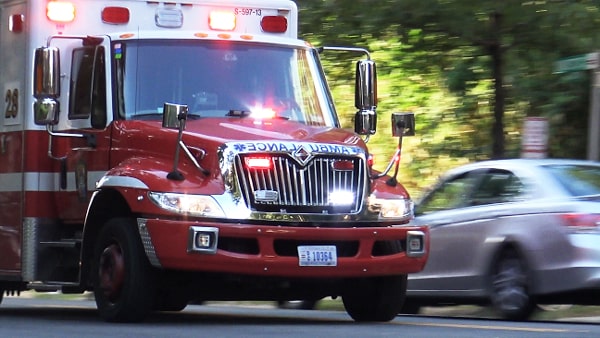
When you hear the siren or see the flashing red light of a closely approaching emergency vehicle, and you are not in the intersection, you should:
  1. A Continue slowly in the right lane
  2. B Accelerate to stay ahead of it
  3. C Move to the extreme right, stop, and wait for it to pass
  4. D Stop immediately in your current lane

Correct answer: C – Move to the extreme right, stop, and wait for it to pass

In New Jersey, a driver must move as near as possible to the right-hand curb or roadway edge, remain clear of an intersection, and stop for an approaching authorized emergency vehicle. Stay stopped until the vehicle has passed unless a police or traffic officer directs otherwise. Do not try to outrun the emergency vehicle.

Source: N.J.S.A. 39:4-92 – Authorized emergency vehicles; clearance for; following or parking near, New Jersey Driver Manual — “Safe Driving Rules and Regulations,” “Pull Over and Stop for Emergency Vehicles”

Question 2

When a pedestrian using a white cane or trained guide dog is crossing the roadway, a driver must:

  1. A Yield only at a signal-controlled intersection
  2. B Stop and give the pedestrian the right-of-way
  3. C Proceed if the pedestrian is outside a marked crosswalk
  4. D Sound the horn before passing

Correct answer: B – Stop and give the pedestrian the right-of-way

The New Jersey manual directs motorists to stop for a blind pedestrian using a white or metallic cane or a trained guide dog. State law also gives a person accompanied by a guide dog, and an instructor training one, priority over vehicles while crossing a highway or intersection. Drivers should wait until the pedestrian can cross safely.

Source: N.J.S.A. 10:5-29.4 – Right-of-way for person accompanied by or instructing a guide dog, New Jersey Driver Manual — “Safe Driving Rules and Regulations,” “Stop Regulations”

Question 3

In New Jersey, may you drive after taking a prescription or other drug that has left you under the influence?

  1. A Yes, if the drug was prescribed
  2. B Yes, if the drug is legal
  3. C No, under no circumstances
  4. D Yes, if you remain below the speed limit

Correct answer: C – No, under no circumstances

Driving while under the influence of a narcotic, hallucinogenic, or habit-producing drug is illegal, including when the substance was lawfully obtained. For a first drug-related conviction, N.J.S.A. 39:4-50(a)(1)(ii) provides a $300–$500 fine, 12–48 hours of Intoxicated Driver Resource Center detainment, possible imprisonment for up to 30 days, and loss of driving privileges for seven months to one year.

Source: N.J.S.A. 39:4-50(a)(1)(ii) – Driving while intoxicated

Question 4

If your vehicle becomes disabled on a New Jersey highway, which actions should you take?

  1. A Pull as far as possible onto the shoulder or median and activate the emergency flashers
  2. B Raise the hood and use a phone, if available, to request help
  3. C Remain in the vehicle with the seat belt fastened and the doors locked
  4. D All of the above

Correct answer: D – All of the above

The driver manual directs a motorist with a disabled vehicle to pull as far as possible onto the shoulder or median and turn on the emergency flashers. Raising the hood signals that assistance is needed, and a phone may be used to call for help. The manual also instructs occupants to remain belted inside the locked vehicle rather than entering a stranger's vehicle.

Source: New Jersey Driver Manual — “Safe Driving Rules and Regulations,” “Disabled Vehicles”

Question 5

Traffic is backed up beyond a railroad crossing. What must be true before you drive onto the tracks?

  1. A No train can be seen in either direction
  2. B There is enough room for the entire vehicle on the other side
  3. C At least half the vehicle can clear the tracks
  4. D The crossing gates are fully raised

Correct answer: B – There is enough room for the entire vehicle on the other side

Do not enter a railroad crossing unless enough space is available beyond it for your entire vehicle. A clear signal or raised gate does not make it safe to proceed when traffic would leave you stopped on the tracks. Wait before the crossing until you can drive completely through without stopping on the rails.

Source: New Jersey Driver Manual — “Safe Driving Rules and Regulations,” “Stop at Railroad Crossings”

Question 6

A protected left-turn arrow changes to a circular green light. If you still intend to turn left, what should you do?

  1. A Turn only after yielding to oncoming traffic and pedestrians
  2. B Turn immediately because the movement remains protected
  3. C Wait for another green arrow
  4. D Stop and wait for the circular light to turn yellow

Correct answer: A – Turn only after yielding to oncoming traffic and pedestrians

A green arrow authorizes movement in the arrow's direction and ordinarily provides a protected turn. Once the display becomes a circular green light, a left turn may still be made, but it is no longer protected from oncoming traffic. Yield to approaching vehicles and to pedestrians in the crosswalk before completing the turn.

Source: New Jersey Driver Manual — “Driver Responsibility,” “Traffic Signals”