New Jersey DMV Practice Test 4

4.7 out of 5 (920 votes)
80% Passing score
20 Questions
4 Mistakes allowed
New Jersey’s permit test is not just a quick scan of road signs and a few common-sense driving rules, even though that is how a lot of people treat it at first. The MVC knowledge test is built from the official New Jersey Driver Manual, and it reaches into the things new drivers are expected to actually understand: traffic laws, safe driving practices, signals, road signs, GDL restrictions, DUI rules, driver responsibility, and the safety details that tend to sit quietly in the manual until they show up on a test question. This free New Jersey permit practice test puts extra attention on child safety seats, which is a more serious topic than it gets credit for. You will see 20 multiple-choice questions covering proper use, installation basics, and the legal safety expectations for young passengers. It is a focused NJ DMV learners permit practice test, yes, but that focus is the point. Child passenger safety is one of those areas where vague familiarity is not enough. You need to know what the rule means, how it applies, and why the MVC cares about it in the first place. The real New Jersey MVC general knowledge exam has 50 questions, and you need 40 correct answers to pass. That is an 80% score, with only 10 misses allowed. If you fail, the MVC requires a 7-day wait before you can retest, which is one of those details people usually learn after they needed to know it. So while this NJ DMV permit practice test is shorter than the actual exam, it is still built to help you practice the kind of careful reading and rule recognition that matters on test day. It also fits different licensing paths without pretending everyone is in the same situation. A 16-year-old pursuing a Special Learner’s Permit usually goes through a high school or licensed driving school program and must complete 6 hours of behind-the-wheel instruction before supervised practice driving. Applicants 17 and older may use the Examination Permit route. First-time drivers 21 and older still need to pass the knowledge and vision tests, complete supervised practice, pass the road test, and move through the probationary license stage before earning a basic license. This MVC practice test is free, but it is not a shortcut dressed up as a cheat sheet. It is a practical way to study the rules, tighten up weak spots, and walk into the New Jersey practice DMV test process with a better grip on what the MVC is really asking.
FREE DMV Practice Test App
Study for your New Jersey permit test or driver’s license with the NextDoorDriving app. 700+ DMV questions and answers, 100% free!
Download on the App Store

Sample New Jersey Permit Test Questions

Question 1

Which action should you avoid when driving near a trolley or light-rail vehicle?

  1. A Watching for rail signals and crossing controls
  2. B Maintaining space when the tracks share the street
  3. C Turning across the path of an approaching rail vehicle
  4. D Waiting until the rail vehicle has passed before crossing its path

Correct answer: C – Turning across the path of an approaching rail vehicle

Never turn across the path of an approaching trolley or light-rail vehicle. These vehicles follow fixed tracks, and their route may pass directly through a street intersection. In New Jersey, drivers should watch for rail signals, remain alert where tracks share the roadway, and maintain a safe distance from the rail vehicle.

Source: New Jersey Driver Manual — Sharing the Road with Others, “Sharing the Road with Light Rail Vehicles”
Question 2

While stopped and signaling for a left turn, how should your front wheels be positioned?

You are waiting in the intersection to complete a left turn. You should:
  1. A Turned sharply left
  2. B Pointed straight ahead
  3. C Turned toward the right shoulder
  4. D Turned in whichever direction traffic is moving

Correct answer: B – Pointed straight ahead

When you must stop before making a turn, keep the front wheels aimed straight ahead. Continue checking traffic in every direction while you wait. Begin steering into the left turn only when opposing traffic, pedestrians, and other potential conflicts have cleared and you are ready to complete the maneuver.

Source: New Jersey Commercial Driver License Manual — § 13.1.1, “Turns”

Question 3

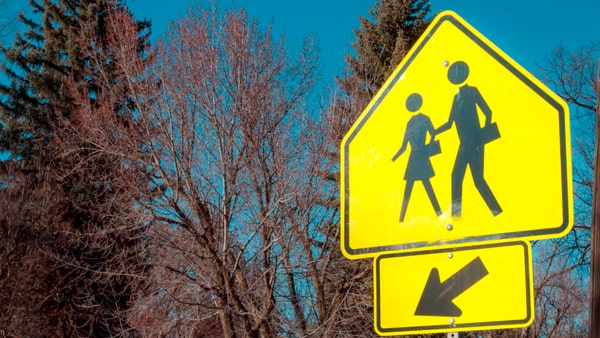
A five-sided yellow-green sign showing two people above crosswalk lines warns of:

This road sign means:
  1. A A school crossing
  2. B A business district
  3. C A sidewalk-only area
  4. D A location where crossing is prohibited

Correct answer: A – A school crossing

This sign marks a school crossing. Reduce speed, look carefully for children entering or using the crosswalk, and be prepared to stop. Follow the directions of a school crossing guard whenever one is controlling traffic.

Source: New Jersey Driver Manual — Signs, Signals, and Road Markings, “School Crossing”

Question 4

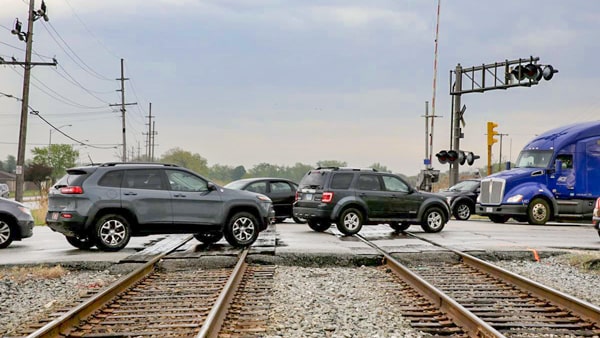
Traffic is backed up beyond a railroad crossing. When should you begin crossing the tracks?

When traffic is slow and heavy and you must cross railroad tracks before reaching the upcoming intersection, you should:
  1. A As soon as the crossing gates rise
  2. B When the vehicle ahead begins moving, even if space is limited
  3. C Only when enough space exists to clear every track completely
  4. D After sounding your horn to warn approaching trains

Correct answer: C – Only when enough space exists to clear every track completely

Do not begin across railroad tracks unless there is enough room beyond them for your entire vehicle. In New Jersey, the driver manual warns motorists not to become trapped on the tracks by stopped or slow traffic. Wait before the crossing until you can pass over every track without stopping.

Source: New Jersey Driver Manual — Sharing the Road with Others, “Railroad Crossings”

Question 5

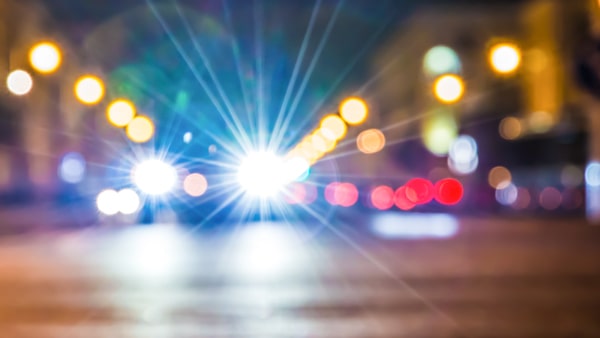
An oncoming vehicle’s high beams are causing glare. Where should you direct your gaze?

When a car with bright headlights comes toward you at night, you should:
  1. A Toward the centerline
  2. B Directly at the approaching headlights
  3. C Above the approaching vehicle
  4. D Toward the right edge of your lane

Correct answer: D – Toward the right edge of your lane

Avoid looking directly into an approaching vehicle’s high beams. Direct your gaze toward the right side of the roadway while continuing to monitor your lane and the road ahead. Do not retaliate by leaving your own high beams on, because doing so increases glare for both drivers.

Source: New Jersey Driver Manual — Defensive Driving, “Night Driving”

Question 6

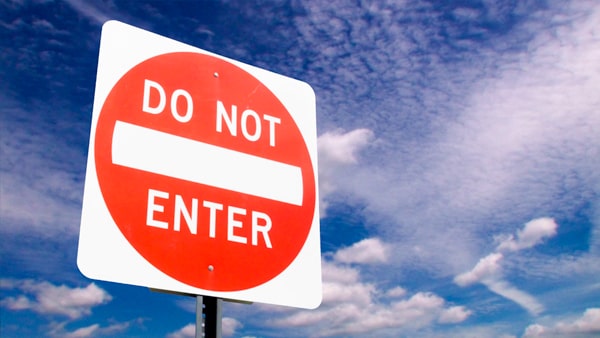
A red circular sign with a white horizontal bar reading “DO NOT ENTER” is intended to prevent:

This sign is used to prevent:
  1. A Entry into a parking area that has reached capacity
  2. B Entry into every roadway construction zone
  3. C Travel onto a dead-end street
  4. D Wrong-way entry onto a one-way road or ramp

Correct answer: D – Wrong-way entry onto a one-way road or ramp

A DO NOT ENTER sign prohibits entry from the direction in which the sign faces. It is commonly placed where entering would send a vehicle the wrong way on a one-way street or highway ramp. New Jersey drivers must choose another entrance or route rather than pass the sign.

Source: New Jersey Driver Manual — Signs, Signals, and Road Markings, “Do Not Enter”