New Jersey Driving Test Practice 7

4.8 out of 5 (543 votes)
80% Passing score
20 Questions
4 Mistakes allowed
This NJ permit practice test, version seven, gives you 20 questions and asks for 16 correct answers to pass, which is a tidy little setup compared with the real New Jersey knowledge test. That one is bigger: 50 questions, 40 correct answers required, 80% to pass, and only 10 mistakes before the whole thing becomes a “come back later” situation. And later, in this case, means at least 7 days if you fail the knowledge test. So, yes, practicing first is not exactly overthinking it. The questions cover the usual suspects — road signs, right-of-way, traffic laws, safe driving choices — but also the New Jersey details that can feel a little too specific until they show up in front of you. Proof of insurance, pedestrian rules, traffic circles, wireless device restrictions, all of it. The test is untimed, thankfully, so there is no fake urgency pushing you into a bad answer. Take the hint, stare at the image, second-guess yourself a little, then read the explanation afterward. That last part is where the useful stuff tends to stick, even if the first answer was, technically speaking, a confident mistake. The visuals help too. Some driving situations are just easier to understand when you can actually see the sign, the lane setup, or the weird little road scenario being described. It is especially helpful with road signs and right-of-way questions, where a sentence can become weirdly fussy for no good reason. And while this New Jersey driving test practice is centered on the written exam, the permit process around it is worth knowing. New Jersey requires 6 Points of ID, proof of residency, and either a Social Security number, ITIN, or affidavit. Vision matters too: you need at least 20/50 acuity, corrective lenses are allowed, and if you use them to pass, that restriction follows you onto the license. For younger drivers, the GDL rules are not background noise. Under-21 drivers usually need 6 months of supervised practice before the road test, including 50 supervised hours and 10 at night. There are passenger limits, a driving curfew from 11:01 p.m. to 5:00 a.m., no interactive wireless devices, and required GDL decals for permit and probationary drivers under 21. Those decals cost $4 per pair; skipping them can cost $100, which is a fairly rude math lesson. Use this NJ drivers permit practice test to get comfortable with the questions, sure — but also to get fluent in the system around the questions. That is the part people forget until it becomes inconvenient.

FREE DMV Practice Test App
Study for your New Jersey permit test or driver’s license with the NextDoorDriving app. 700+ DMV questions and answers, 100% free!
Download on the App Store

Sample New Jersey Permit Test Questions

Question 1

A second New Jersey DWI conviction may include which consequences?

  1. A Imprisonment
  2. B A mandatory fine
  3. C Forfeiture of driving privileges
  4. D All of these consequences

Correct answer: D – All of these consequences

For a second DWI violation, the statute imposes a fine of $500 to $1,000, 30 days of community service, and imprisonment for at least 48 consecutive hours but no more than 90 days. The person also forfeits driving privileges for one to two years upon conviction. Additional ignition-interlock requirements may apply.

Source: N.J.S.A. 39:4-50(a)(2) – Driving while intoxicated

Question 2

When monitoring the road ahead, where should you direct your attention?

  1. A Toward traffic and conditions beyond the vehicle directly ahead
  2. B Only toward the rear bumper of the nearest vehicle
  3. C Only toward the right edge of your lane
  4. D Only toward the left edge of your lane

Correct answer: A – Toward traffic and conditions beyond the vehicle directly ahead

A defensive driver stays alert to traffic and roadway conditions ahead rather than fixating on one nearby vehicle. Looking farther ahead provides more opportunity to recognize slowing traffic, stopped vehicles, or other hazards. Maintaining adequate following space also supplies the time and room needed to respond safely.

Source: New Jersey Driver Manual — Ch. 5, “Crash Prevention Formula”, New Jersey Driver Manual — Ch. 5, “Keep a Safe Distance/Do Not Tailgate”

Question 3

Why should you reduce speed when heavy rain or standing water covers the roadway?

  1. A Water always improves tire traction
  2. B Braking distance becomes shorter
  3. C The tires may hydroplane and the vehicle may lose control
  4. D Standing water affects only large trucks

Correct answer: C – The tires may hydroplane and the vehicle may lose control

Wet pavement can cause tires to hydroplane by riding on a film of water instead of maintaining full contact with the road. Hydroplaning can begin at about 35 mph, and the risk increases with speed and standing water. Slow down during heavy rain and avoid sudden braking, steering, or acceleration.

Source: New Jersey Driver Manual — Ch. 5, “Road Conditions—Hydroplaning”

Question 4

At an intersection, what should determine which driver proceeds first?

  1. A A habit of always waving every other driver through
  2. B The applicable right-of-way rules and whether proceeding is safe
  3. C The size of each vehicle

Correct answer: B – The applicable right-of-way rules and whether proceeding is safe

The New Jersey manual explains that laws govern right-of-way, although drivers must remain prepared to yield when safety requires it. Automatically waving every driver through can conflict with the expected order of movement. Follow the applicable signal, sign, and right-of-way rule while checking that the intersection is safe before proceeding.

Source: New Jersey Driver Manual — Ch. 4, “Yielding the Right-of-Way”, New Jersey Driver Manual — Ch. 4, “Intersections”

Question 5

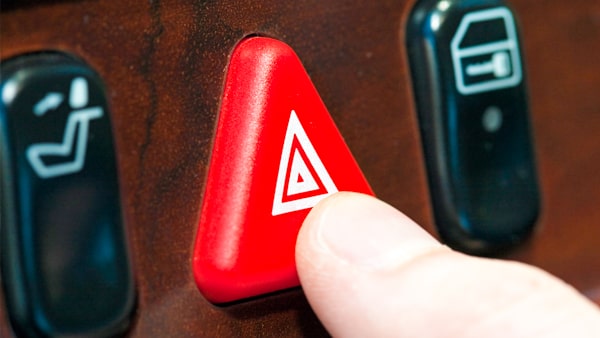
When should you activate your vehicle’s emergency flashers?

You should always use your emergency flashers when:
  1. A To make double-parking lawful
  2. B Whenever driving through fog
  3. C When your vehicle becomes disabled and you pull off the roadway
  4. D To remain on the road when you are too tired to drive

Correct answer: C – When your vehicle becomes disabled and you pull off the roadway

If a vehicle becomes disabled in New Jersey, the driver should pull as far as possible onto the shoulder or median and turn on the emergency flashers. The flashers help warn approaching motorists about the stopped vehicle. They do not legalize double-parking or make it safe to continue driving while fatigued.

Source: New Jersey Driver Manual — Ch. 4, “Disabled Vehicles”

Question 6

What is the safest response if you become sleepy behind the wheel?

  1. A Move to the right lane and continue
  2. B Depend on coffee to remain alert
  3. C Pull off at a safe location and rest before continuing
  4. D Increase speed to arrive sooner

Correct answer: C – Pull off at a safe location and rest before continuing

A tired driver has reduced reaction time and may fall asleep behind the wheel. The New Jersey manual recommends regular rest during long trips and sharing the driving with another licensed motorist when possible. If sleepiness develops, leave the roadway at a safe location and rest rather than attempting to push through the fatigue.

Source: New Jersey Driver Manual — Ch. 5, “Tired Driver/Highway Hypnosis”