New Jersey DMV Test Evaluation

4.6 out of 5 (2601 votes)
80% Passing score
10 Questions
2 Mistakes allowed
A NJ DMV practice test is a practical first check before you get too deep into studying, because it tells you pretty quickly whether you know the New Jersey material or whether you have just been nodding along at familiar-sounding answers. This version gives you 10 randomly selected questions covering the same kinds of topics that show up in the MVC knowledge test: traffic laws, safe driving rules, road signs and signals, right-of-way, DUI rules, GDL restrictions, vehicle operation, and the driver-responsibility details pulled from the New Jersey Driver Manual. You’ll need 8 out of 10 correct to pass this practice round. That is not an arbitrary number; it mirrors the real test standard in a smaller format. The actual New Jersey MVC knowledge test has 50 multiple-choice questions, and you need 40 correct answers, or 80%, to pass. So, yes, a short quiz can still tell you something useful, especially if the questions you miss are clustered around signs, stopping rules, or those deceptively plain right-of-way scenarios. Road signs deserve their own attention, but not because New Jersey gives everyone a separate road-sign-only exam. It does not. Sign questions are mixed into the regular knowledge test along with signals, school bus rules, pedestrian safety, alcohol laws, and general safe-driving judgment. That matters, because studying signs in isolation can give you a false sense of comfort. You might know the shape of a warning sign and still stumble when the question folds that sign into an intersection, a crosswalk, or a “what should you do next” situation. There are also New Jersey-specific licensing rules sitting behind the test, and they are worth learning before they become paperwork. First-time drivers move through the state’s GDL system, with different routes depending on age. Drivers under 21 need supervised driving experience before the road test, including 50 practice hours and 10 hours at night, plus the required red GDL decals for permit and probationary drivers. Adult first-time applicants have their own supervised-practice period, too, just a shorter one. Use this NJ practice permit test as a first pass, not the whole plan. Pair it with the New Jersey Driver Manual, more DMV permit test practice questions, and a little extra time on road signs. Boring advice, maybe. Correct advice, definitely.
FREE DMV Practice Test App
Study for your New Jersey permit test or driver’s license with the NextDoorDriving app. 700+ DMV questions and answers, 100% free!
Download on the App Store

Sample New Jersey Permit Test Questions

Question 1

How should you handle turns and stops when the pavement is slippery?
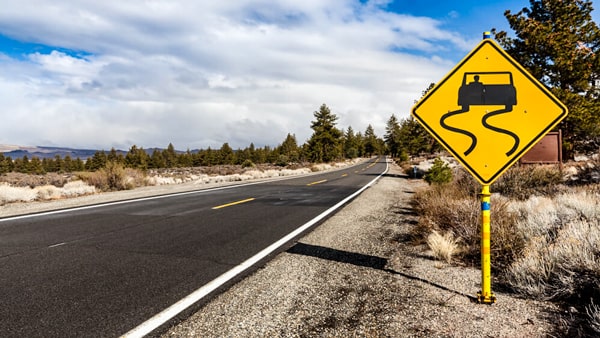
When roads are slippery, you should:
  1. A Look a shorter distance ahead
  2. B Stop on hills to test tire traction
  3. C Turn and brake gradually rather than suddenly
  4. D Continue at your normal speed

Correct answer: C – Turn and brake gradually rather than suddenly

Wet, icy, or otherwise slippery pavement reduces tire traction and increases stopping distance. Reduce speed and make steering, braking, and acceleration changes gradually. Sharp turns or hard braking can cause the tires to lose their grip, making the vehicle difficult to control.

Source: New Jersey Driver Manual (2025) — Ch. 5, “Driving in Bad Weather”
Question 2

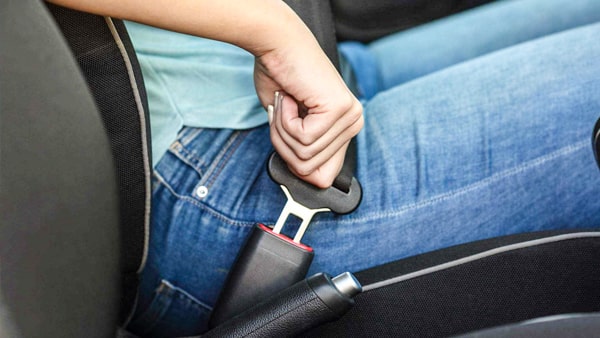
When should a vehicle's driver and passengers wear seat belts?

Seat belts can be most effective as injury preventive devices when they are worn by:
  1. A Only while the vehicle is on an expressway
  2. B Only during trips far from home
  3. C Only when traveling at high speed
  4. D Whenever the vehicle is being driven

Correct answer: D – Whenever the vehicle is being driven

In New Jersey, the driver and all passengers in a passenger vehicle must wear seat belts, subject to limited statutory exemptions. The law applies to occupants in both front and rear seats, although enforcement rules vary by seating position and age. Seat belts should be properly fastened every time the vehicle is driven.

Source: New Jersey Driver Manual (2025) — Ch. 3, “Buckle Up—New Jersey’s Seat Belt Law”

Question 3

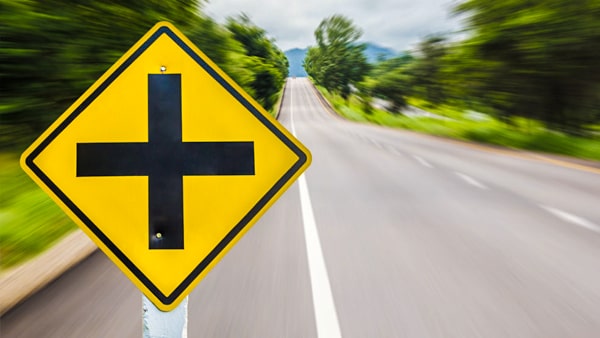
A yellow diamond warning sign containing a black cross indicates:

This sign shows one type of:
  1. A A crossroad ahead
  2. B A reverse curve ahead
  3. C A mandatory right turn
  4. D A lane ending

Correct answer: A – A crossroad ahead

The cross-shaped symbol warns that another roadway intersects the road ahead. Check for traffic entering or crossing from either side and be prepared for signs, signals, or vehicles near the intersection. The sign warns of the roadway layout; it does not itself require a particular turn.

Source: New Jersey Driver Manual (2025) — Ch. 4, “Warning Signs”

Question 4

An oncoming driver turns left across your lane and a collision is becoming likely. What should you do?

  1. A Maintain speed because you have the right-of-way
  2. B Slow down or stop to avoid the collision
  3. C Sound the horn while maintaining speed
  4. D Accelerate through the conflict area

Correct answer: B – Slow down or stop to avoid the collision

New Jersey law requires a driver turning left within an intersection to yield to approaching traffic that presents an immediate hazard. If that driver turns across your path, reduce speed or stop as needed to prevent a collision. Having the right-of-way does not make continuing at the same speed the safest response to an immediate danger.

Source: N.J.S.A. 39:4-90 — Right of way at intersections, New Jersey Driver Manual (2025) — Ch. 5, “Prevent a Collision”

Question 5

Under New Jersey law, what must you do when an emergency vehicle approaches from behind using its siren and required warning lights?

  1. A Pull near the right edge, clear of an intersection, and stop
  2. B Accelerate until you are ahead of surrounding traffic
  3. C Remain in your lane and merely reduce speed
  4. D Stop immediately wherever you are

Correct answer: A – Pull near the right edge, clear of an intersection, and stop

Upon the immediate approach of an authorized emergency vehicle using the required signals, pull as close as possible to the right-hand curb or roadway edge, clear of an intersection, and stop. Remain stopped until the emergency vehicle has passed unless directed otherwise by a police or traffic officer. Avoid stopping where you would obstruct the intersection.

Source: N.J.S.A. 39:4-92 — Authorized emergency vehicles; clearance for; following or parking near

Question 6

Which commuting choice most directly reduces the number of individual vehicles using New Jersey roads?

  1. A Taking public transportation instead of driving alone
  2. B Following other vehicles more closely
  3. C Increasing posted speed limits
  4. D Prohibiting bicycles from using the road

Correct answer: A – Taking public transportation instead of driving alone

Public transportation carries multiple passengers in fewer vehicles and can help relieve roadway congestion. Following more closely removes a necessary safety cushion, while higher speed limits do not reduce the number of vehicles. Bicycles are also lawful roadway users when operated according to applicable traffic rules.

Source: N.J.S.A. 27:25-2 — Legislative findings and declarations