New Jersey Road Signs Test

4.7 out of 5 (701 votes)
80% Passing score
10 Questions
2 Mistakes allowed
New Jersey road signs deserve a little more attention than most people give them, especially if you are getting ready for the MVC knowledge test. They are not just scattered decorations along the Parkway, Route 1, local school zones, and all those intersections where still no one seems to know who should go. Signs are part of the language of the road, and on the New Jersey permit test, that language counts. This NJ road signs test gives you 20 multiple-choice questions built around the signs, colors, shapes, symbols, and recognition details you are expected to understand before you sit for the real exam. The signs follow the design standards used in the Manual on Uniform Traffic Control Devices, which is a dry name, yes, but an important one. It means you are practicing with signs that match the way traffic control devices are actually designed and used, not a loose collection of “close enough” pictures pulled together for convenience. And here is the part that tends to get blurred: New Jersey does not publish a separate road-sign-only passing score for the standard auto knowledge test. Road sign questions are folded into the full MVC written driver test, along with traffic laws, safe driving rules, signals, GDL restrictions, DUI and alcohol laws, school bus rules, emergency vehicle rules, vehicle operation, and driver responsibility. So this practice test is focused, but the real exam is broader. That distinction matters. On the actual New Jersey permit knowledge test, first-time drivers answer 50 questions and need 40 correct answers to pass. That is 80%, with no more than 10 missed questions. The main study source is the New Jersey Driver Manual, which the MVC publishes in English, Spanish, Chinese, Tagalog, Gujarati, and Korean. If you fail the knowledge test, you have to wait 7 days before retaking it, which is not catastrophic, but it is also not how most people want to spend another week. Use this NJ DMV practice test as a way to tighten up the road sign portion before it gets mixed into everything else. Take it once, review the end-of-test summary, notice which signs you confused, and then take it again if needed. That repetition is where the useful part is, frankly. By the time the MVC sign test material shows up inside the full permit exam, road signs should feel familiar enough that they are not quietly stealing points from the questions you actually studied harder for.

FREE DMV Practice Test App
Study for your New Jersey permit test or driver’s license with the NextDoorDriving app. 700+ DMV questions and answers, 100% free!
Download on the App Store

Sample New Jersey Permit Test Questions

Question 1

When may you continue cautiously after a green signal changes to yellow?

  1. A Whenever an emergency vehicle is crossing
  2. B Whenever no pedestrians are visible
  3. C Whenever you intend to turn right
  4. D When you are already within the intersection

Correct answer: D – When you are already within the intersection

New Jersey’s manual directs a driver to stop before entering when a yellow light follows green, unless the vehicle is too close to stop safely. If the signal changes while the vehicle is already in the intersection, continue through cautiously. A yellow light does not authorize a driver to accelerate into the intersection.

Source: New Jersey Driver Manual — Safe Driving Rules and Regulations, “Stopping Regulations”

Question 2

The center lane shown has left-turn arrows for traffic approaching from both directions. What is it used for?

The center lane in the illustration is used for:
  1. A Regular through travel
  2. B Preparing for and making left turns
  3. C Passing slower vehicles
  4. D Emergency vehicles only

Correct answer: B – Preparing for and making left turns

In New Jersey, pavement arrows show the direction a motorist must travel from a marked lane. A center lane marked with opposing left-turn arrows is intended for drivers preparing to make permitted left turns. It is not a regular through lane or a passing lane.

Source: New Jersey Driver Manual — Appendix: Driver Safety, “Road Markings”

Question 3

What color centerlines separate vehicles traveling in opposite directions?

  1. A White
  2. B Red
  3. C Black
  4. D Yellow

Correct answer: D – Yellow

Yellow centerlines separate traffic moving in opposite directions. White lines generally separate lanes moving in the same direction or mark roadway edges. Yellow centerlines may be solid, broken, or a combination, depending on whether passing is permitted.

Source: New Jersey Driver Manual — Ch. 11, “Road Markings”

Question 4

A green arrow appears for your dedicated turn lane. What does the signal permit?

  1. A Travel straight through the intersection
  2. B Proceed only in the arrow’s direction while yielding to pedestrians
  3. C Turn without observing the intersection
  4. D Choose any direction if the intersection looks clear

Correct answer: B – Proceed only in the arrow’s direction while yielding to pedestrians

In New Jersey, a green arrow permits movement only in the direction shown. The driver must remain cautious and yield to pedestrians. The arrow does not remove the responsibility to observe the intersection or authorize movement in another direction.

Source: New Jersey Driver Manual — Ch. 11, “Traffic Signals”

Question 5

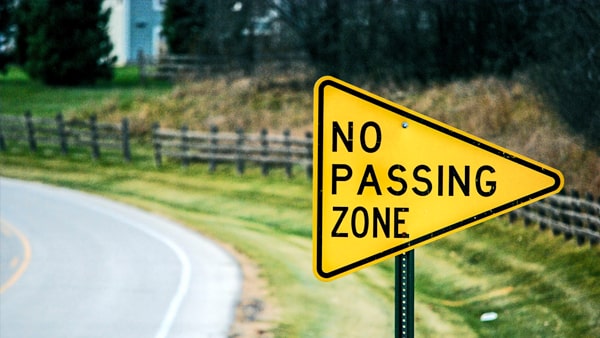
A yellow, pennant-shaped traffic sign warns of what?

The sign with this shape and color is a _____________ sign.
  1. A A no-passing zone
  2. B Wrong-way traffic
  3. C A railroad crossing
  4. D A stop ahead

Correct answer: A – A no-passing zone

A yellow pennant is a no-passing warning sign. It alerts drivers that a no-passing zone begins ahead. Other distinctive shapes include the red octagon for STOP, the red-and-white triangle for YIELD, and the round yellow advance-warning sign for a railroad crossing.

Source: New Jersey Driver Manual — Ch. 11, “Traffic Signs”

Question 6

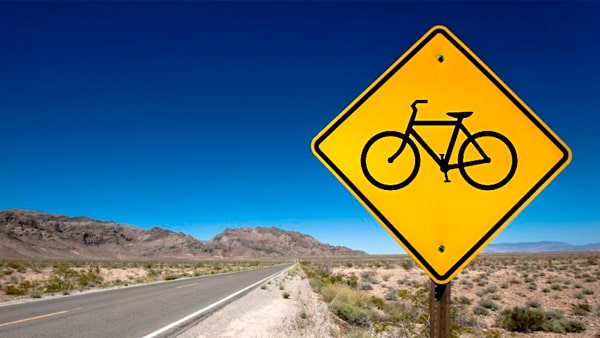
A yellow warning sign displaying a bicycle symbol indicates:

This sign means:
  1. A A children’s play area
  2. B A bicycle rental location
  3. C A recreational parking entrance
  4. D A bicycle crossing or area where bicyclists may enter the roadway

Correct answer: D – A bicycle crossing or area where bicyclists may enter the roadway

Bicycle warning signs alert motorists that bicyclists may be crossing or sharing the roadway. Drivers should reduce speed as conditions require, watch carefully for riders, and be prepared to yield. The sign is a warning rather than an indication of bicycle rentals or recreational parking.

Source: New Jersey Driver Manual — Ch. 11, “Traffic Signs”