


New Jersey Road Signs Test Simulator

4.9 out of 5 (391 votes)
80% Passing score
25 Questions
5 Mistakes allowed
This New Jersey road signs practice test is meant to do one thing well: give you focused practice with the signs, signals, shapes, colors, and little visual rules that can appear on the NJ MVC knowledge test. The real permit test is not a road-sign-only exam. It is a 50-question general knowledge test based on the New Jersey Driver Manual, and you need 40 correct answers to pass, which works out to 80%. Road signs are folded into that larger test along with traffic laws, safe driving rules, GDL restrictions, DUI laws, and basic driver responsibility. So, yes, this practice test narrows the lens on purpose — not because signs are the whole test, but because they are a part worth drilling until they feel automatic. Each practice session gives you 20 road sign questions from a larger pool, so you are not just clicking through the same predictable set again and again. You will see multiple-choice and true-or-false questions, the same general style used by MVC sample knowledge test materials, and the passing mark here is 16 out of 20. That keeps the standard aligned with New Jersey’s 80% benchmark while giving you a cleaner, more concentrated way to study. The test is untimed, which is honestly how this kind of practice should be handled. There is no extra virtue in rushing past a sign you almost recognize. Take the moment. Look at the color, the shape, the symbol, the wording, the thing the question is quietly asking you to notice. Some answers will be obvious, and some will be close enough to make you slow down, which is the whole point. For new drivers, this fits into the bigger MVC process without pretending to replace it. Depending on your age, New Jersey may route you through a Special Learner’s Permit, an Examination Permit, supervised driving, a road test, a probationary license, and eventually a basic license. First-time applicants also need to pass vision screening and bring the required identity and residency documents. But that is the licensing process. This is the practice test. Its job is narrower, cleaner, and more practical: help you handle road sign questions with less guessing and more actual recognition when test day comes.
FREE DMV Practice Test App
Study for your New Jersey permit test or driver’s license with the NextDoorDriving app. 700+ DMV questions and answers, 100% free!
Download on the App Store

Sample New Jersey Permit Test Questions

Question 1

A police officer directs you through an intersection while the signal is red. What should you do?
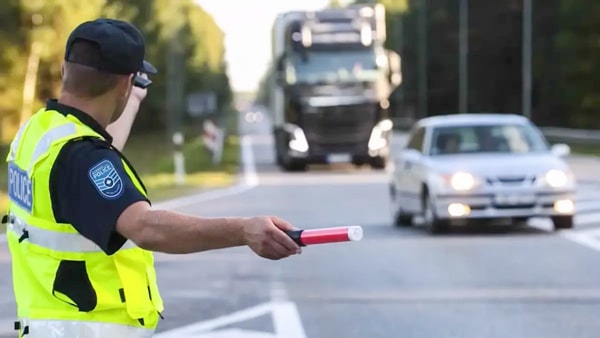
A traffic light is red, but a police officer is telling you to go ahead anyway. What should you do?
  1. A Remain stopped until the light turns green
  2. B Change lanes before entering the intersection
  3. C Follow the officer’s direction
  4. D Wait for the officer to approach your vehicle

Correct answer: C – Follow the officer’s direction

New Jersey law requires drivers to obey a traffic or police officer who is stationed on a highway to direct traffic. The officer’s instructions control even when they differ from the displayed traffic signal. Proceed as directed while continuing to watch for other road users.

Source: N.J.S.A. 39:4-80 – Traffic Control by Officers, N.J.S.A. 39:4-81 – Traffic Signals, Observance; Rule at Nonoperational Signals
Question 2

A curbside space is marked with an official NO PARKING sign. What does the restriction require?

  1. A Do not stand or park in the marked space
  2. B Use the space only for commercial deliveries
  3. C Use the space only with a disability placard

Correct answer: A – Do not stand or park in the marked space

In New Jersey, a driver may not stand or park in an appropriately marked NO PARKING space. The driver manual advises motorists to read curbside parking signs because local restrictions and time limits may apply. A painted curb alone should not be treated as a substitute for checking the official signs.

Source: N.J.S.A. 39:4-138 – Places Where Parking Prohibited; Exceptions; Moving Vehicle Not Under One’s Control into Prohibited Area, New Jersey Driver Manual — Safe Driving Rules and Regulations, “Parking Regulations”

Question 3

What color lines separate traffic lanes moving in the same direction?

  1. A Yellow
  2. B White
  3. C Red
  4. D Black

Correct answer: B – White

White lines separate lanes carrying traffic in the same direction. Dashed white lines commonly divide travel lanes on multilane roads, while white lines may also mark the roadway edge. Yellow centerlines are used to separate traffic moving in opposite directions.

Source: New Jersey Driver Manual — Appendix: Driver Safety, “Road Markings”

Question 4

Which direction takes priority when it conflicts with the other choices?

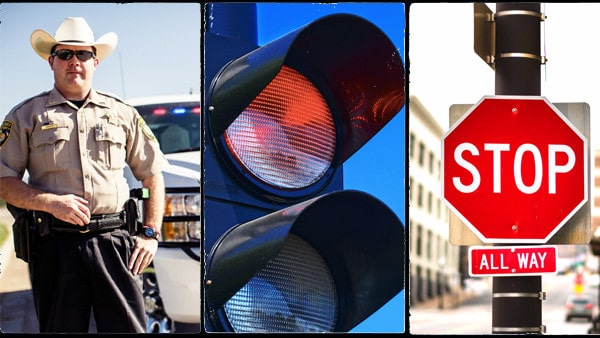
Which of the following must you obey over the other three?
  1. A A steady red traffic light
  2. B A police officer directing traffic
  3. C A STOP sign
  4. D A flashing red signal

Correct answer: B – A police officer directing traffic

Under New Jersey law, drivers must follow the orders of a traffic or police officer stationed to direct traffic. This duty applies even when the officer’s instruction conflicts with a sign or traffic signal. A driver must stop, proceed, or turn as the officer directs.

Source: N.J.S.A. 39:4-80 – Traffic Control by Officers, N.J.S.A. 39:4-81 – Traffic Signals, Observance; Rule at Nonoperational Signals
Question 5

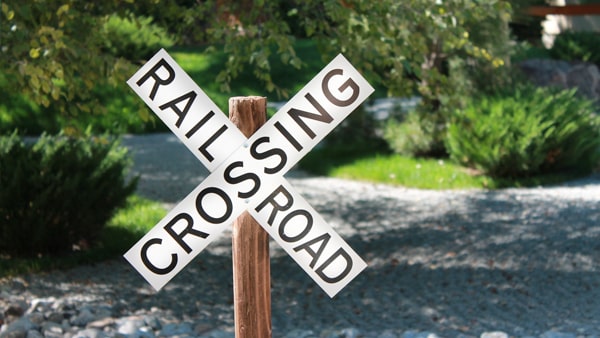
What does the white X-shaped CROSSBUCK sign identify?

This road sign means:
  1. A An intersection where stopping depends on traffic
  2. B A three-way intersection
  3. C A crossroad intersection
  4. D A railroad crossing

Correct answer: D – A railroad crossing

A CROSSBUCK identifies a railroad grade crossing and is treated like a yield sign. Drivers must yield to trains and other on-track equipment. If warning lights, gates, a flagger, or an approaching train require a stop, stop between 15 and 50 feet from the nearest rail and proceed only when safe.

Source: N.J.S.A. 39:4-127.1 – Railroad Crossings; Stopping, New Jersey Driver Manual — Appendix: Driver Safety, “Cross Buck”

Question 6

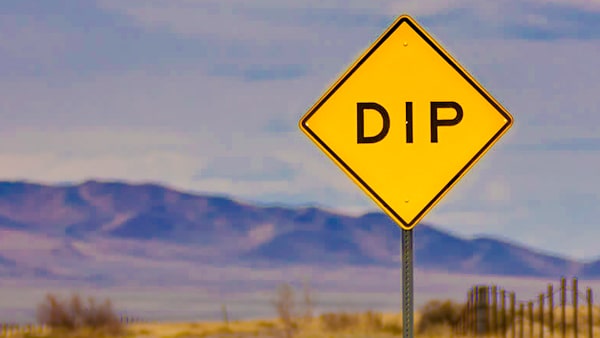
The yellow DIP warning sign tells you that:

This sign means:
  1. A A low section of roadway is ahead
  2. B The road has soft shoulders
  3. C A pedestrian crossing is ahead
  4. D A complete stop is required

Correct answer: A – A low section of roadway is ahead

A DIP sign warns that a low place in the roadway lies ahead. It is a warning sign, not a stop requirement. The driver manual advises motorists to drive slowly around road hazards such as dips because excessive speed can make it difficult to slow or maintain control.

Source: New Jersey Driver Manual — Defensive Driving, “Hills, Bridges and Other Road Hazards”, New Jersey Driver Manual — Appendix: Driver Safety, “Traffic Signs, Signals and Road Markings”