New Mexico DMV Practice Test 4

5 out of 5 (60 votes)
80% Passing score
20 Questions
4 Mistakes allowed
This New Mexico DMV practice test is built around one specific part of driver safety: child safety seats and the rules for using them correctly. That may sound narrow at first, but it is the kind of topic that deserves its own attention. Young passengers depend entirely on the driver to get the details right — placement, installation, age and size considerations, the whole slightly fussy but important set of rules. So, yes, this is a focused NM DMV practice test, not a broad tour through every road sign and lane-change rule in the book. The test includes 20 multiple-choice questions and is available online, which makes it easier to study without turning the whole thing into a formal event. You answer a question, get immediate feedback, and see an explanation that tells you why the answer is correct or why your choice missed the mark. That is where the practice actually earns its keep. A wrong answer is not just a little red mark and a vague sense of betrayal; it becomes a quick correction before the same idea shows up again later. To pass this practice test, you need a score of 80%, or at least 16 correct answers out of 20. The licensing process is separate from the practice test, but it gives the whole thing some context. New Mexico’s teen driver system moves through three stages: instructional permit, provisional license, and full unrestricted driver license. A teen may apply for an instructional permit at 15, and applicants under 18 must be enrolled in or have completed a state-approved driver education course. Those courses include DWI prevention education, and depending on the program, they may involve classroom instruction, behind-the-wheel training, or a public-school format with more classroom time. From there, the requirements become more specific. To qualify for a provisional license, a teen must be at least 15½, hold the instructional permit for at least 6 months, complete driver education, and log 50 supervised driving hours, including 10 at night. The provisional license allows unsupervised driving, but with restrictions on late-night driving and certain young passengers. A full unrestricted license can come at 16½ after at least 12 months on the provisional license, as long as the driver has followed the rules and avoided disqualifying violations. So this New Mexico learners permit practice test is best understood as a focused study tool. It is useful for first-time applicants, renewing drivers, seniors refreshing their knowledge, or anyone who wants to review child passenger safety before taking the official NM DMV knowledge test.
FREE DMV Practice Test App
Study for your New Mexico permit test or driver’s license with the NextDoorDriving app. 700+ DMV questions and answers, 100% free!
Download on the App Store

Sample New Mexico Permit Test Questions

Question 1

How should you position your vehicle when safely passing a bicyclist?
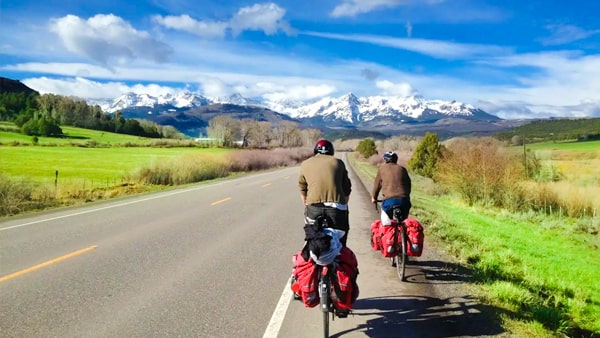
When passing a bicyclist, you should:
  1. A Move close and sound a long horn blast
  2. B Move left as needed to provide a safe passing clearance
  3. C Remain centered in the lane regardless of available space
  4. D Turn on the emergency flashers and maintain your position

Correct answer: B – Move left as needed to provide a safe passing clearance

Move left enough to provide the bicyclist with safe clearance, and pass only when the maneuver is safe and legal. The New Mexico manual recommends trying to leave at least five feet. If oncoming traffic or limited roadway width prevents adequate clearance, slow down and wait for a safe opportunity to pass.

Source: New Mexico Driver Manual — “Sharing the Road: Bicycles Are Vehicles”
Question 2

Which centerline marking prohibits passing by traffic in both directions?

  1. A A broken white line
  2. B Two solid yellow lines
  3. C A broken yellow line
  4. D A solid white line

Correct answer: B – Two solid yellow lines

Two solid yellow centerlines indicate that drivers traveling in either direction may not cross the centerline to pass. A broken yellow line permits passing from that side when the maneuver is otherwise legal and safe. The manual notes that a solid yellow line may be crossed to turn into a driveway when it is safe to do so.

Source: New Mexico Driver Manual — “Rules of the Road: Pavement Markings”

Question 3

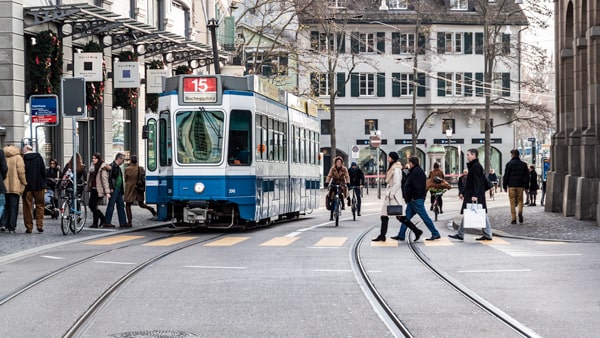
Which statement is true when a rail vehicle approaches a roadway crossing?

Which of these statements is true about light rail vehicles?
  1. A The approaching rail vehicle may activate flashing crossing lights that require drivers to stop
  2. B Drivers may go around a lowered gate when the tracks appear clear
  3. C The rail vehicle must always stop before entering the crossing
  4. D Road traffic always has priority over the rail vehicle

Correct answer: A – The approaching rail vehicle may activate flashing crossing lights that require drivers to stop

Flashing lights at a rail crossing warn that a train is approaching, and drivers must stop. Never drive around a lowered crossing gate. Wait until the warnings have stopped and the crossing is clear before proceeding.

Source: New Mexico Driver Manual — “Traffic Control Devices,” “Railroad Crossing Warning Signs”

Question 4

Compared with a passenger car traveling at the same speed, a large truck generally:

When sharing the road with a truck, it is important to remember that, in general, trucks:
  1. A Needs more distance to stop
  2. B Has a smaller turning radius
  3. C Has fewer blind spots
  4. D Accelerates more quickly on an uphill grade

Correct answer: A – Needs more distance to stop

Large trucks and recreational vehicles generally require much more stopping distance than passenger cars traveling at the same speed. Avoid moving closely in front of a truck and then slowing suddenly. The truck driver may not have enough distance to prevent a collision.

Source: New Mexico Driver Manual — “Large Trucks and RVs,” “Braking”

Question 5

What does a broken white line between traffic lanes indicate?

A broken white center line on the roadway means:
  1. A The lanes carry traffic in opposite directions
  2. B Drivers may not leave their lane
  3. C The line marks the roadway shoulder
  4. D The lanes carry traffic in the same direction, and drivers may cross when it is safe

Correct answer: D – The lanes carry traffic in the same direction, and drivers may cross when it is safe

A broken white line separates lanes traveling in the same direction. You may cross the line to change lanes after checking that the movement can be made safely. Check mirrors and blind spots and signal before moving into the other lane.

Source: NMSA 1978 § 66-7-317(A) — Driving on Roadways Laned for Traffic, New Mexico Driver Manual — “Pavement Markings,” “White Lane Marking”

Question 6

What should you do when another driver is following your vehicle too closely?

  1. A Reduce the space between you and the vehicle ahead
  2. B Increase your following distance and make speed changes gradually
  3. C Tap your brakes repeatedly to warn the other driver
  4. D Speed up beyond the normal traffic flow

Correct answer: B – Increase your following distance and make speed changes gradually

When you are being tailgated, increase the open space ahead of your vehicle. This reduces the likelihood that you will need to brake or change direction suddenly. Signal early and slow gradually when a speed change or turn is necessary.

Source: Commercial Driver’s License Manual — § 2.7.2, “Space Behind”