


New Mexico Learners Permit Practice Test 9

4.9 out of 5 (42 votes)
80% Passing score
20 Questions
4 Mistakes allowed
The New Mexico DMV practice test is a practical place to start if you are studying for the New Mexico learner’s permit test and want something more useful than rereading the same handbook section until the words blur together. This 20-question practice test focuses heavily on school bus safety, especially the rules for stopping when children are being loaded or unloaded. That is not filler material. New Mexico expects drivers to know it, and the official DMV written test can lean into those safety rules in ways that reward careful reading, not just vague familiarity. The format is simple enough, which is part of the point. You work through the questions online, check your answers right away, and use the hints and explanations to clean up the parts you missed. There is no penalty for getting something wrong here, no clerk waiting, no testing-room pressure, no awkward moment where you realize you rushed through a question you actually knew. You can retake the New Mexico learners permit practice test as needed, and because it is available online at any hour, it fits around school, work, family stuff, or whatever else is already taking up the day. A score of 16 out of 20 shows you are in decent shape on this set, especially on school bus laws and related safety rules. Now, the permit test is only one part of the New Mexico licensing process, and this is where people sometimes lose track of the extra requirements. First-time New Mexico license applicants ages 18 to 24 must complete the None for the Road self-study DWI Awareness Class through UNM Continuing Education. It costs $25. Applicants age 25 or older who have ever been convicted of DWI and are applying for a first New Mexico driver license must provide proof of completing an approved DWI prevention and education program. There are a few practical details beyond the written test, too. Some Traffic Safety Bureau-licensed driver education schools are contracted with MVD and may be able to issue learner permits or conduct written and road tests. And when the road test comes around, the vehicle has to be insured, registered, and in good working condition. New Mexico’s minimum liability coverage is $25,000 for injury or death of one person, $50,000 for injury or death of two or more people, and $10,000 for property damage. So, use the learner permit test online for what it does best: building test confidence before the rest of the process starts asking for paperwork.
FREE DMV Practice Test App
Study for your New Mexico permit test or driver’s license with the NextDoorDriving app. 700+ DMV questions and answers, 100% free!
Download on the App Store

Sample New Mexico Permit Test Questions

Question 1

How should you adjust your speed when driving at night on a poorly lit road?

  1. A Drive faster to spend less time in the dark area
  2. B Match the speed of any vehicle approaching from behind
  3. C Drive slowly enough to stop within the distance illuminated by your headlights
  4. D Use high beams at all times, including near oncoming traffic

Correct answer: C – Drive slowly enough to stop within the distance illuminated by your headlights

At night, you must be able to stop within the distance visible in your headlights. Driving faster than that distance allows is known as overdriving your headlights. Reduce speed when darkness, weather, hills or curves limit how far ahead you can see.

Source: New Mexico Driver Manual — “How Well Can You See?” “Darkness”
Question 2

When turning left from a two-way street onto a one-way street, where should you leave the intersection?

  1. A In the rightmost lane
  2. B Across the center of both lanes
  3. C As nearly as practicable in the leftmost available lane
  4. D In whichever lane appears to have less traffic

Correct answer: C – As nearly as practicable in the leftmost available lane

For a left turn at an intersection where traffic on one or more roadways is restricted to one direction, approach from the extreme left available lane. Complete the turn as nearly as practicable into the left-hand lane available on the one-way street. Follow any signs or markings that direct a different path.

Source: NMSA 1978 § 66-7-322(D), (E) — Required Position and Method of Turning at Intersections

Question 3

If your vehicle becomes disabled while you are driving, what should you do first?

  1. A Stop immediately in the travel lane
  2. B Back along the roadway to the nearest exit
  3. C Leave the vehicle where it blocks approaching traffic
  4. D Move off the roadway to a safe location if possible

Correct answer: D – Move off the roadway to a safe location if possible

Do not stop in a travel lane for a breakdown if the vehicle can still be moved. Continue only as far as necessary to pull safely off the roadway. A tire blowout or power failure should also be handled by slowing gradually and moving to a safe place off the road.

Source: New Mexico Driver Manual — “General Rules”; “Emergencies,” “Vehicle Emergencies”

Question 4

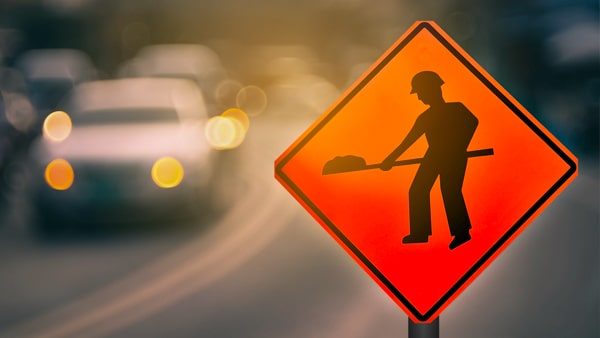
An orange diamond-shaped work-area sign warns that:

This sign means that:
  1. A A volunteer cleanup group is scheduled somewhere along the highway
  2. B People may be working on or near the roadway ahead
  3. C Children are playing near a residential street
  4. D A pedestrian crosswalk is the only hazard ahead

Correct answer: B – People may be working on or near the roadway ahead

Orange work-area signs warn of construction, maintenance or emergency operations on or near the roadway. They may also warn of reduced speeds, detours, equipment or changing road surfaces. Be prepared to follow directions from signs and authorized traffic-control personnel.

Source: New Mexico Driver Manual — “Traffic Control Devices,” “Work Area Signs”

Question 5

If alcohol will be served at a social event, which plan best protects against impaired driving?

  1. A Drink coffee before driving home
  2. B Ride with a designated driver who has not consumed alcohol
  3. C Take a cold shower before leaving
  4. D Stop drinking 30 minutes before driving

Correct answer: B – Ride with a designated driver who has not consumed alcohol

Plan for a designated driver who will not drink, or use public transportation or a taxi when available. Coffee, fresh air, exercise and cold showers do not quickly remove alcohol from the body. Time is the only reliable way for the body to eliminate alcohol.

Source: New Mexico Driver Manual — “Drinking and Driving,” “Effects of Alcohol”

Question 6

How should you respond to a flashing yellow traffic signal?

  1. A Continue at the same speed without checking the intersection
  2. B Come to a full stop before proceeding
  3. C Slow down and proceed through the intersection with caution
  4. D Wait for the signal to display a steady green light

Correct answer: C – Slow down and proceed through the intersection with caution

A flashing yellow signal permits drivers to proceed only with caution. Slow down, observe the intersection and continue carefully. Unlike a flashing red signal, a flashing yellow signal does not automatically require a complete stop.

Source: NMSA 1978 § 66-7-107(A)(2) — Flashing Signals, New Mexico Driver Manual — “Traffic Control Devices,” “Traffic Signals”