New Mexico Permit Test Simulator

4.9 out of 5 (43 votes)
72% Passing score
25 Questions
7 Mistakes allowed
The New Mexico DMV practice test gives you a realistic run at the written knowledge test before you walk into an MVD office or test through an approved provider. The real exam is not huge, which is part of why people sometimes misjudge it: 25 multiple-choice questions, with 18 correct answers needed to pass. That is a 72% passing score, and yes, it means you can miss up to 7 questions. Still, treating 18 as the target is cutting it a little close. Better to use this permit test simulator until passing feels routine, not lucky. Each test pulls 25 random questions, so you are not staring at the same fixed quiz over and over and slowly convincing yourself that recognition equals understanding. The questions cover the material New Mexico expects you to know from the Driver Manual, including traffic laws, right-of-way rules, speed limits, school zones, pavement markings, safe driving practices, DWI laws, and sharing the road with pedestrians, motorcycles, bicycles, emergency vehicles, and large trucks. Road signs are folded into the main knowledge test, too, not saved for some separate road-sign-only exam in the standard Class D permit process. So this New Mexico MVD permit test online mixes signs, signals, lane-use markings, and regular driving rules together, which is the more useful way to practice anyway. There is also the licensing context, which is where New Mexico gets a little more particular. Teen applicants start through the Graduated Driver Licensing program and must be at least 15 to apply for an instructional permit, with approved driver education either underway or completed. First-time applicants ages 18 to 24 have to complete the None for the Road DWI Awareness Class before applying for a first New Mexico license. Adults 25 and older usually follow the standard first-license process, although a prior DWI conviction can add a required DWI prevention or education step. None of that changes the basic written-test format, but it does change what you may need to bring, finish, or prove before the license process moves along. Use this NM DMV written test practice as a serious rehearsal, not a quick skim before test day. Pair it with the official New Mexico Driver Manual, especially for the rules that sound familiar until you have to choose between two almost-right answers. Keep going until your scores are comfortably above 18 out of 25. That cushion matters for walking in to test day feeling confident.
FREE DMV Practice Test App
Study for your New Mexico permit test or driver’s license with the NextDoorDriving app. 700+ DMV questions and answers, 100% free!
Download on the App Store

Sample New Mexico Permit Test Questions

Question 1

When should you reduce speed for a sharp curve?

When you approach a sharp curve in the road, you should:
  1. A After entering the curve
  2. B Before entering the curve
  3. C Only after the vehicle begins to skid
  4. D After reaching the curve's midpoint

Correct answer: B – Before entering the curve

Slow before entering a curve. Excessive speed can use more traction than the tires can provide and cause the vehicle to skid. Braking after entering the curve can further reduce the traction available for steering, particularly when the roadway is wet, snowy or icy.

Source: New Mexico Driver Manual — “Adjusting to Road Conditions: Curves”
Question 2

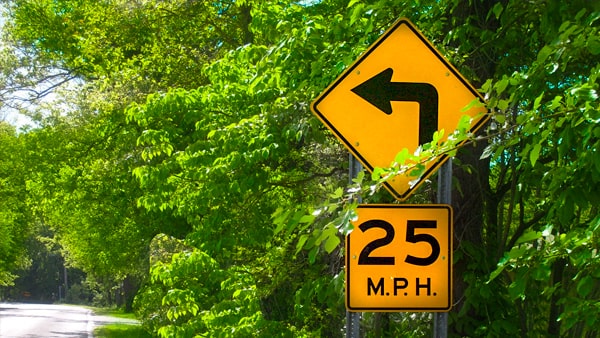
A yellow left-curve warning sign has a 25 MPH plaque below it. What does the combination mean?

This sign means:
  1. A The road curves left, and you must drive at least 25 mph
  2. B The road curves right, and you must drive at least 25 mph
  3. C The road curves right, with an advised speed of 25 mph
  4. D The road curves left, with an advised speed of 25 mph

Correct answer: D – The road curves left, with an advised speed of 25 mph

The curved arrow shows that the roadway bends to the left. The 25 mph plaque provides an advisory speed for negotiating that curve under favorable conditions; it is not a minimum-speed requirement. Reduce speed further when weather, visibility, traffic or road-surface conditions make 25 mph unsafe.

Source: New Mexico Driver Manual — “Rules of the Road: Warning Signs”

Question 3

Traffic is moving at 50 mph on a road posted at 45 mph. What is the fastest you may legally drive?

  1. A 50 mph because that is the traffic flow
  2. B Any speed from 45 through 50 mph
  3. C 45 mph

Correct answer: C – 45 mph

A posted 45 mph limit remains the maximum lawful speed even when surrounding traffic is moving faster. New Mexico's speed-regulation statute also requires a reasonable and prudent speed based on actual conditions. Traffic, weather or visibility may require you to drive below 45 mph, but they do not authorize driving above the posted limit.

Source: NMSA 1978 § 66-7-301 – Speed Regulation, New Mexico Driver Manual — “Rules of the Road: Speed Limits”

Question 4

When approaching a steep downhill section covered with snow or ice, you should:

  1. A Follow the vehicle ahead closely for guidance
  2. B Wait until the descent begins before braking hard
  3. C Reduce your speed before starting downhill
  4. D Accelerate to increase tire traction

Correct answer: C – Reduce your speed before starting downhill

Snow and ice reduce the tires' grip and increase the distance needed to stop. Reduce speed before beginning the descent and avoid abrupt steering, braking or acceleration. The manual advises slowing substantially on packed snow and slowing to a crawl on ice; avoiding travel is preferable when roads are dangerously icy.

Source: New Mexico Driver Manual — “Adjusting to Road Conditions: Slippery Roads”

Question 5

While waiting to turn left across oncoming traffic, what are you responsible for doing?

You are waiting in the intersection to complete a left turn. You should:
  1. A Turn as soon as the vehicle ahead begins moving
  2. B Signal and wait for a safe gap and a clear path
  3. C Flash your headlights until oncoming traffic stops
  4. D Drive behind any vehicle blocking the intersection

Correct answer: B – Signal and wait for a safe gap and a clear path

Before turning left, signal and verify that oncoming traffic provides a safe gap. The New Mexico manual also directs you to check the roadway you are entering for vehicles and pedestrians that could block your path. Look once more toward oncoming traffic immediately before beginning the turn.

Source: New Mexico Driver Manual — “Safe Driving Tips: Scanning—Intersections”

Question 6

A yellow diamond sign shows a side lane joining your roadway from the right. What does it warn of?

This sign means:
  1. A Two-way traffic begins ahead
  2. B Your lane ends and you must move right
  3. C Traffic may merge into your lane ahead
  4. D A divided highway begins ahead

Correct answer: C – Traffic may merge into your lane ahead

The sign warns that another traffic stream joins your roadway ahead. Watch the merging lane, maintain a safe space cushion and be prepared to adjust if conditions require it. Entering drivers should use the available ramp or acceleration lane to find a safe gap and approach the speed of roadway traffic.

Source: New Mexico Driver Manual — “Rules of the Road: Warning Signs—Merging Traffic”, New Mexico Driver Manual — “Sharing Space: Space to Merge”