


New Mexico DMV Sign Test 3

5 out of 5 (38 votes)
80% Passing score
20 Questions
4 Mistakes allowed
The New Mexico road signs practice test gives you a focused way to study the part of the knowledge exam that people tend to rush through, which is usually not the wisest move. Signs are not just decoration along the highway. Their shapes, colors, symbols, and placement are part of the language of driving, and New Mexico expects you to understand that language before you start making decisions in real traffic. This NM road signs practice test includes 20 questions, with a passing score of 16 correct answers. That setup is simple enough, but the value is in the repetition: seeing an octagon and knowing it means stop before your brain starts negotiating, recognizing a yield sign by shape, sorting warning signs from regulatory signs, and getting used to the way sign meanings are tested. Some questions include road sign images, which matters because real driving is visual and fast. Nobody on the road is going to pause politely while you remember what a diamond-shaped sign was trying to tell you. For teen drivers, this practice fits into New Mexico’s Graduated Driver Licensing process, not off to the side as some optional extra. The state uses three stages: instructional permit, provisional license, and full unrestricted driver license. A teen can apply for an instructional permit at 15, but only after being enrolled in or having completed an approved driver education program. There is also the vision screening, the written knowledge test, and all the document business that comes with applying. And, yes, that written test is where road signs can quietly do damage if you have only skimmed them. The study aids are there for a reason. Hints can help when a question is almost familiar, and missed answers come with explanations so you are not just being told you were wrong and then abandoned there. That sounds basic, maybe, but it is the useful kind of basic. It helps turn a wrong answer into something you are less likely to repeat on the real New Mexico permit test. The licensing path keeps going after the permit. Teens must hold the instructional permit for at least 6 months, complete driver education, and log 50 supervised driving hours, including 10 at night, before applying for a provisional license. Adults follow a more direct process, though first-time applicants still need the required testing unless they qualify for an exemption. So this New Mexico driving test practice is not just about memorizing signs for a screen. It is about building the quick, practical recognition you will need once the sign is no longer in a quiz box and is instead approaching fast.
FREE DMV Practice Test App
Study for your New Mexico permit test or driver’s license with the NextDoorDriving app. 700+ DMV questions and answers, 100% free!
Download on the App Store

Sample New Mexico Permit Test Questions

Question 1

Which symbol identifies a Keep Right sign?

  1. A Two opposing arrows separated by a median
  2. B An arrow bending to the right of an obstruction
  3. C A single arrow curving sharply left
  4. D A right lane line merging into the left lane

Correct answer: B – An arrow bending to the right of an obstruction

The Keep Right symbol shows an arrow passing to the right of an island, median, pier, or other roadway feature. It requires traffic to use the right side of that feature. New Mexico adopted the MUTCD containing this standard regulatory sign.

Source: New Mexico State Transportation Commission Resolution 2003-5 – Adopting the Manual on Uniform Traffic Control Devices, Millennium Edition (December 2000), Manual on Uniform Traffic Control Devices, Millennium Edition — § 2B.28, “Keep Right and Keep Left Signs (R4-7, R4-8)”
Question 2

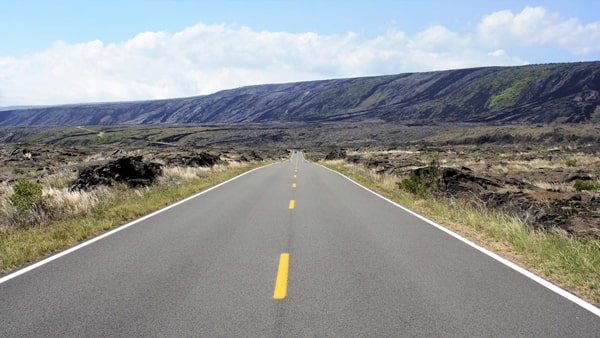
What does a broken yellow line between opposing lanes allow?

A broken yellow center line on the roadway means:
  1. A No passing from either direction
  2. B Crossing temporarily to pass when permitted and safe
  3. C Parking along the center of the roadway
  4. D Turning only at signal-controlled intersections

Correct answer: B – Crossing temporarily to pass when permitted and safe

A broken yellow centerline separates traffic traveling in opposite directions. A driver may cross it temporarily to pass when passing is otherwise permitted and can be completed safely. The marking does not guarantee that adequate sight distance or a safe gap is available.

Source: New Mexico Driver Manual — “Pavement Markings—Yellow Lane Markings”

Question 3

In a New Mexico work zone, orange warning signs alert drivers to:

  1. A Permanent highway closures only
  2. B Road work, workers, or temporarily changed conditions
  3. C Ordinary regulatory speed limits
  4. D High-occupancy vehicle lanes

Correct answer: B – Road work, workers, or temporarily changed conditions

Orange signs are used around construction, maintenance, and emergency work areas. They may warn of workers, detours, reduced speeds, equipment, or changing road surfaces. Drivers should follow the signs and obey authorized people directing traffic within the work area.

Source: New Mexico Driver Manual — “Traffic Signs—Work Area Signs”

Question 4

The solid white line marking the right edge of the roadway gradually angles left. What roadway change does this indicate?

  1. A An intersection is immediately ahead
  2. B A railroad crossing is ahead
  3. C Every vehicle must turn left
  4. D The roadway is becoming narrower

Correct answer: D – The roadway is becoming narrower

A solid edge line identifies the outside edge of the roadway. If the right edge line gradually moves toward the center, the available roadway width is narrowing. Drivers should observe the changing roadway boundary and remain within the travel lane.

Source: New Mexico Driver Manual — “Pavement Markings—Edge and Lane Lines”

Question 5

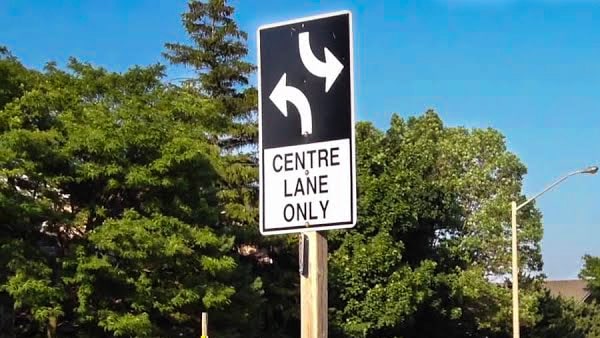
A shared center lane marked with alternating left-turn arrows is primarily used to:

From the center lane, what maneuvers can you perform?
  1. A Enter and complete left turns from either direction
  2. B Make a U-turn wherever desired
  3. C Pass slower-moving vehicles
  4. D Travel continuously during heavy traffic

Correct answer: A – Enter and complete left turns from either direction

The New Mexico driver manual identifies this as a shared center lane reserved for left turns from either direction. It is not a through-travel or passing lane. A U-turn may be made from it only where U-turns are otherwise permitted; the lane itself does not authorize the maneuver everywhere.

Source: New Mexico Driver Manual — “Other Lane Controls—Shared Center Lane”

Question 6

After making the required full stop, your view of cross traffic is blocked. What should you do next?

  1. A Wait five seconds and proceed without looking
  2. B Sound the horn and enter the intersection
  3. C Listen through an open window and proceed
  4. D Edge forward slowly and proceed only when traffic and pedestrians are clear

Correct answer: D – Edge forward slowly and proceed only when traffic and pedestrians are clear

In New Mexico, first make the complete stop at the location required by law. If the initial position does not provide an adequate view, move forward cautiously while checking for crossing vehicles and pedestrians. Enter the intersection only when it is safe and the required right-of-way has been yielded.

Source: NMSA 1978 § 66-7-345(C) – Authority to Designate Through Highways and Stop and Yield Intersections, New Mexico Driver Manual — “Traffic Signs—Stop Sign”