


New York CDL Class B Practice Test (NY) 3

4.8 out of 5 (612 votes)
80% Passing score
20 Questions
4 Mistakes allowed
Welcome to your crucial third step on the road to acing the New York CDL General Knowledge Test! Here, in this third practice test, you're stepping into an essential phase of your preparation. We've tailored this test with 20 critical questions that reflect the real exam, whether you're gunning for Class A or B. The magic number here is 16 - that's how many you've got to get right to pass, mirroring the actual test's standards. But here's the kicker - unlike many other options out there, our practice test is totally free. That's right, you're getting the same quality and quantity of questions as those high-priced versions, but without opening your wallet. We believe in accessibility and opportunity for all our aspiring CDL holders. And here's another thing - we're not timing you. In the real world, you'll face time pressures, but we want you to learn at your pace. Take your time, understand each question, and really get to grips with the material. It's not just about passing the test; it's about becoming a safe, knowledgeable driver. So, dive in, take your time, and remember - this isn't just a practice test, it's a stepping stone to your success on the road. Good luck!
FREE CDL Practice Test App
Pass your New York CDL General Knowledge test with the NextDoorDriving app. Real questions and answers—100% free and ad-free.
Download on the App Store

Sample New York CDL Test Questions - General Knowledge

Question 1

Properly adjusted outside convex mirrors on a school bus should show:

  1. A The entire side of the bus up to the mirror mounts
  2. B The front of the rear tires where they touch the ground
  3. C At least one traffic lane on each side of the bus
  4. D All of these areas

Correct answer: D – All of these areas

The New York school bus section specifies all three viewing areas for the outside convex mirrors. The driver should see the entire side of the bus to the mirror mounts, the front of the rear tires touching the ground, and at least one traffic lane on each side. Convex mirrors widen the view but distort apparent size and distance.

Source: New York State Commercial Driver’s Manual — § 10.1.4, “Outside Left and Right Side Convex Mirrors”
Question 2

How far ahead should a commercial vehicle driver generally scan while driving?

  1. A One football field at every speed
  2. B Two football fields at every speed
  3. C Five to ten seconds
  4. D At least 12 to 15 seconds

Correct answer: D – At least 12 to 15 seconds

Good drivers generally look at least 12 to 15 seconds ahead while continuing to monitor nearby conditions. At lower speeds, that distance is about one city block; at highway speeds, it is approximately one-quarter mile. Looking far enough ahead gives the driver more time and space to adjust speed or position for developing traffic and roadway conditions.

Source: New York State Commercial Driver’s Manual — § 2.4.1, “How Far Ahead to Look”

Question 3

Which statement about tire air pressure is correct?

  1. A Air should be released from tires whenever the weather becomes warmer
  2. B Tire pressure does not need to be checked during a pre-trip inspection
  3. C Tire air pressure increases as temperature rises
  4. D All of these statements are correct

Correct answer: C – Tire air pressure increases as temperature rises

Tire air pressure rises as the tire’s temperature increases. Do not release air merely because a hot tire shows higher pressure, because the tire may become underinflated when it cools. During very hot-weather operation, check tire mounting and air pressure and inspect the tires at the intervals specified in the manual.

Source: New York State Commercial Driver’s Manual — § 2.14.1, “Vehicle Checks—Tires”; § 11.3.4, “Wheels—Tires”

Question 4

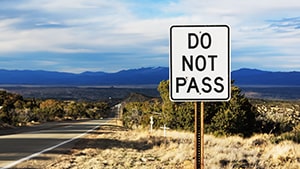
A rectangular white regulatory sign reading “DO NOT PASS” means:

This sign indicates that the driver should _____________.
  1. A Passing is allowed only when you are in a hurry
  2. B You may not pass another vehicle in the restricted zone
  3. C You should prepare to stop at the sign
  4. D You must finish passing before reaching the sign

Correct answer: B – You may not pass another vehicle in the restricted zone

In New York, a DO NOT PASS sign marks or emphasizes a restriction on passing. It may be placed at the beginning of and within a zone where restricted sight distance or other conditions make overtaking inappropriate. Remain behind the vehicle ahead until you reach a location where passing is permitted and can be completed safely.

Source: Manual on Uniform Traffic Control Devices for Streets and Highways, 11th Edition with Revision 1 — § 2B.36, “DO NOT PASS Sign (R4-1)”

Question 5

How long does a typical tractor-trailer require to clear a double railroad track?

  1. A More than 13 seconds
  2. B More than 14 seconds
  3. C More than 15 seconds
  4. D More than 16 seconds

Correct answer: C – More than 15 seconds

A typical tractor-trailer requires more than 15 seconds to clear a double track. Before entering a railroad-highway crossing, the driver must be certain there is enough room to move completely across without stopping on the tracks. The manual also instructs drivers not to shift gears while crossing the tracks.

Source: New York State Commercial Driver’s Manual — § 2.15, “Crossing the Tracks”

Question 6

When using an extinguisher on a vehicle fire, should you stand as close to the flames as possible?

  1. A Yes
  2. B No

Correct answer: B – No

Do not crowd a vehicle fire when using an extinguisher. Stay as far from the fire as possible, aim the extinguisher at the source or base rather than the tops of the flames, and position yourself upwind. If you are unsure which extinguishing agent is suitable, especially with hazardous materials, wait for trained firefighters.

Source: New York State Commercial Driver’s Manual — § 2.21, “Extinguish the Fire”