New York CDL Practice Test: General Knowledge (NY) 6

4.9 out of 5 (230 votes)
80% Passing score
50 Questions
10 Mistakes allowed
Dive into the sixth New York CDL General Knowledge Practice Test and gear up to tackle one of the most comprehensive assessments you'll face on your path to obtaining your commercial driver's license. This test, packed with 50 questions, is not just a tick-the-box exercise. You're aiming to hit a score of at least 40 correct answers. Focusing exclusively on key areas of the general knowledge test, this practice session hones in on vital topics like pre-trip vehicle inspections, emergency responses, understanding the effects of drugs and alcohol on driving, ways to combat driver fatigue, and mastering the art of sharing the road. The strength of this practice test lies in its diverse pool of questions. It's crafted to give you a well-rounded preparation, covering a broad spectrum of scenarios and situations you'll likely encounter. This variety ensures you're not just memorizing answers but truly understanding the principles behind safe and effective commercial driving. Tailored specifically for New York, this test mirrors the unique driving conditions and regulations of the Empire State. It's not just any generic set of questions; it's a focused study tool reflecting New York's specific road rules, regulations, and signs. This state-specific approach ensures you're not just prepared for the CDL exam but also primed for real-world driving in New York's diverse roadways.
FREE CDL Practice Test App
Pass your New York CDL General Knowledge test with the NextDoorDriving app. Real questions and answers—100% free and ad-free.
Download on the App Store

Sample New York CDL Test Questions - General Knowledge

Question 1

What is the basic rule for distributing cargo weight from the front to the rear of a vehicle?

  1. A Keep the load centered
  2. B Concentrate the load over the steering axle
  3. C Place the heaviest cargo at the rear
  4. D Cargo location does not matter if it is secured

Correct answer: A – Keep the load centered

Keep the load centered rather than concentrating its weight at either end. Too much forward weight can overload the steering axle and make steering difficult. Too much rearward weight may underload the steering axle, reducing steering control, and may also leave insufficient weight on the drive axles for proper traction.

Source: New York State Commercial Driver’s Manual — § 3.2.4, “Balance the Weight”
Question 2

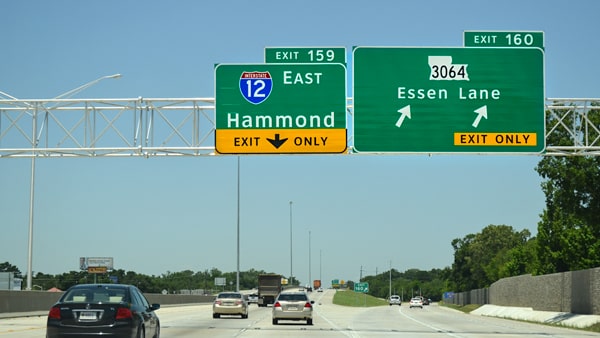
Which category of signs directs road users to routes, destinations, and other navigational information?

____________ signs inform drivers of basic highway information.
  1. A Parking signs
  2. B Guide signs
  3. C Regulatory signs
  4. D Warning signs

Correct answer: B – Guide signs

Guide signs provide information that helps road users navigate streets and highways. They can identify intersecting routes, direct traffic toward cities and other destinations, and provide useful orientation information. On conventional highways, these signs generally use a white message and border on a green background unless another color is specified for a particular sign type.

Source: Manual on Uniform Traffic Control Devices, 11th Edition with Revision 1 — §§ 2D.01–2D.02, “Scope of Conventional Road Guide Sign Standards and Application” and “Color, Retroreflection, and Illumination”

Question 3

Besides keeping cargo close to the ground, what driving practice helps prevent a rollover?

  1. A Adjust the brakes before every curve
  2. B Grip the wheel as tightly as possible
  3. C Drive slowly through curves and ramps
  4. D Eliminate all fifth-wheel movement

Correct answer: C – Drive slowly through curves and ramps

The New York CDL manual emphasizes two basic rollover precautions: keep cargo as low as possible and drive slowly around turns. Excessive speed through corners, entrance ramps, and exit ramps can overturn a combination vehicle. Quick lane changes also increase rollover risk, particularly when the vehicle is fully loaded or the cargo is not centered.

Source: New York State Commercial Driver’s Manual — § 6.1.1, “Rollover Risks”

Question 4

A NARROW BRIDGE sign on a New York roadway warns that:

This sign warns drivers that _____________.
  1. A The bridge roadway is narrower than the approach travel lanes
  2. B The bridge structure is unsafe
  3. C Traffic must stop and allow every oncoming vehicle to cross
  4. D Drivers should increase speed before entering the bridge

Correct answer: A – The bridge roadway is narrower than the approach travel lanes

A NARROW BRIDGE sign warns that the bridge or culvert has limited horizontal clearance, such as a roadway narrower than the approach travel lanes. It does not by itself mean the structure is unstable or that the bridge carries only one lane of traffic. A separate ONE LANE BRIDGE sign is used when the width and other conditions call for that warning.

Source: Manual on Uniform Traffic Control Devices, 11th Edition with Revision 1 — § 2C.18, “NARROW BRIDGE and NARROW UNDERPASS Signs (W5-2 and W5-2a)”, Manual on Uniform Traffic Control Devices, 11th Edition with Revision 1 — § 2C.19, “ONE LANE BRIDGE and ONE LANE UNDERPASS Signs (W5-3 and W5-3a)”

Question 5

When should a commercial driver conduct the pre-trip vehicle inspection?

  1. A Once each week
  2. B Only at the beginning of each workweek
  3. C Only after a defect was reported on the previous trip
  4. D Before driving the vehicle

Correct answer: D – Before driving the vehicle

A pre-trip inspection should be conducted before driving so safety problems can be discovered before the vehicle enters traffic. The federal driver-inspection rule requires the driver to be satisfied that the vehicle is in safe operating condition and to review the previous inspection report. Any reported safety defect must be properly addressed before operation.

Source: New York State Commercial Driver’s Manual — § 2.1.2, “Types of Vehicle Inspection”, 49 CFR § 396.13 – Driver Inspection

Question 6

When must a driver recheck cargo and its securement during a trip?

  1. A After the first 25 miles and every 100 miles afterward
  2. B Only at the beginning and end of the trip
  3. C Within the first 50 miles, then at a duty-status change or after 3 hours or 150 miles, whichever occurs first
  4. D Only after the vehicle has traveled 500 miles

Correct answer: C – Within the first 50 miles, then at a duty-status change or after 3 hours or 150 miles, whichever occurs first

Federal regulations require the driver to inspect cargo and securement devices within the first 50 miles and make any needed adjustments. Further checks are required when the driver changes duty status or after three hours or 150 miles of driving, whichever occurs first. Limited exceptions apply to certain sealed vehicles and loads that cannot practicably be inspected.

Source: New York State Commercial Driver’s Manual — § 3.1, “Inspecting Cargo”, 49 CFR § 392.9(b)(2)–(4) – Inspection of Cargo, Cargo Securement Devices and Systems