New York Practice Permit Test

4.7 out of 5 (1569 votes)
80% Passing score
20 Questions
4 Mistakes allowed
The NY DMV practice test gives you a solid, realistic way to prepare for New York’s learner permit exam. Some of it is common sense, sure. A lot of it is also specific DMV wording, road-sign recognition, right-of-way details, alcohol and drug rules, and small legal requirements that are much easier to handle after you have seen them in question form once or twice. This practice permit test includes 20 multiple-choice questions, the same number used on the official New York learner permit knowledge test. The real test is based on the New York State Driver’s Manual and covers rules of the road, safe driving techniques, traffic signals, road signs, and driving laws. To pass the official exam, you need at least 14 correct answers out of 20. There is one extra wrinkle, though, and it is worth taking seriously: 4 of the questions are about road signs, and you must get at least 2 of those 4 correct. So a decent overall score is not always enough if the signs trip you up. The test is useful for first-time drivers applying for a Class D permit, teens working toward a junior Class DJ permit, adults starting the licensing process, and drivers who simply need a focused refresher before dealing with the DMV again. It is not just a random quiz dressed up as test prep. The questions are meant to keep the main New York permit test topics in front of you: lane use, turns, traffic control devices, safe following distance, school zones, impaired driving rules, and the kind of everyday judgment calls that show up both on the written test and, later, behind the wheel. For younger applicants, passing the permit test is only the beginning of the process. New York’s graduated licensing rules can include a 6-month permit holding period, 50 hours of supervised practice driving, 15 of those hours after sunset, and regional restrictions that change depending on whether you are driving upstate, in New York City, or on Long Island. Adults have fewer junior-license restrictions, obviously, but they still need to pass the knowledge test, meet the vision standard, complete the required pre-licensing course or driver education program, and pass the road test. Use this NY permit practice test as a practical rehearsal. Read the explanations, notice the questions you miss, and do not skip the road signs because they look familiar. Familiar is not the same as test-ready, unfortunately, and New York does expect you to know the difference.

FREE DMV Practice Test App
Study for your New York permit test or driver’s license with the NextDoorDriving app. 700+ DMV questions and answers, 100% free!
Download on the App Store

Sample New York Permit Test Questions

Question 1

When right-of-way rules indicate that you should proceed at an intersection, what is the best approach?

  1. A Always wave every other driver through first
  2. B Proceed when safe, but remain prepared to yield to prevent a collision
  3. C Insist on proceeding even if another driver enters your path

Correct answer: B – Proceed when safe, but remain prepared to yield to prevent a collision

Right-of-way rules identify who should proceed and who must wait in common traffic situations. Follow the applicable rule instead of automatically surrendering your turn at every intersection. However, having the right-of-way is not an absolute guarantee that the path is clear, and the driver’s manual advises being prepared to yield rather than risk a crash.

Source: New York State Driver’s Manual — Ch. 5, “Right-of-Way”, New York State Driver’s Manual — Ch. 8, “Aggressive Drivers”

Question 2

Which motorcycle characteristic can make it harder for other drivers to notice one in traffic?

Which of these statements is true about motorcycles?
  1. A Its visible outline is smaller than that of most passenger vehicles
  2. B It is never allowed to use a full traffic lane
  3. C It must travel more slowly than surrounding vehicles
  4. D It always has priority over other road users

Correct answer: A – Its visible outline is smaller than that of most passenger vehicles

A motorcycle has a much smaller outline than a typical car, especially when viewed from the front or rear. Its size can also make its distance and speed difficult to judge. Drivers should actively look for motorcycles at intersections, before changing lanes, and while entering or leaving expressways rather than scanning only for larger vehicles.

Source: New York State Driver’s Manual — Ch. 11, “Motorcyclists”

Question 3

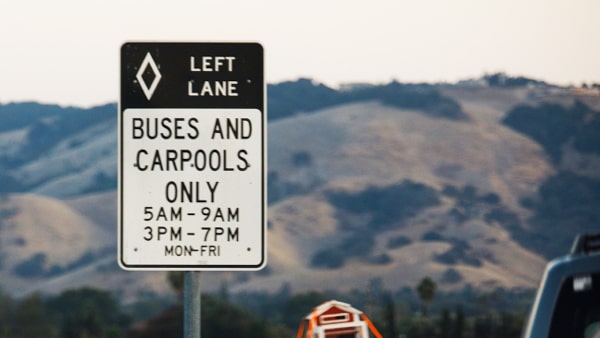
When may you use a lane marked with the HOV diamond symbol?

You can drive in a carpool lane if:
  1. A When your vehicle meets the occupancy or other requirements shown on the signs
  2. B Whenever you are driving an empty passenger van
  3. C Whenever you want to pass slower traffic
  4. D Whenever you are running late

Correct answer: A – When your vehicle meets the occupancy or other requirements shown on the signs

New York’s diamond symbol identifies a lane reserved for buses, carpools, vanpools, bicycles, or other specified vehicles. A driver may use the lane only when the vehicle meets the posted occupancy or other requirements while the restriction is in effect. Drivers must obey official signs and markings that assign particular lanes to specified traffic.

Source: N.Y. VTL § 1128(c) – Driving on roadways laned for traffic, New York State Driver’s Manual — Ch. 4, “Pavement Markings—Diamond Symbol”

Question 4

Outside New York City, when may you turn right at a steady circular red signal?

  1. A After a full stop, if the turn is not prohibited and you yield to pedestrians and lawful traffic
  2. B Whenever a red right-turn arrow is displayed
  3. C Only from the left lane
  4. D After slowing down without stopping

Correct answer: A – After a full stop, if the turn is not prohibited and you yield to pedestrians and lawful traffic

Outside New York City, a driver may generally turn right at a steady circular red signal after stopping, unless a sign or other traffic-control device prohibits the turn. The driver must yield to pedestrians in marked or unmarked crosswalks and to traffic lawfully using the intersection. In New York City, a turn on red is prohibited unless a sign specifically permits it.

Source: N.Y. VTL § 1111(d)(1), (2)(a) – Traffic-control signal indications, New York State Driver’s Manual — Ch. 4, “Traffic Signals”

Question 5

Why should you scan both directions before entering an intersection after the signal turns green?

  1. A A driver on the cross street may fail to stop for the red signal
  2. B You must look only straight ahead after entering
  3. C Cross traffic always receives a green arrow at the same time
  4. D A green signal gives cross-street pedestrians priority

Correct answer: A – A driver on the cross street may fail to stop for the red signal

A green signal allows you to proceed, but you must yield to traffic or pedestrians already lawfully within the intersection or adjacent crosswalk. Defensive driving also requires anticipating that another road user may make an error or disregard a traffic control. Scanning before entering can reveal cross traffic that has not stopped and give you time to avoid a collision.

Source: N.Y. VTL § 1111(a)(1) – Traffic-control signal indications, New York State Driver’s Manual — Ch. 8, “Be Prepared and Look Ahead”

Question 6

What may a driver do at double solid yellow centerlines?

  1. A Cross them to make a lawful left turn into a driveway
  2. B Use either side because the road is one-way
  3. C Drive along them as a continuous center turn lane
  4. D Cross them to pass a slow vehicle

Correct answer: A – Cross them to make a lawful left turn into a driveway

In New York, double solid centerlines prohibit passing and ordinary lane changes across the markings. The no-passing restriction does not prevent a driver from crossing the lines while making a lawful left turn to enter or leave the highway, such as a turn into a driveway. Check for approaching traffic and complete the turn only when it can be made safely.

Source: N.Y. VTL § 1126(a), (b) – No-passing zones, New York State Driver’s Manual — Ch. 4, “Pavement Markings—Double Solid Lines”