


New York Permit Test Practice 3

4.8 out of 5 (858 votes)
80% Passing score
20 Questions
4 Mistakes allowed
The NY DMV practice test gives you a realistic run at the material New York expects permit applicants to know, without pretending the process is more mysterious than it is. The real Class D and Class DJ learner permit knowledge test has 20 questions. To pass, you need at least 14 correct answers overall, and at least 2 of the 4 road sign questions have to be right. That road sign detail matters, because a decent total score will not help much if the sign questions go sideways. This practice permit test keeps the focus where it belongs: New York traffic laws, safe driving habits, signs, signals, lane markings, right-of-way rules, handheld device restrictions, and the sort of driving situations that sound simple until the answer choices start crowding each other a little. The point is not to memorize a pile of disconnected facts. Well, not only that. It is to get used to how the NY permit test thinks, how it phrases things, and where it expects you to slow down. For younger applicants, the test is part of the junior permit process. New York residents can apply for a learner permit at age 16 or older, and applicants under 18 usually receive a Class DJ junior learner permit. Some minors may be able to take the permit test online before the DMV office visit, though passing online does not finish the job by itself. The DMV still has to review the result and identity documents, and the office visit still has to happen. Adults follow the standard Class D route: pass the written knowledge test, pass the vision test, pay the required fee, complete the pre-licensing course or approved driver education, and then move on toward the road test. Road signs are not handled as a separate test for a regular New York Class D or DJ permit, which is worth knowing upfront. They are built directly into the 20-question knowledge test. So yes, stop signs and yield signs matter, but so do warning signs, school signs, railroad signs, guide signs, divided-highway signs, lane-use signs, and the signs people recognize visually but sometimes misread when the wording is formal. After each question, the practice test gives immediate feedback with an explanation, which is where the useful learning happens. A score tells you how you did. An explanation tells you what to fix before the real New York DMV permit test.
FREE DMV Practice Test App
Study for your New York permit test or driver’s license with the NextDoorDriving app. 700+ DMV questions and answers, 100% free!
Download on the App Store

Sample New York Permit Test Questions

Question 1

A vehicle moves into the short gap directly ahead of you. If there is room to slow smoothly, what should you do first?
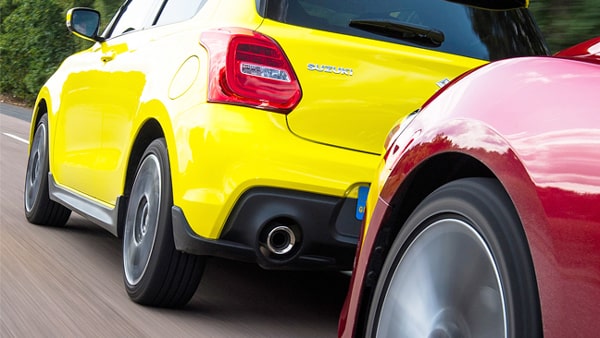
When you follow too closely and another driver cuts suddenly in front of you, what is the best thing to do?
  1. A Swerve immediately into the next lane
  2. B Apply the brakes as sharply as possible
  3. C Drive onto the shoulder
  4. D Ease off the accelerator to rebuild a safe following gap

Correct answer: D – Ease off the accelerator to rebuild a safe following gap

A driver must maintain a following distance that is reasonable for the speed, traffic, and road conditions. If another vehicle enters your gap, easing off the accelerator can gradually reduce your speed and restore space. An abrupt lane change or unnecessary hard braking can introduce additional hazards, so use a smooth response when conditions allow it.

Source: N.Y. VTL § 1129(a) – Following too closely, New York State Driver’s Manual — Ch. 8, “Allow Yourself Space”
Question 2

When should high-beam headlights be used at night?

  1. A As rarely as possible
  2. B Only on roads outside cities
  3. C When they improve visibility without dazzling another driver and their use is lawful
  4. D At all times on highways

Correct answer: C – When they improve visibility without dazzling another driver and their use is lawful

New York requires drivers to avoid using dazzling light when an oncoming vehicle is within 500 feet or when following a moving vehicle within 200 feet. Low beams must also be used when roadway lighting or traffic makes illumination beyond 200 feet unnecessary or impractical. High beams are appropriate on dark roads only when these restrictions and safety conditions permit.

Source: N.Y. VTL § 375(3) – Equipment

Question 3

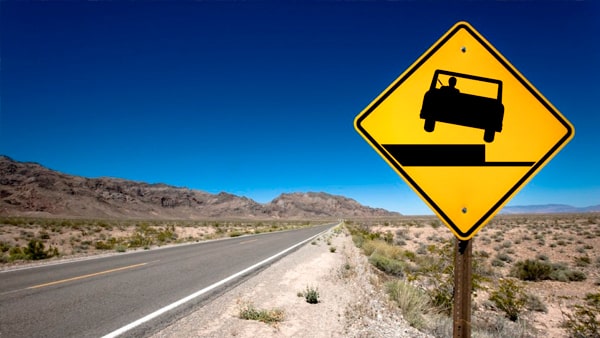
A SHOULDER DROP-OFF warning sign primarily alerts you to what hazard?

What should you be most concerned about when you see this sign?
  1. A Headlights may appear uneven because the roadway slopes
  2. B Tire damage is certain if you touch the shoulder
  3. C Water is always covering the shoulder
  4. D A sharp pavement-edge drop can affect vehicle control if your wheels leave the roadway

Correct answer: D – A sharp pavement-edge drop can affect vehicle control if your wheels leave the roadway

The adopted traffic-control standard uses the SHOULDER DROP-OFF warning sign to identify a significant difference in elevation at the pavement edge. New York’s driver manual advises easing off the accelerator and braking gently if the wheels leave the pavement. After slowing and checking traffic, steer carefully back onto the roadway rather than swerving abruptly.

Source: N.Y. VTL § 1680(a) – Department of transportation to maintain a manual of uniform traffic-control devices, Manual on Uniform Traffic Control Devices, 11th ed. — W8-17, “Shoulder Drop-Off”, New York State Driver’s Manual — Ch. 10, “Driving Emergencies—Running Off the Pavement”

Question 4

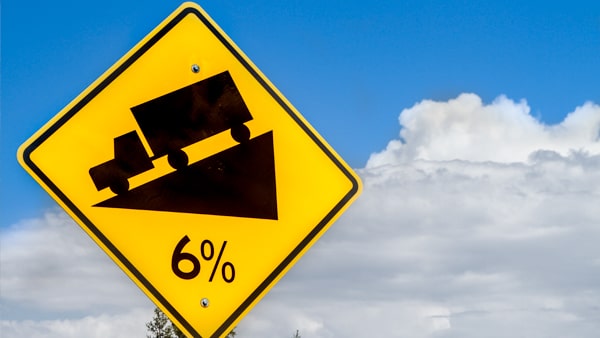
A yellow diamond sign showing a truck descending a slope warns of:

This sign means:
  1. A A truck weight restriction
  2. B A steep hill or downgrade ahead
  3. C A truck service area
  4. D A roadway closed to trucks

Correct answer: B – A steep hill or downgrade ahead

The truck-on-slope symbol is the Hill Ahead warning sign. Its yellow diamond shape indicates a roadway condition or hazard rather than a prohibition. Be prepared for a steep grade and adjust your speed as needed to maintain control; the sign does not establish a truck weight limit or prohibit trucks.

Source: New York State Driver’s Manual — “Road Signs You Must Know—Hill Ahead”

Question 5

What is the highest maximum speed limit that may be established on designated New York highways?

  1. A 55 mph
  2. B 65 mph
  3. C 70 mph

Correct answer: B – 65 mph

New York’s general maximum is 55 mph unless another authorized limit is posted, and state law permits no maximum above 65 mph. For ordinary speeding convictions, exceeding the limit by up to 10 mph carries a $45–$150 fine; 11–30 mph carries $90–$300 and up to 15 days; more than 30 mph carries $180–$600 and up to 30 days.

Source: N.Y. VTL § 1180(b), (d), (h)(1) – Basic rule and maximum limits, N.Y. VTL § 1180-a(1)–(3) – Maximum speed limits

Question 6

At an intersection without an operating traffic signal, a driver must yield to a pedestrian crossing within:

  1. A Only a crosswalk controlled by a stop sign
  2. B Either a marked crosswalk or an unmarked crosswalk at the intersection
  3. C Only a crosswalk outlined with painted lines
  4. D Only a crosswalk where the pedestrian has a green signal

Correct answer: B – Either a marked crosswalk or an unmarked crosswalk at the intersection

When traffic signals are absent or not operating, New York requires a driver to yield to a pedestrian within a crosswalk, slowing or stopping when necessary. This protection applies to marked crosswalks and unmarked crosswalks at intersections. A pedestrian may not suddenly enter the path of a vehicle that is too close for the driver to yield safely.

Source: N.Y. VTL § 1151(a)–(c) – Pedestrians’ right of way in crosswalks, New York State Driver’s Manual — Ch. 11, “Pedestrians”