


New York Permit Practice Test 7

4.8 out of 5 (357 votes)
80% Passing score
20 Questions
4 Mistakes allowed
Preparing for the New York DMV permit test is not just about recognizing a Stop sign and hoping for the best. This seventh NY practice permit test gives you 20 questions that stay close to the material New York expects new drivers to understand, including traffic laws, road signs, safe driving habits, and a few of the licensing details that people tend to discover a little too late, usually while standing at the DMV with the wrong folder of documents. You’ll need at least 16 correct answers to pass this DMV permit test practice, which matches the kind of score discipline you should bring to the real exam. The questions are written to feel like the official knowledge test without pretending to be leaked DMV material, because the DMV does not release its actual permit test questions. Still, the phrasing, topics, and general rhythm should feel familiar enough that the official NY DMV permit test does not seem like some entirely new animal when you sit down at the testing station. And yes, there is more to getting a learner permit than the written test. New York applicants also have to pass a vision test, with a standard of 20/40 visual acuity in at least one eye, with or without corrective lenses. You can handle that at a DMV office, through a provider in the DMV Online Vision Registry, or with a completed MV-619 Vision Test Report from an eligible provider. If you need glasses or contacts to meet the standard, the state adds a corrective-lenses restriction to your permit or license. It is a small letter on the document, but it matters. The testing setup itself is fairly flexible, in that very DMV sort of flexible. Class D knowledge tests may be taken at DMV offices on touch-screen stations or on paper, and some applicants under 18 may be able to test online before going in person to finish the permit transaction. New York also offers the Class D permit test in 20 languages, with accommodations available for disability access and sign language interpreting. After you finish, you can review your answers, read the explanations, and use the hints to clean up whatever you missed. That review is where this NY permit practice test earns its keep. It helps you study the rules, but it also gives you a clearer feel for the whole learner permit process — the MV-44 application, proof of identity and residence, fees based on age and county, and the general paperwork shuffle that comes with getting licensed in New York.
FREE DMV Practice Test App
Study for your New York permit test or driver’s license with the NextDoorDriving app. 700+ DMV questions and answers, 100% free!
Download on the App Store

Sample New York Permit Test Questions

Question 1

Which condition can reduce what a driver is able to see?
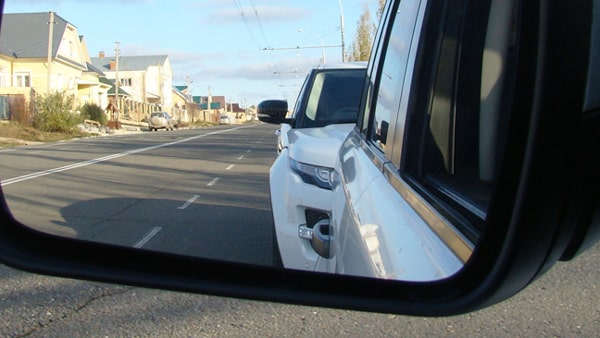
Which of the following might cause other drivers not to see you?
  1. A Rain, fog or snow reducing visibility
  2. B A large vehicle blocking the view of traffic
  3. C Blind spots created by a vehicle’s window supports
  4. D All of the above

Correct answer: D – All of the above

Rain, fog and snow can make road users harder to see. A large vehicle can block your view of surrounding traffic, while window supports and other vehicle features can create blind spots. Drivers must continue scanning and account for areas that are temporarily hidden from view.

Source: New York State Driver’s Manual — Ch. 10, “Driving in Rain, Fog, or Snow”, New York State Driver’s Manual — Ch. 11, “Large Vehicles”, New York State Driver’s Manual — Ch. 11, “Pedestrians”

Question 2

If the accelerator sticks and you cannot free it, what should you do?

  1. A Shift into Neutral, brake and move safely off the road
  2. B Apply the parking brake fully and immediately
  3. C Turn off the ignition while moving at traffic speed
  4. D Pump the service brakes as rapidly as possible

Correct answer: A – Shift into Neutral, brake and move safely off the road

First, the manual advises trying to free the stuck pedal with your shoe. If that does not work, shift into Neutral and use the brakes to slow down and leave the roadway. Do not turn off the ignition while moving because you could lose steering control or lock the steering wheel.

Source: New York State Driver’s Manual — Ch. 10, “Driving Emergencies”

Question 3

When may you open a vehicle door on the traffic side after parallel parking?

  1. A Whenever it is daylight
  2. B When the nearest traffic signal is red
  3. C Only when it is reasonably safe and will not interfere with moving traffic
  4. D Whenever the four-way flashers are operating

Correct answer: C – Only when it is reasonably safe and will not interfere with moving traffic

Under New York law, a door on the side available to moving traffic may be opened only when it is reasonably safe and will not interfere with traffic. The driver’s manual specifically warns against opening a roadside door into the path of bicyclists or other traffic. A red light or flashing hazard lamps do not remove this duty.

Source: N.Y. VTL § 1214 – Opening and closing vehicle doors, New York State Driver’s Manual — Ch. 7, “How to Park”

Question 4

You intend to turn left, but an oncoming vehicle is close enough to present an immediate hazard. What must you do?

  1. A Turn first if no pedestrians are present
  2. B Yield to the oncoming vehicle
  3. C Proceed because a turning vehicle has priority
  4. D Move into the oncoming lane and wait

Correct answer: B – Yield to the oncoming vehicle

In New York, a driver turning left must yield to an oncoming vehicle that is within the intersection or close enough to be an immediate hazard. Wait until the turn can be completed safely. The absence of pedestrians does not give the left-turning driver priority over approaching traffic.

Source: N.Y. VTL § 1141 – Vehicle turning left

Question 5

A school bus ahead has stopped and is displaying flashing red lights. What must you do?

  1. A Stop before reaching the bus and remain stopped until it moves or you are directed to proceed
  2. B Change lanes and pass at a reduced speed
  3. C Stop only until the visible passengers leave the roadway
  4. D Proceed unless the bus driver steps outside

Correct answer: A – Stop before reaching the bus and remain stopped until it moves or you are directed to proceed

In New York, a driver meeting or overtaking a stopped school bus with its red visual signal operating must stop before reaching the bus. The driver may not proceed until the bus resumes motion or a bus driver or police officer signals permission. Do not proceed merely because the passengers appear to be clear.

Source: N.Y. VTL § 1174(a) – Overtaking and passing school bus, New York State Driver’s Manual — Ch. 6, “School Buses”

Question 6

What does a flashing yellow traffic signal require?

  1. A Merge with traffic
  2. B Proceed only with caution
  3. C Yield only to pedestrians
  4. D Come to a complete stop

Correct answer: B – Proceed only with caution

A driver facing a flashing yellow circular signal or yellow arrow may proceed only with caution. Check for vehicles, pedestrians and other hazards before entering or passing the signal. Unlike a flashing red signal, a flashing yellow signal does not require a complete stop in every case.

Source: N.Y. VTL § 1113(b) – Flashing signal indications