


New York Drivers Ed Practice Test 8

4.8 out of 5 (321 votes)
80% Passing score
20 Questions
4 Mistakes allowed
New York driving rules are not something you want to learn in loose pieces, because the DMV rarely treats them that way. This NY DMV practice test brings the important pieces together: intersection rules, right-of-way decisions, permit test wording, and the licensing requirements that sit behind the whole process. It is still a 20-question multiple-choice practice permit test, yes, but it is not just a quick spin through random road signs and easy guesses. This one focuses on the decisions drivers actually have to make when traffic is moving, people are crossing, another car is inching forward, and the “obvious” answer suddenly needs a second look. The questions in this eighth New York drivers ed practice test lean into intersections and right-of-way rules because those are the areas where new drivers tend to get a little too comfortable too soon. Four-way stops, left turns, pedestrians, uncontrolled intersections, busy city streets, quieter upstate roads — the setting changes, but the rule still has to be applied correctly. And, honestly, that is where a good NY practice permit test earns its keep. Not by handing you a fake shortcut, but by making you slow down long enough to understand why one answer works and the others do not. Each question gives immediate feedback with an explanation, so you are not just collecting correct answers like little trophies and hoping the real written knowledge test is in a generous mood. This also fits into the bigger New York licensing picture, which is worth knowing before it becomes paperwork you forgot about. You can apply for a learner permit at 16, and new drivers need to pass the written knowledge test and vision test. Before the road test, New York requires either the DMV-approved 5-hour Pre-Licensing Course or a qualifying 48-hour Driver Education Program. Drivers under 18 have extra rules layered on top: at least 50 hours of supervised driving, including 15 after sunset, plus a signed MV-262 form from a parent or guardian. Junior permit and junior license restrictions also change depending on whether you are driving upstate, in New York City, or on Long Island, which is a detail that sounds minor until it very much is not. Use this New York driver ed practice test as a serious study tool, not a DMV test cheat sheet with a shiny label. It gives you the rules, the reasoning, and the licensing context in one place, which is exactly what you want before walking into the permit test.
FREE DMV Practice Test App
Study for your New York permit test or driver’s license with the NextDoorDriving app. 700+ DMV questions and answers, 100% free!
Download on the App Store

Sample New York Permit Test Questions

Question 1

A yellow left-curve sign with a 25 MPH plaque means:
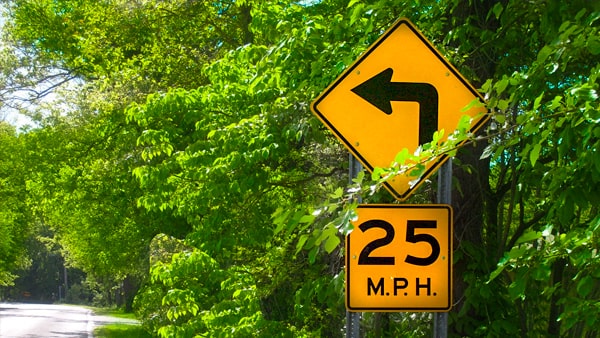
This sign means:
  1. A The road curves left, and you must drive at least 25 mph
  2. B The road curves right, with a regulatory 25 mph limit
  3. C The road curves right, with an advisory speed of 25 mph
  4. D The road curves left, with an advisory speed of 25 mph

Correct answer: D – The road curves left, with an advisory speed of 25 mph

The warning symbol shows that the roadway curves to the left. The 25 MPH plaque displays an advisory speed determined for the roadway condition; it is not a minimum-speed instruction. Advisory-speed plaques supplement warning signs and are different from regulatory speed-limit signs.

Source: Manual on Uniform Traffic Control Devices, 11th ed. — § 2C.59, “Advisory Speed Plaque (W13-1P) and Confirmation Advisory Speed Plaque (W13-1aP)”, New York State Driver’s Manual — Ch. 4, “Warning Signs”
Question 2

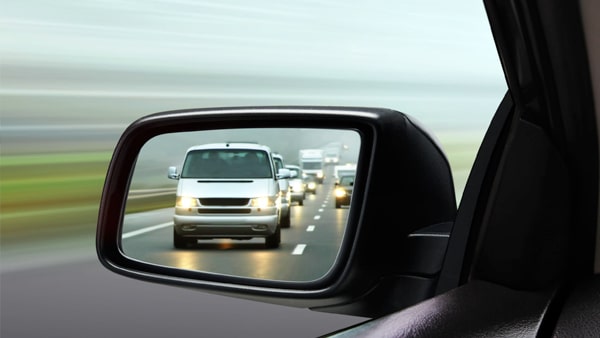
Another vehicle begins passing you on the left. What should you do?

The car behind you begins to pass you. You should:
  1. A Increase your speed to maintain your position
  2. B Pull off the roadway and stop immediately
  3. C Decrease speed slightly and remain centered in your lane
  4. D Sound your horn until the vehicle completes the pass

Correct answer: C – Decrease speed slightly and remain centered in your lane

The New York manual advises decreasing speed slightly and remaining centered in your lane while another vehicle passes on the left. State law prohibits increasing your speed until the passing vehicle has completely passed. When an audible passing signal is given, the overtaken driver must also give way to the right.

Source: N.Y. VTL § 1122(b) – Overtaking a vehicle on the left, New York State Driver’s Manual — Ch. 6, “Being Passed”

Question 3

Standard warning signs for roadway hazards such as curves and narrow bridges usually have:

  1. A Black symbols on a white background
  2. B Black symbols on a yellow background
  3. C White symbols on a blue background
  4. D White symbols on a green background

Correct answer: B – Black symbols on a yellow background

Standard warning signs are normally yellow and diamond-shaped, with black letters or symbols. They alert drivers to hazardous locations or other conditions that may require attention or a speed adjustment. A yellow-and-black advisory-speed plaque may accompany a warning sign when a reduced speed is recommended.

Source: New York State Driver’s Manual — Ch. 4, “Warning Signs”
Question 4

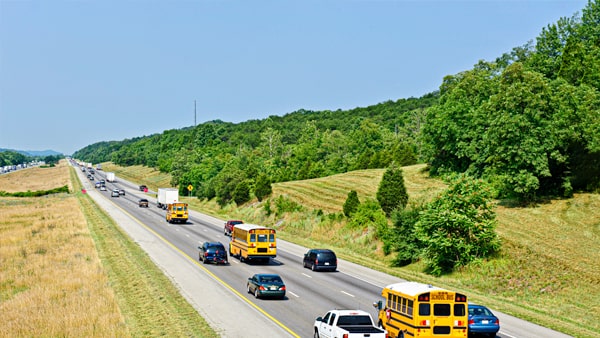
You are in the left lane of an expressway and need to take an exit on the right. What should you do?

  1. A Cut across all lanes near the exit
  2. B Accelerate until you are traveling faster than all other traffic
  3. C Slow sharply before every lane change
  4. D Plan ahead and make separate lane changes after verifying each movement is safe

Correct answer: D – Plan ahead and make separate lane changes after verifying each movement is safe

The New York manual directs drivers to enter the correct exit lane ahead of time and to signal all expressway lane changes. State law requires remaining as nearly as practicable within a single lane and verifying that a movement from the lane can be made safely. Check mirrors and blind spots before each move toward the exit lane.

Source: N.Y. VTL § 1128(a) – Driving on roadways laned for traffic, New York State Driver’s Manual — Ch. 10, “Expressway Driving”

Question 5

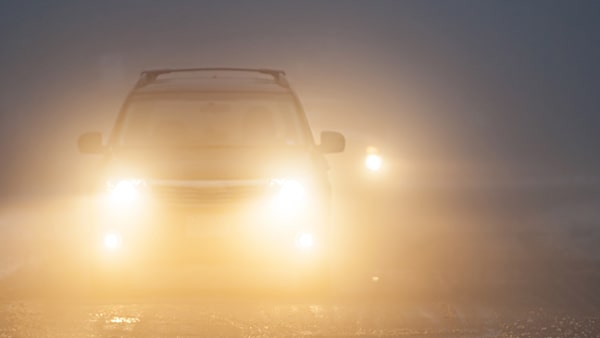
Under New York law, when must a driver use headlights?

When should you use your headlights while driving?
  1. A Only immediately after sunset
  2. B During the required nighttime period, when weather requires windshield wipers, or when visibility is under 1,000 feet
  3. C Only on roads without streetlights
  4. D Only when another driver flashes their lights

Correct answer: B – During the required nighttime period, when weather requires windshield wipers, or when visibility is under 1,000 feet

New York requires headlights from one-half hour after sunset until one-half hour before sunrise. They are also required when windshield wipers are used because of unfavorable weather and whenever the road is not clearly visible for 1,000 feet ahead. These rules help drivers see the roadway and make their vehicles visible to others.

Source: N.Y. VTL § 375(2)(a) – Equipment

Question 6

In New York, a school bus is stopped with red lights flashing on the opposite side of a divided four-lane highway. What must you do?

If a school bus stops to unload children on a four-lane highway, divided by a four-foot paved strip, vehicles traveling in the opposite direction are:
  1. A Stop and remain stopped until the bus moves or an authorized person signals you to proceed
  2. B Stop, then proceed immediately at a slow speed
  3. C Move onto the shoulder and pass cautiously
  4. D Continue because the bus is across the divider

Correct answer: A – Stop and remain stopped until the bus moves or an authorized person signals you to proceed

Drivers approaching a school bus from either direction must stop when its red visual signals are operating. They may proceed only when the bus resumes motion or the bus driver or a police officer signals them. A first conviction carries a $250–$400 fine, up to 30 days in jail, or both; penalties increase for additional violations within three years.

Source: N.Y. VTL § 1174(a), (c) – Overtaking and passing school bus