


New York DMV Permit Test Simulator

4.5 out of 5 (3895 votes)
80% Passing score
20 Questions
4 Mistakes allowed
New York gives you a 20-question permit test, which sounds tidy and manageable until you realize the scoring has a little more going on than just “get most of them right.” To pass the official NY DMV written knowledge test, you need at least 14 correct answers overall. Road signs matter separately, too: 4 of the 20 questions are sign questions, and you have to get at least 2 of those right. So a good NY DMV practice test should not just throw random road rules at you and call it preparation. It needs to train you for the shape of the real thing. This New York DMV test simulator is built around that format. Each round gives you 20 questions, pulled from a larger pool, so the practice does not turn into that fake kind of confidence where you remember the order of the answers more than the actual rule. The questions cover the material New York expects permit applicants to know: rules of the road, traffic signs and signals, safe driving habits, alcohol and drug laws, and the driver-safety details that show up in the official New York State Driver’s Manual. Some questions are straightforward. Others are, well, written the way test questions are written, which is its own little genre. It is useful for Class D and Class DJ applicants, including teens working toward a junior learner permit and adults applying for a standard learner permit. New York residents can apply for a learner permit at 16, and younger drivers have a longer road ahead after the written test: a 6-month permit holding period, 50 hours of supervised driving, and at least 15 of those hours after sunset before the road test. Adults skip that junior-license waiting period, but they still have to pass the knowledge test, pass the vision test, complete the required pre-licensing course or qualifying driver education, and pass the road test. Different path, same need to know the material. Use this NY permit practice test as a working companion to the official manual. The manual gives you the rules; the simulator makes you prove, repeatedly and sometimes a little uncomfortably, that you can recognize those rules when they are phrased as a test question. Since it works on a phone, tablet, or desktop, you can run through a practice round whenever you have a spare few minutes. That steady repetition is where the test starts to feel less like a surprise and more like something you have already handled.
FREE DMV Practice Test App
Study for your New York permit test or driver’s license with the NextDoorDriving app. 700+ DMV questions and answers, 100% free!
Download on the App Store

Sample New York Permit Test Questions

Question 1

Which statement about driving substantially slower than normal traffic is correct?

  1. A It is always safer than traveling with traffic
  2. B It is prohibited when it impedes normal traffic unless necessary for safety or required by law
  3. C It is permitted whenever you remain below the maximum speed limit
  4. D It is permitted in every lane except the far-left lane

Correct answer: B – It is prohibited when it impedes normal traffic unless necessary for safety or required by law

New York prohibits driving so slowly that you impede the normal and reasonable movement of traffic. The rule does not apply when the reduced speed is necessary for safe operation or compliance with law. A driver must consider both the lawful maximum speed and the effect an unnecessarily low speed has on traffic.

Source: N.Y. VTL § 1181(a) – Minimum Speed Regulations, New York State Driver’s Manual — Ch. 8, “Speed”

Question 2

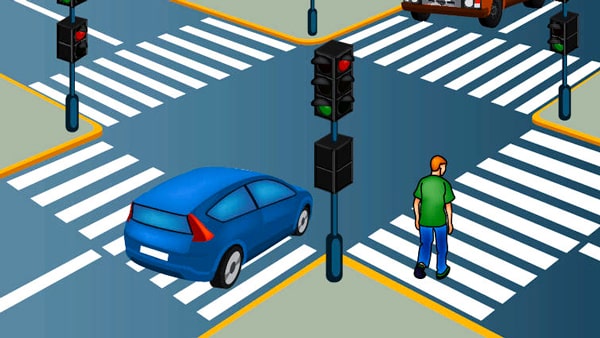
You are turning right on a steady green light as a pedestrian crosses the adjacent crosswalk. What must you do?

You are waiting at a red light to turn right, and a pedestrian on your right is waiting to cross the street you want to enter. Who has the right-of-way when your light turns green?
  1. A Yield to the pedestrian before completing the turn
  2. B Proceed first if the crosswalk has no painted lines
  3. C Proceed because a green light gives vehicles priority
  4. D Sound your horn and turn ahead of the pedestrian

Correct answer: A – Yield to the pedestrian before completing the turn

Traffic facing a steady green signal may turn unless a sign prohibits the movement. A turning driver must yield to traffic lawfully within the intersection or an adjacent crosswalk. Pedestrians facing the green signal may cross within a marked or unmarked crosswalk unless a pedestrian-control signal directs otherwise.

Source: N.Y. VTL § 1111(a)(1), (3) – Traffic-Control Signal Indications

Question 3

A steady yellow traffic signal warns that which indication will appear next?

  1. A A flashing yellow indication
  2. B A steady green indication
  3. C A red indication
  4. D A flashing red indication

Correct answer: C – A red indication

A steady circular yellow signal warns drivers that the related green movement is ending and a red indication will appear immediately afterward. The New York manual advises drivers to be prepared to stop. A yellow light is not an instruction to accelerate through the intersection.

Source: N.Y. VTL § 1111(b)(1) – Traffic-Control Signal Indications, New York State Driver’s Manual — Ch. 4, “Traffic Signals”

Question 4

Which observation habit best helps you detect roadway hazards early?

  1. A Watch only the vehicle directly ahead
  2. B Concentrate continuously on the rearview mirror
  3. C Scan the road ahead while keeping your eyes moving
  4. D Use high-beam headlights in all conditions

Correct answer: C – Scan the road ahead while keeping your eyes moving

Traffic conditions continuously change, so the New York manual instructs drivers to scan the road ahead. Do not use only the roadway or vehicle immediately ahead as your point of focus. Keep your eyes moving, observe the sides of the road, and check behind through your mirrors regularly.

Source: New York State Driver’s Manual — Ch. 8, “Be Prepared and Look Ahead”

Question 5

In the New York driver’s manual, the two-second rule measures the space where?

  1. A Beside your vehicle
  2. B Ahead of your vehicle
  3. C Behind your vehicle
  4. D Equally in every direction

Correct answer: B – Ahead of your vehicle

The two-second rule measures the following gap between your vehicle and the vehicle ahead. Begin counting when that vehicle passes a fixed roadside object; reaching the object before completing two seconds indicates that you are too close. The manual recommends increasing the count to at least three or four seconds in bad weather or when following large trucks.

Source: N.Y. VTL § 1129(a) – Following Too Closely, New York State Driver’s Manual — Ch. 8, “Allow Yourself Space”

Question 6

When may you use the left half of a two-way roadway to pass another vehicle?

On a two-way highway, you are allowed to drive on the left half of the roadway when:
  1. A When the roadway has double solid center lines
  2. B When a solid yellow line is on your side
  3. C When passing is authorized and the road ahead is visible and clear for a sufficient distance
  4. D Whenever the vehicle ahead is traveling below the speed limit

Correct answer: C – When passing is authorized and the road ahead is visible and clear for a sufficient distance

A vehicle is normally driven on the right half of a two-way roadway, with an exception for lawful overtaking and passing. Before using the opposing side, the driver must have sufficient clear, visible roadway to complete the pass without interfering with oncoming or overtaken traffic. A slower vehicle alone does not make a pass lawful.

Source: N.Y. VTL § 1120(a)(1) – Drive on Right Side of Roadway; Exceptions, N.Y. VTL § 1124 – Limitations on Overtaking on the Left