


North Carolina DMV Permit Practice Test 5

4.9 out of 5 (781 votes)
80% Passing score
20 Questions
4 Mistakes allowed
Getting ready for your NC driver’s license means you’ll need to know more than where the turn signal is, which, frankly, some licensed drivers still seem to be investigating. This NC DMV practice test zeroes in on alcohol, impaired driving, DUI rules, and the kind of road-safety decisions that can turn from “probably fine” into “oh no, this is now very serious” faster than anyone wants. You’ll work through 20 practice questions covering blood alcohol content, how alcohol affects judgment and reaction time, and what North Carolina expects from drivers who would rather keep their license, their money, and their dignity mostly intact. Now, the real North Carolina permit exam is not only about DUI rules. Annoying, yes, but fair. The written knowledge test has 25 multiple-choice questions on traffic laws and safe driving, and you need 20 correct answers to pass. There is no time limit, so at least you will not have a clock bullying you while you try to remember who goes first at an intersection. You will also take a road signs test, where you identify signs by color and shape and explain what they mean. Miss more than 3 there and, well, that is not ideal. Adult applicants also have to pass a vision test, because seeing the road is apparently still considered important. This North Carolina practice permit test tries not to feel like a dusty handout from a waiting room with bad lighting. Some questions include images, which helps when a rule makes more sense after you actually see the situation instead of decoding it from a stiff little paragraph. After you answer, you can review the explanation and figure out why the correct answer is right, and why your answer, if it was wrong, wandered off into the weeds. Before you show up at the DMV, do the boring-but-necessary document shuffle. The permit fee is $25.50, and if you fail, you must wait 7 calendar days before retaking the test. Bring proof of identity and date of birth, proof of Social Security number, one proof of North Carolina residency, and the fee. Under 18? You’ll also need a Driving Eligibility Certificate, a Driver’s Education Certificate, and a parent or guardian. Use this DMV learners permit practice test whenever your brain is willing. Passing matters, obviously. But knowing this stuff before you drive around North Carolina matters more, in the deeply unglamorous way that safety usually does.
FREE DMV Practice Test App
Study for your North Carolina permit test or driver’s license with the NextDoorDriving app. 700+ DMV questions and answers, 100% free!
Download on the App Store

Sample North Carolina Permit Test Questions

Question 1

When double solid yellow centerlines prohibit passing, which movement may still be made when it is safe?

  1. A A left turn into a private driveway
  2. B Travel in either direction on a one-way street
  3. C Continuous driving in a center turn lane
  4. D Crossing the lines to pass a slow vehicle

Correct answer: A – A left turn into a private driveway

Double solid yellow centerlines prohibit crossing to overtake and pass another vehicle. North Carolina's passing limitations do not apply to a driver turning left into or from an alley, private road or driveway. Before making the turn, the driver must verify that it can be completed safely and provide any required signal.

Source: N.C. Gen. Stat. § 20-150(e), (f) – Limitations on privilege of overtaking and passing, N.C. Gen. Stat. § 20-154(a) – Signals on starting, stopping or turning
Question 2

When may you drive around or under a railroad crossing gate that is being raised or lowered?

  1. A When no train is visible
  2. B When your vehicle will not touch the gate
  3. C After looking in both directions
  4. D Never while the gate is opening or closing

Correct answer: D – Never while the gate is opening or closing

North Carolina law prohibits driving through, around or under a railroad gate while it is closed, opening or closing. When a lowered gate warns of an approaching train or on-track equipment, stop between 15 and 50 feet from the nearest rail and remain stopped until proceeding is safe. A violation is an infraction.

Source: N.C. Gen. Stat. § 20-142.1(a), (b), (d) – Obedience to railroad signal

Question 3

Which action most directly helps a new teen driver develop the skills needed before driving independently?

  1. A Avoiding every road with a speed limit above 35 mph
  2. B Depending on quick reflexes instead of planning
  3. C Completing substantial supervised driving practice
  4. D Driving well below the normal traffic speed

Correct answer: C – Completing substantial supervised driving practice

The North Carolina handbook states that drivers under 18 have a much higher crash rate and are subject to graduated licensing requirements. Before advancing from a limited learner permit, a driver must log at least 60 hours of operation, including 10 hours at night, with a qualified supervising driver. This provides structured practice before unsupervised driving.

Source: North Carolina Driver Handbook — Ch. 1, “Graduated Licensing—Licensing for Drivers 15–18”, North Carolina Driver Handbook — Ch. 1, “The Provisional Licensee”

Question 4

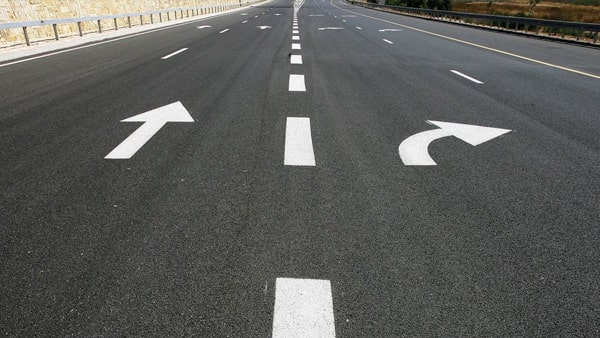
What does a broken white line between two travel lanes indicate?

A broken white center line on the roadway means:
  1. A Turning is prohibited from both lanes
  2. B Traffic must slow for a hazard
  3. C The lanes carry opposing traffic and passing is prohibited
  4. D The lanes travel in the same direction, and you may change lanes when safe

Correct answer: D – The lanes travel in the same direction, and you may change lanes when safe

White pavement lines separate lanes carrying traffic in the same direction. A broken line may be crossed for a lane change unless another traffic-control device prohibits the movement. Before crossing it, signal, check the mirrors and blind spot, and verify that the vehicle can leave its lane safely.

Source: N.C. Gen. Stat. § 20-146(d)(1), (4) – Drive on right side of highway; exceptions, North Carolina Driver Handbook — Ch. 5, “Pavement Markings”, North Carolina Driver Handbook — Ch. 4, “Changing Lanes”

Question 5

Your light turns green, but vehicles ahead still block the intersection. What must you do?

  1. A Enter and wait in the intersection
  2. B Drive around the vehicles using any open space
  3. C Remain outside until there is enough room to clear the intersection
  4. D Enter because the green signal gives you priority

Correct answer: C – Remain outside until there is enough room to clear the intersection

North Carolina law prohibits entering an intersection unless sufficient space is available on the other side for your vehicle. This rule applies even when a traffic signal indicates that you may proceed. Wait outside the intersection until the blocking vehicles move and you have enough room to cross without obstructing other vehicles or pedestrians.

Source: N.C. Gen. Stat. § 20-142.5 – Stop when traffic obstructed

Question 6

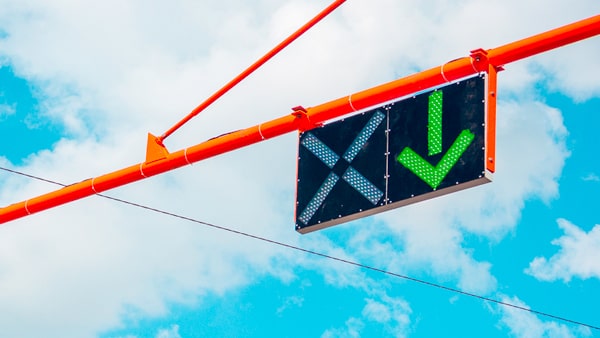
What does a steady downward green arrow displayed over a travel lane mean?

This green arrow on a lane use control signal means that:
  1. A The lane is open for travel
  2. B Traffic is prohibited from using the lane
  3. C Traffic in the lane has unconditional right-of-way
  4. D All nearby vehicles must merge into the lane

Correct answer: A – The lane is open for travel

A downward green arrow is a lane-use control signal indicating that the lane beneath it is open to traffic. It regulates lane availability rather than granting an unconditional right-of-way through an intersection. Drivers must continue to obey other traffic-control devices and use the lane safely.

Source: N.C. Gen. Stat. § 20-146(d)(3) – Drive on right side of highway; exceptions, North Carolina Driver Handbook — Ch. 5, “Traffic Signals”