


North Carolina DMV Sign Test 3

4.9 out of 5 (461 votes)
80% Passing score
20 Questions
4 Mistakes allowed
Getting ready for the North Carolina permit exam means, unfortunately, making peace with road signs. Not just “red means stop” signs, either — though yes, please know that one. The real NC DMV permit test includes a written knowledge test with 25 multiple-choice questions on traffic laws and safe driving, and you’ll need 20 correct answers to pass. That’s 80%, which sounds friendly until you remember the DMV is involved. Then there’s the road signs test, sitting there like a separate little trapdoor. On that part, applicants have to identify signs by color and shape and explain what they mean. You can miss no more than 3 questions, so this is not the place to vaguely gesture at a yellow diamond and hope everyone understands your energy. This NC road signs permit test gives you 20 practice questions focused on the signs you’re expected to recognize across North Carolina. You’ll see the obvious ones, the less-obvious ones, and the ones that seem obvious until they are suddenly not obvious at all. Octagonal stop signs, triangular yield signs, rectangular informational signs, warning signs, regulatory signs — the whole roadside cast shows up. And since NC driving can mean anything from Raleigh traffic to mountain curves near Asheville to a quiet road where a deer is clearly considering a life choice, knowing what signs are trying to tell you is useful in a very real, very unglamorous way. The practice test is built to feel close to the North Carolina DMV sign test without dragging you into full fluorescent-light misery. If you get stuck, hints can nudge you along. If you miss something, the answer explanations explain the mistake instead of just tossing a red X at you and wandering off. That matters, because memorizing sign shapes for five minutes and then immediately forgetting them is a classic move — common, understandable, not ideal. To pass this NC practice permit test, aim for at least 16 correct answers out of 20. It is a solid way to check whether your road sign recognition is actually ready for the official NC DMV road signs test, or whether you need another round before you walk in feeling confident-ish, which is sometimes the most realistic kind of confident.
FREE DMV Practice Test App
Study for your North Carolina permit test or driver’s license with the NextDoorDriving app. 700+ DMV questions and answers, 100% free!
Download on the App Store

Sample North Carolina Permit Test Questions

Question 1

What does a steady yellow circular signal require you to prepare for?

  1. A An unrestricted movement through the intersection
  2. B A yield sign at the next intersection
  3. C Stopping because a red signal is about to appear
  4. D An immediate stop regardless of whether it can be made safely

Correct answer: C – Stopping because a red signal is about to appear

In North Carolina, a steady yellow signal warns that the related green movement is ending and a red signal will immediately follow. Stop if you can do so safely before entering the intersection. If you are too close to stop safely, continue cautiously rather than accelerating to beat the red light.

Source: G.S. 20-158(b)(2a) – Vehicle control signs and signals, North Carolina Driver Handbook — Ch. 5, “Traffic Signals”
Question 2

Orange signs and channelizing cones appear on a freeway. What should you do?

  1. A Change lanes immediately while maintaining speed
  2. B Stay alert for work-zone directions and construction activity
  3. C Stop in your lane until the work area is clear
  4. D Accelerate to leave the area quickly

Correct answer: B – Stay alert for work-zone directions and construction activity

In North Carolina, black-on-orange signs identify construction or maintenance work zones and provide directions as drivers approach and travel through them. Cones, drums, barricades, and flaggers may guide traffic through changed conditions. Stay alert and make any required lane or speed adjustment in response to the posted controls.

Source: North Carolina Driver Handbook — Ch. 4, “Work Zones”, North Carolina Driver Handbook — Ch. 5, “Warning Signs”

Question 3

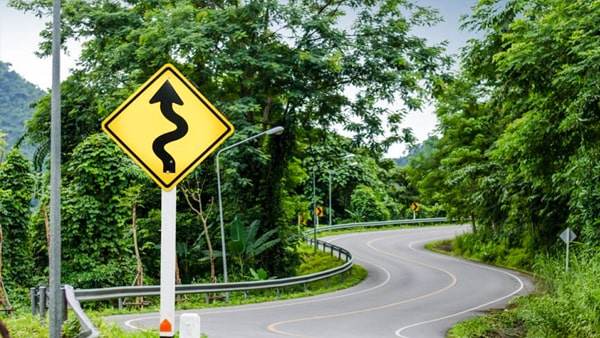
A yellow diamond sign displaying a black winding arrow warns of:

This sign tells you that:
  1. A A roadway where turns are prohibited
  2. B A roadway that becomes narrower
  3. C Several curves ahead
  4. D Pavement that is slippery when wet

Correct answer: C – Several curves ahead

The winding-road sign warns that the roadway has a series of curves ahead. Reduce your speed before entering the curves because braking after entering a curve can make vehicle control more difficult. Continue at a speed that allows you to follow each change in roadway direction safely.

Source: North Carolina Driver Handbook — Ch. 5, “Warning Signs”; Ch. 4, “Rounding a Curve”

Question 4

At a stop-controlled intersection, where must you stop first?

  1. A Where you can see all cross traffic
  2. B After entering the crosswalk
  3. C At the stop line, or before the marked crosswalk if there is no line
  4. D Beside the stop sign

Correct answer: C – At the stop line, or before the marked crosswalk if there is no line

North Carolina law requires a driver to stop at the marked stop line. If there is no stop line, stop before entering a marked crosswalk. When neither is present, stop at the point nearest the intersecting street where you can see approaching traffic, without first entering the intersection.

Source: G.S. 20-158(b)(5) – Vehicle Control Signs and Signals

Question 5

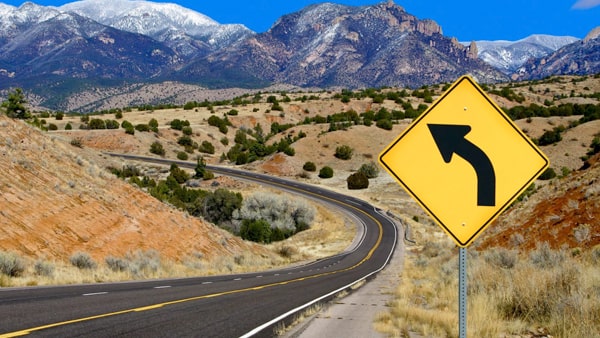
A yellow diamond sign with a black arrow bending left warns that:

This sign is used to warn drivers about:
  1. A An intersection is ahead
  2. B Road work begins ahead
  3. C The roadway curves to the left
  4. D The number of travel lanes will change

Correct answer: C – The roadway curves to the left

This warning sign indicates a change in roadway alignment, with a curve to the left ahead. Slow before entering the curve rather than braking sharply after the turn begins. Choose a speed that lets you maintain traction and control throughout the curve.

Source: North Carolina Driver Handbook — Ch. 5, “Warning Signs”; Ch. 4, “Rounding a Curve”

Question 6

Which pavement marking normally identifies the right edge of a roadway?

  1. A A broken white line
  2. B A solid yellow line
  3. C A solid white line
  4. D A broken yellow line

Correct answer: C – A solid white line

A single solid white line is used along the right edge of the roadway. White markings also separate lanes carrying traffic in the same direction. A solid yellow line may mark the left edge of a divided highway, so seeing the edge colors reversed can indicate that you are traveling in the wrong direction.

Source: North Carolina Driver Handbook — Ch. 5, “Pavement Markings”