


North Dakota CDL Practice Test Questions and Answers (ND) 7

5 out of 5 (36 votes)
80% Passing score
50 Questions
10 Mistakes allowed
If you're gearing up to take the North Dakota CDL permit test, our seventh CDL practice test is a crucial tool in your preparation arsenal in 2026! With this DMV practice test, you're not just reading about what to expect - you're actively engaging with the material in a way that mirrors the actual DMV written test. This alignment in format and content is no coincidence; it's designed to give you the most realistic test-taking experience possible, short of sitting in the DMV office. Our CDL practice test offers a comprehensive set of 50 North Dakota permit test questions, covering crucial topics like road signs, rules of the road, traffic signals, and pavement markings. The format is straightforward: you need to correctly answer at least 40 questions to pass. What makes this North Dakota CDL practice test an essential part of your study plan is its consistency. Each time you take the DMV prep test, you'll encounter the same DMV questions. This repetition is a powerful tool, reinforcing your knowledge and boosting your confidence. But it's not just about answering questions. Our general knowledge practice test goes a step further by providing immediate feedback and detailed explanations for each North Dakota permit test question. Whether you answer correctly or miss the mark, you'll learn why. This immediate feedback loop is invaluable in solidifying your understanding and helping you correct any misconceptions. Remember, there's no limit to how many times you can take this North Dakota DMV practice test. Use it to your advantage - retake it as many times as needed to feel comfortable and confident with the material. Each attempt is an opportunity to improve and get closer to achieving your goal of passing the North Dakota CDL permit test in 2026. In essence, this seventh ND CDL practice test is more than just a set of DMV questions; it's a comprehensive learning tool designed to prepare you thoroughly for your CDL permit test!
FREE CDL Practice Test App
Pass your North Dakota CDL General Knowledge test with the NextDoorDriving app. Real questions and answers—100% free and ad-free.
Download on the App Store

Sample North Dakota CDL Test Questions - General Knowledge

Question 1

Which condition is acceptable during an inspection of the brakes and suspension?

  1. A Brake shoes and pads are free of oil, grease, and brake fluid
  2. B One missing leaf in a leaf spring can be ignored
  3. C A cracked spring hanger does not need repair
  4. D All of these conditions are acceptable

Correct answer: A – Brake shoes and pads are free of oil, grease, and brake fluid

Brake shoes or pads must not be contaminated with oil, grease, or brake fluid because contamination can reduce braking effectiveness. Cracked or broken spring hangers are suspension defects. A missing or broken leaf can also be dangerous, even when the number missing is not enough by itself to place the vehicle out of service.

Source: North Dakota Commercial Driver License Manual (2025–2027) — § 2.1.3, “What to Look For”: “Bad Brake Drums or Shoes” and “Suspension System Defects”
Question 2

You are approaching a downhill off-ramp that curves while driving a heavy commercial vehicle. What should you do?

  1. A Rely on the posted ramp speed because it is set for the heaviest vehicles
  2. B Reduce to a safe speed before reaching the curve
  3. C Accelerate before entering the curve
  4. D Wait until you are in the curve to downshift

Correct answer: B – Reduce to a safe speed before reaching the curve

Ramp speed signs may indicate a speed suitable for automobiles but not for a large or heavily loaded commercial vehicle. A downhill curve is especially hazardous because the downgrade makes slowing more difficult. Reduce to a safe speed before reaching the curved portion of the ramp rather than braking and turning at the same time.

Source: North Dakota Commercial Driver License Manual (2025–2027) — § 2.8.2, “Hazardous Roads”: “Off Ramps/On Ramps”

Question 3

During an air-pressure buildup check at operating rpm, a dual air system should build between which pressures within 45 seconds?

  1. A From 85 to 100 psi
  2. B From 40 to 60 psi
  3. C From 60 to 80 psi
  4. D From 100 to 120 psi

Correct answer: A – From 85 to 100 psi

The North Dakota CDL manual specifies that a dual air system should build from 85 to 100 psi within 45 seconds when the engine is running at operating rpm. A vehicle with larger-than-minimum air tanks may require more time and still be safe. In that situation, follow the manufacturer's specifications.

Source: North Dakota Commercial Driver License Manual (2025–2027) — § 5.3.3, “Step 7 Final Airbrake Check”

Question 4

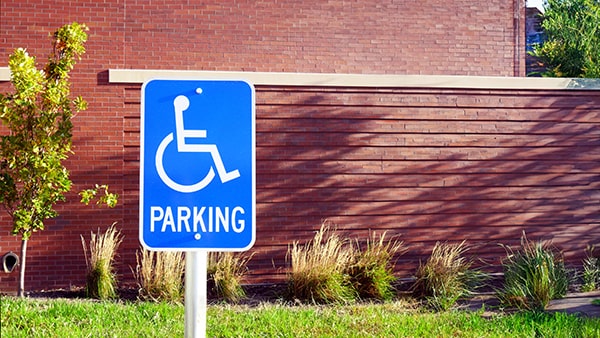
A white rectangular parking sign displaying the International Symbol of Accessibility indicates:

This sign indicates ___________.
  1. A A parking space reserved for persons with disabilities
  2. B Parking is prohibited for every vehicle
  3. C The space is available to any driver
  4. D Parking is permitted for a limited time

Correct answer: A – A parking space reserved for persons with disabilities

The Accessible Parking sign designates a parking space reserved for persons with disabilities. It displays the official International Symbol of Accessibility. A VAN ACCESSIBLE plaque may be installed below it when the space is designed to accommodate a wheelchair-accessible van.

Source: Manual on Uniform Traffic Control Devices, 11th ed. — § 2B.53, “Parking, Standing, and Stopping Signs (R7 and R8 Series)”

Question 5

When driving a commercial vehicle at night, which speed practice should you follow?

  1. A Use caffeine so you can maintain your daytime speed
  2. B Increase speed to reduce the time spent driving after dark
  3. C Open a window whenever you begin feeling sleepy
  4. D Drive slowly enough to stop within the distance illuminated by your headlights

Correct answer: D – Drive slowly enough to stop within the distance illuminated by your headlights

North Dakota's CDL manual instructs drivers to match their speed to their headlight sight distance. At night, headlights reveal much less roadway than daylight does. If your stopping distance extends beyond the illuminated area, you may see a hazard too late to stop. Sleep is the only safe remedy when you become drowsy.

Source: North Dakota Commercial Driver License Manual 2025–2027 — §§ 2.11.2, “Driver Factors”; 2.11.4, “Vehicle Factors”

Question 6

Which statement correctly describes how vehicle weight affects braking?

  1. A As vehicle weight increases, the brakes must do more work and absorb more heat
  2. B Brakes gain stopping power as they become extremely hot
  3. C Continuous heavy braking is preferred on long downgrades
  4. D Brake drums cool immediately during repeated braking

Correct answer: A – As vehicle weight increases, the brakes must do more work and absorb more heat

Stopping a heavier vehicle requires the brakes to perform more work and absorb more heat. Excessive heat caused by overusing the brakes can produce brake fade or failure. On a long or steep downgrade, engine braking should control most of the vehicle's speed while the service brakes provide supplemental braking.

Source: North Dakota Commercial Driver License Manual 2025–2027 — §§ 2.6.1, “Stopping Distance”; 2.16.3, “Brake Fading or Failure”