


North Dakota Practice Permit Test 4

4.8 out of 5 (190 votes)
80% Passing score
20 Questions
4 Mistakes allowed
North Dakota’s permit process starts earlier than a lot of new drivers expect, which means the rules around the ND DMV permit test are worth taking seriously from the beginning. A Class D instruction permit can be issued at age 14, and from there, the licensing path has a few details that are easy to miss if you only skim the handbook. This North Dakota permit practice test is built to make those details feel familiar before they show up on the real exam. The practice test has 20 multiple-choice questions, all based on the official ND Driver’s Manual. You need 16 correct answers to pass, so there is room for a mistake or two, but not enough room to guess your way through the whole thing and hope it works out. The questions cover general driving rules, safe driving judgment, licensing requirements, and child passenger safety, including proper child safety seat use and installation. That topic can feel oddly tucked into the study material, and still, it matters. North Dakota expects drivers to understand how younger passengers are protected, not just how to identify a stop sign or handle a four-way intersection. For teen drivers, this ND permit test practice also helps connect the written test to the bigger licensing process. Permit holders must drive with a supervising driver who is at least 18, properly licensed, has at least three years of driving experience, and sits beside the permit holder. No electronic communication devices are allowed while driving. For 14- and 15-year-olds, there are added limits on what vehicle they may drive, and before moving toward the road test, they must meet permit-holding requirements, complete driver education, and log 50 hours of supervised practice in varied conditions. A parent or guardian has to certify those hours, which is one of those small administrative facts that becomes very important at exactly the wrong moment if nobody planned for it. A 15-year-old who passes the road test receives a restricted Class D license, with nighttime driving limits and vehicle ownership restrictions still in place. At 16, that restricted license can transition to an unrestricted license. So, yes, the permit test is only one piece of the process — but it is the piece that proves you are ready to begin handling the rules with some seriousness. Because this ND permit test practice is available online 24/7, you can work through it alongside the handbook, road sign review, flashcards, and actual supervised driving. Use it to find the weak spots before test day, while there is still time to fix them.
FREE DMV Practice Test App
Study for your North Dakota permit test or driver’s license with the NextDoorDriving app. 700+ DMV questions and answers, 100% free!
Download on the App Store

Sample North Dakota Permit Test Questions

Question 1

A guide sign above your lane includes a yellow “EXIT ONLY” panel. If you remain in that lane, you:
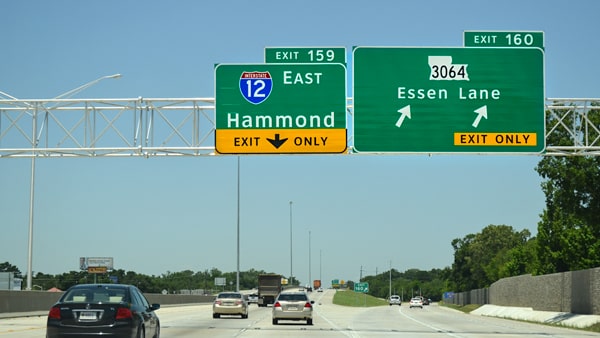
If you see this sign above your lane, you:
  1. A May not use the upcoming exit
  2. B May choose to exit or continue straight from the same lane
  3. C Will continue through the interchange
  4. D Must leave the highway at that exit

Correct answer: D – Must leave the highway at that exit

An official sign directing a lane to an exit must be obeyed. A driver who remains in the marked exit lane must follow that lane off the highway. Drivers who intend to continue should move safely into the proper through lane before reaching the interchange rather than stopping or backing on the ramp.

Source: N.D.C.C. § 39-10-04.1 – Obedience to and Required Traffic-Control Devices, North Dakota Noncommercial Driver License Manual — “Rules of the Road,” “Interchanges”
Question 2

When passing another vehicle traveling in your direction, the usual passing side is:

  1. A The right side
  2. B The left side
  3. C Whichever side the other driver signals
  4. D The shoulder whenever it is clear

Correct answer: B – The left side

The general rule is to overtake and pass another vehicle on the left at a safe distance, remaining left until safely clear. Passing on the right is permitted only in specified circumstances and when the movement can be completed safely. A driver may not leave the roadway to pass on the right.

Source: N.D.C.C. § 39-10-11 – Overtaking a Vehicle on the Left, N.D.C.C. § 39-10-12 – When Overtaking on the Right Is Permitted

Question 3

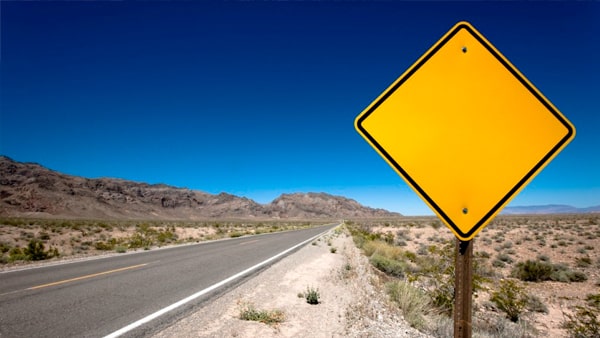
What does a standard yellow diamond-shaped sign with a black symbol usually indicate?

A yellow and black diamond-shaped sign:
  1. A A potentially hazardous condition on or near the roadway
  2. B Directions and distances to destinations
  3. C A traffic law that must be obeyed
  4. D A construction zone identified by orange coloring

Correct answer: A – A potentially hazardous condition on or near the roadway

Standard yellow diamond-shaped signs warn drivers about roadway conditions or potential hazards ahead. Regulatory signs give mandatory instructions and usually use different shapes and colors. Construction and maintenance warnings are generally orange with black symbols or lettering, even though many are also diamond-shaped.

Source: North Dakota Noncommercial Driver License Manual — “Signs, Signals, and Road Markings,” “Warning Signs”, North Dakota Noncommercial Driver License Manual — “Signs, Signals, and Road Markings,” “Construction and Maintenance Devices”

Question 4

When North Dakota law requires vehicle lights, may a moving car be driven with only its parking lights illuminated?

  1. A Yes, during the first 30 minutes after sunset
  2. B No, the required headlamps and other lamps must be displayed
  3. C Yes, whenever fog reduces visibility
  4. D Yes, whenever rain reduces visibility

Correct answer: B – No, the required headlamps and other lamps must be displayed

When lighting is required, a vehicle on the highway must display its required lighted headlamps, taillamps, and illuminating devices. These requirements apply from sunset to sunrise and when weather or insufficient light prevents a person or vehicle from being clearly visible at 1,000 feet. Parking lights alone do not meet the headlamp requirement for a moving car.

Source: N.D.C.C. § 39-21-01 – When Lighted Lamps Are Required, N.D.C.C. § 39-21-25.1 – Number of Driving Lamps Required or Permitted

Question 5

Which statement about driving on snow or ice is correct?

  1. A Bridges and shaded areas may form ice sooner and retain it longer
  2. B Drivers should slow down and increase their following distance
  3. C Testing the brakes gently at low speed can help assess available traction
  4. D All of the above

Correct answer: D – All of the above

Bridges and shaded areas can develop frost or ice more quickly and retain it longer than other roadway surfaces. On snow or ice, drivers should reduce speed and increase the distance behind other vehicles. The driver manual also recommends carefully trying the brakes while moving slowly to determine how much traction is available.

Source: North Dakota Noncommercial Driver License Manual — “Driving Skills and Emergency Situations,” “Winter Driving”

Question 6

At a North Dakota intersection, the traffic signals are completely unlit. What should you do?

  1. A Wait until the signals are repaired
  2. B Continue without stopping if the roadway appears clear
  3. C Stop and apply the right-of-way rules used at stop signs
  4. D Follow the last signal color you observed

Correct answer: C – Stop and apply the right-of-way rules used at stop signs

A driver approaching an intersection where the normally colored traffic signals are unlit must stop. After stopping, the driver must yield to vehicles that create an immediate hazard and to another vehicle that previously stopped at the intersection when the intersection is clear. Proceed only after applying the required stop-sign right-of-way rules.

Source: N.D.C.C. § 39-10-22.2 – Vehicle Approaching or Entering Intersection, N.D.C.C. § 39-10-24.2 – Stop Signs and Yield Signs