


North Dakota Practice Permit Test 5

4.8 out of 5 (177 votes)
80% Passing score
20 Questions
4 Mistakes allowed
This North Dakota permit practice test gives you a practical way to study before the official Class D knowledge test, not just a quick round of questions that feels useful for five minutes and then disappears from your brain. It is built around the material first-time drivers actually need to know in ND: state driving laws, road signs, safe-driving judgment, and the rules that come before you receive a learner permit and start practicing with a supervising driver. The test includes 20 multiple-choice questions, with a noticeable focus on blood alcohol content, impaired driving, and DUI consequences. That is one of the areas you should take seriously, even if it is not the most pleasant thing to study. North Dakota expects new drivers to understand how alcohol affects reaction time, judgment, control, and decision-making, along with the penalties and real-world damage that can follow impaired driving. So, yes, the BAC questions matter. They are not there as extra decoration. The format also helps if you are trying to learn instead of just guessing your way through. There is no time limit, which means you can read the question, slow down when the wording gets dense, and use the answer explanations as actual study material. Since this online ND DMV permit test practice works on mobile, desktop, and through the app, it fits into the way people really study — a little at home, a little on a break, maybe one more round when you realize the DUI material still needs work. For adults age 18 and older, the licensing process follows the normal first-time driver route. You need to submit the required application, provide proof of identity, date of birth, legal presence, Social Security number, and North Dakota residence address, then pass the Class D knowledge test and vision screening. After that, you can obtain a learner permit, but you must practice with a supervising driver while using it. To become fully licensed, you will need to pass the road test or qualify for a waiver and pay the required fees. Adults do get a more direct path than teen drivers. The 50-hour supervised-driving requirement, the under-16 driver education rule, the 12-month permit holding period for ages 14 and 15, and the restricted Class D vehicle and nighttime limits for younger drivers do not apply to adults. Still, the knowledge test is the gate you have to get through first, and this ND permit practice test helps you walk into it with the rules, risks, and details already in your head.
FREE DMV Practice Test App
Study for your North Dakota permit test or driver’s license with the NextDoorDriving app. 700+ DMV questions and answers, 100% free!
Download on the App Store

Sample North Dakota Permit Test Questions

Question 1

Which pavement marking shows the movement assigned to a particular turn lane?

  1. A A flashing red signal
  2. B A flashing yellow signal
  3. C A solid white edge line
  4. D A white directional arrow painted in the lane

Correct answer: D – A white directional arrow painted in the lane

Directional arrows painted in traffic lanes identify the movement assigned to those lanes, such as turning left, turning right, or continuing straight. At intersections with specially designated turn lanes, drivers must use the lane intended for their planned movement. Drivers must also obey official devices directing traffic into designated lanes.

Source: N.D.C.C. § 39-10-17.3 – Driving on Roadways Laned for Traffic, North Dakota Noncommercial Driver License Manual — “Signs, Signals, and Road Markings,” “Pavement Markings”
Question 2

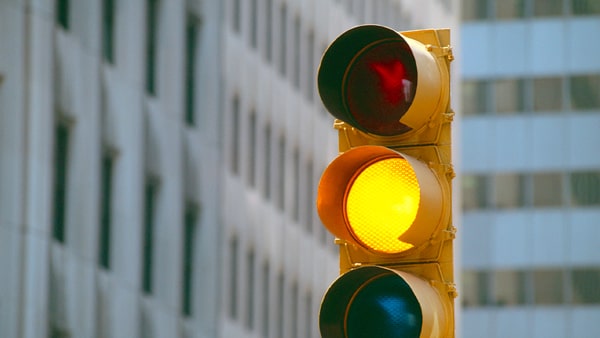
As you approach an intersection, a steady green light changes to yellow. What does the yellow indication mean?

As you near an intersection, the traffic light changes from green to yellow. Your best action would be to:
  1. A Accelerate before cross traffic receives a green light
  2. B You have a protected movement through the intersection
  3. C Stop after entering the center of the intersection
  4. D The green movement is ending and a red indication will follow

Correct answer: D – The green movement is ending and a red indication will follow

A steady yellow signal warns that the related green movement is ending and that a red indication will appear immediately afterward. It is a caution signal, not an instruction to accelerate. Drivers should recognize that traffic will soon be prohibited from entering the intersection under that signal.

Source: N.D.C.C. § 39-10-05.2 – Traffic-Control Signal Legend, North Dakota Noncommercial Driver License Manual — “Signs, Signals, and Road Markings,” “Traffic Signals”

Question 3

In North Dakota, where is driving left of center to pass generally prohibited?

  1. A Within 100 feet of or while crossing an intersection
  2. B Within 100 feet of or while crossing a railroad grade crossing
  3. C Near an obstructed bridge, viaduct, or tunnel within the specified 100-foot area
  4. D All of the above

Correct answer: D – All of the above

The law prohibits driving left of center to pass when approaching within 100 feet of or crossing an intersection or railroad grade crossing. The restriction also applies when the driver’s view is obstructed while approaching within 100 feet of a bridge, viaduct, or tunnel. These locations do not provide appropriate conditions for an ordinary left-of-center passing maneuver.

Source: N.D.C.C. § 39-10-14.1 – Further Limitations on Driving on Left of Center of Roadway

Question 4

In North Dakota, which lane should you use to turn left from a one-way street onto another one-way street?

  1. A The extreme left-hand lane available for your direction
  2. B Any lane, provided no vehicle is immediately beside you
  3. C The lane nearest the right-hand curb
  4. D Whichever lane has the fewest vehicles

Correct answer: A – The extreme left-hand lane available for your direction

A driver intending to turn left must approach from the extreme left-hand lane lawfully available in the direction of travel. When practicable, the vehicle should enter the extreme left-hand lane of the roadway being entered. A posted traffic-control device may direct drivers to follow a different turning path.

Source: N.D.C.C. § 39-10-35.2-.3 – Required Position and Method of Turning, North Dakota Noncommercial Driver License Manual — “Rules of the Road,” “Turning”

Question 5

In North Dakota, high beams must be dimmed when you are within how many feet behind another vehicle?

  1. A 300 feet
  2. B 400 feet
  3. C 200 feet
  4. D 100 feet

Correct answer: A – 300 feet

When following another vehicle within 300 feet, a driver may not continue using the uppermost headlight beam. The low beam prevents excessive glare from reaching the driver ahead through the mirrors. For comparison, high beams must be dimmed when approaching an oncoming vehicle within 500 feet.

Source: N.D.C.C. § 39-21-21.1-.2 – Use of Multiple-Beam Road-Lighting Equipment, North Dakota Noncommercial Driver License Manual — “Rules of the Road,” “Night Driving”

Question 6

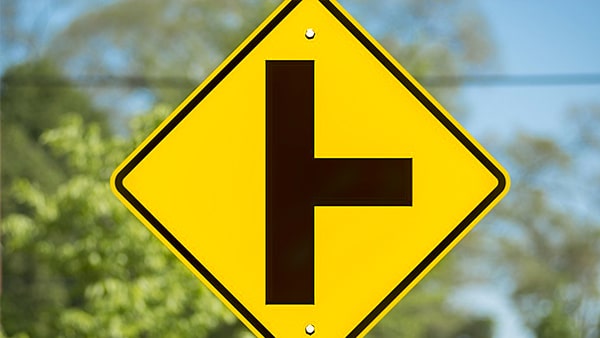
A yellow diamond sign showing a short road joining from the right warns of:

This sign means:
  1. A A mandatory right turn
  2. B A side road entering from the right
  3. C A straight-ahead-only lane
  4. D A prohibited right turn

Correct answer: B – A side road entering from the right

The symbol shows that a side road joins the main roadway from the right. Yellow warning signs alert drivers to roadway conditions or potential conflicts ahead rather than imposing a mandatory movement. Watch for vehicles that may enter or leave the traffic flow near the intersection.

Source: North Dakota Noncommercial Driver License Manual — “Signs, Signals, and Road Markings,” “Warning Signs”