North Dakota Permit Test Practice 6

4.8 out of 5 (144 votes)
80% Passing score
20 Questions
4 Mistakes allowed
This North Dakota permit practice test gives you a more useful kind of review than just rereading the driver manual and hoping the details stay put. It is aimed at the Class D learner permit knowledge test, the Rules of the Road exam for a noncommercial driver license, and it keeps the focus where it belongs: traffic laws, signs, signals, road markings, safe driving decisions, impaired-driving rules, sharing the road, emergencies, and the North Dakota-specific rules that can quietly decide whether you pass or miss by a few questions. This sixth ND permit practice test spends extra time on turn signals, which is fair, because signaling is one of those skills people treat as automatic before they have really learned when it matters. Lane changes, turns from the correct position, parking maneuvers, merging, rural highways, four-way stops with impatient drivers nearby — your signal is not decoration. It is how you tell everyone else what you are about to do before your vehicle starts doing it. That sounds obvious, and maybe it is, but obvious things are exactly what permit tests like to dress up in careful wording. The real North Dakota Class D knowledge test is commonly reported as 25 multiple-choice questions, with 20 correct answers needed to pass, or 80%. This practice permit test keeps that exam mindset close, using multiple-choice and true/false questions so you can get comfortable reading the full question, catching small wording differences, and choosing the best answer without rushing. You can retake it as often as needed, which is not a loophole or a trick; it is simply how studying tends to work when the subject has lots of small rules that blur together. Before North Dakota issues a learner permit, applicants must pass the knowledge test and a vision screening. Some people take the test at a Driver License office, while others may use the online KnowToDrive option. Younger drivers have a longer road ahead after that. Applicants ages 14–15 generally need parent or guardian sponsorship and must hold the permit for 12 months or until age 16, whichever comes first, though never less than 6 months. Drivers ages 16–17 usually hold it for 6 months or until age 18. So this North Dakota DMV practice test is not just test prep in the narrow sense. It is the first clean pass through rules you will be expected to understand long after the screen says you passed.
FREE DMV Practice Test App
Study for your North Dakota permit test or driver’s license with the NextDoorDriving app. 700+ DMV questions and answers, 100% free!
Download on the App Store

Sample North Dakota Permit Test Questions

Question 1

What should you do before entering a sharp curve?

When you approach a sharp curve in the road, you should:
  1. A Wait until you are in the curve before braking hard
  2. B Reduce your speed before entering the curve
  3. C Accelerate into the curve and brake while leaving it
  4. D Maintain acceleration throughout the curve

Correct answer: B – Reduce your speed before entering the curve

Warning signs for curves and turns are intended to give drivers time to reduce speed before entering them. Slowing beforehand helps the driver negotiate the change in direction with better control. An advisory speed plaque may be posted with the warning sign to show the recommended maximum speed for the curve.

Source: North Dakota Noncommercial Driver License Manual — “Warning Signs”
Question 2

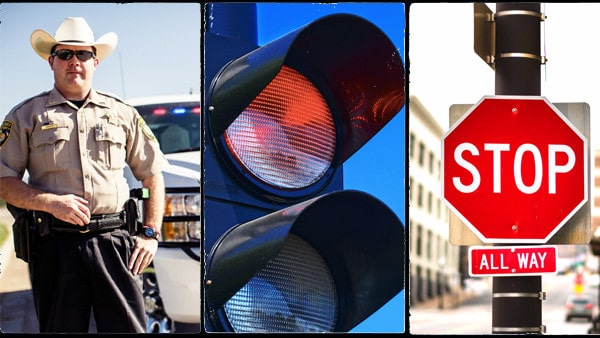
In North Dakota, which instruction takes precedence over the listed traffic-control devices?

Which of the following must you obey over the other three?
  1. A A steady red traffic light
  2. B A lawful direction from a police officer
  3. C A stop sign
  4. D A flashing red signal

Correct answer: B – A lawful direction from a police officer

Drivers must obey official traffic-control devices unless a traffic or police officer directs them otherwise. A person may not willfully refuse a lawful traffic direction from a police officer or an authorized firefighter. Follow the officer’s direction even when it differs from a traffic light or sign.

Source: N.D.C.C. § 39-10-02 – Obedience to Police Officer or Firefighter, N.D.C.C. § 39-10-04(1) – Obedience to and Required Traffic-Control Devices

Question 3

Why is following another vehicle too closely dangerous?

Following closely behind another vehicle:
  1. A It keeps you in the other driver’s blind spot
  2. B It may leave too little time to stop if traffic ahead slows suddenly
  3. C It always reduces fuel consumption
  4. D It makes passing vehicles easier to see

Correct answer: B – It may leave too little time to stop if traffic ahead slows suddenly

A driver may not follow another vehicle more closely than is reasonable and prudent for the speed, traffic, and roadway conditions. The manual explains that following too closely can leave insufficient time to stop in an emergency. Use at least a three-second following interval in ordinary conditions and increase it when conditions require more space.

Source: N.D.C.C. § 39-10-18(1) – Following Too Closely, North Dakota Noncommercial Driver License Manual — “Following and Stopping Distances”

Question 4

A yellow diamond warning sign with a black arrow bending sharply to the right indicates:

When you see this sign, it means:
  1. A An obstruction is lying in the roadway
  2. B Traffic will enter from the right
  3. C A sharp right turn is ahead
  4. D A merging lane begins ahead

Correct answer: C – A sharp right turn is ahead

Yellow diamond signs warn of potentially hazardous roadway conditions ahead. An arrow that bends sharply to the right indicates an upcoming right turn, allowing the driver time to reduce speed before reaching it. An advisory speed plaque may accompany the warning sign and show the recommended speed for negotiating the turn.

Source: North Dakota Noncommercial Driver License Manual — “Warning Signs”
Question 5

An approaching vehicle does not dim its high beams at night. Where should you direct your eyes?

  1. A Directly at the approaching headlights
  2. B Toward the right edge of the road
  3. C Straight at the centerline
  4. D Toward the left edge of the roadway

Correct answer: B – Toward the right edge of the road

The North Dakota manual advises looking toward the right edge of the road when an approaching driver fails to dim high beams. This reduces the risk of being temporarily blinded while helping you track your position. Avoid staring at the headlights, and allow time for your eyes to readjust after the vehicle passes.

Source: North Dakota Noncommercial Driver License Manual — “Night Driving”

Question 6

When driving at night on a poorly lighted road, how should you select your speed?

When driving in traffic at night on a dimly lit street, you should:
  1. A Drive slowly enough to stop within the distance illuminated by your headlights
  2. B Use high beams regardless of nearby traffic
  3. C Keep the instrument panel at maximum brightness
  4. D Operate the hazard lights continuously

Correct answer: A – Drive slowly enough to stop within the distance illuminated by your headlights

At night, drivers can see only as far as their headlights illuminate, reducing the time available to respond to hazards. The manual directs drivers to slow down enough to stop within the distance covered by their headlights. This principle applies even when an unlighted or poorly lighted vehicle or object is ahead.

Source: North Dakota Noncommercial Driver License Manual — “Night Driving”