


North Dakota Permit Test Practice 7

4.7 out of 5 (125 votes)
80% Passing score
20 Questions
4 Mistakes allowed
This ND DMV permit practice test gives you a cleaner way to study for the North Dakota Class D knowledge test. This practice test is 20 questions long, and you need 16 correct answers to pass, which makes it close enough to be useful without turning every missed answer into a small personal crisis. The better part, really, is the instant feedback. When you miss something, you see why, right then, before your brain has already moved on to the next guess. The practice test covers the material North Dakota drivers are expected to know: road signs, right-of-way rules, safe driving habits, insurance responsibility, speed limits, and the kind of basic traffic law that sounds simple when you read it in the manual but becomes less simple once it is tucked inside a multiple-choice answer. And, yes, there are state-specific details worth paying attention to. North Dakota lets applicants get a Class D instruction permit at age 14, but younger applicants do not just stroll through the process on their own. Drivers under 18 need parent or legal guardian approval and sponsorship. Applicants ages 14 and 15 must hold the permit for 12 months or until they turn 16, whichever comes first, though never less than 6 months. For ages 16 and 17, the holding period is 6 months or until age 18, whichever comes first. The official process has a few practical pieces that are easy to blur together, so it helps to know them while you study. Permit applicants must pass the knowledge test and a vision screening. Adults who are getting licensed for the first time still need the permit step, the vision screening, and the road test before becoming fully licensed. North Dakota offers the knowledge test in person at a Driver License office and online through KnowToDrive, but passing online does not mean the permit simply appears. You still need to visit a Driver License office to receive the physical permit. Use this ND permit test practice with the driver manual, not as a replacement for it. The manual gives you the rules in full; the practice permit test shows whether you can recognize those rules when the wording is a little dry, a little official, and sometimes more particular than expected. It is also a good place to catch weak spots before you are paying fees, bringing identity documents, proving residency, showing Social Security documentation, and trying to keep all of that paperwork straight at the same time.
FREE DMV Practice Test App
Study for your North Dakota permit test or driver’s license with the NextDoorDriving app. 700+ DMV questions and answers, 100% free!
Download on the App Store

Sample North Dakota Permit Test Questions

Question 1

If you are moving slower than normal traffic in the left lane of an Interstate, what should you do?

  1. A Move to an available right lane when the lane change is safe
  2. B Remain left until at least five vehicles are behind you
  3. C Stay left whenever you are driving at the speed limit
  4. D Turn on your hazard lights and require traffic to pass on the right

Correct answer: A – Move to an available right lane when the lane change is safe

North Dakota requires a vehicle traveling below the normal speed of traffic to use the available right-hand lane, except when passing or preparing for a left turn. The driver must verify that any lane change can be completed safely. The state manual also instructs drivers traveling slowly on the Interstate to keep right.

Source: N.D.C.C. § 39-10-08 – Drive on Right Side of Roadway—Exceptions, N.D.C.C. § 39-10-17 – Driving on Roadways Laned for Traffic, North Dakota Noncommercial Driver License Manual — “Rules of the Road,” “Interstate Driving”
Question 2

Which result is not an effect of alcohol consumption?

  1. A Slower reactions
  2. B Impaired vision and judgment
  3. C Difficulty concentrating
  4. D Improved concentration and safer decisions

Correct answer: D – Improved concentration and safer decisions

Alcohol slows reactions, impairs vision, interferes with concentration, and dulls judgment. It also depresses the central nervous system and slows brain activity. Rather than improving a driver’s decisions, alcohol may create a false sense of confidence and make dangerous situations seem less serious.

Source: North Dakota Noncommercial Driver License Manual — “Drinking, Drugs, and Driving,” “Effects of Alcohol”

Question 3

What is a primary safety benefit of wearing a seat belt correctly?

  1. A It prevents every collision
  2. B It reduces the chance of death or injury in a crash
  3. C It prevents the driver from operating the controls
  4. D It increases the chance of being ejected

Correct answer: B – It reduces the chance of death or injury in a crash

Seat belts help hold occupants in place and reduce the chance of death or injury during a crash. They should be adjusted snugly, with the lap belt low across the hips and the shoulder belt across the chest and collarbone. North Dakota law generally requires each occupant of a qualifying passenger vehicle to wear a properly adjusted and fastened belt.

Source: N.D.C.C. § 39-21-41.4 – Use of Safety Belts Required in Certain Motor Vehicles—Enforcement—Evidence, North Dakota Noncommercial Driver License Manual — “Seat Belts,” “Wear Your Belt Correctly”

Question 4

Traffic is backed up beyond an intersection. When may you enter the intersection?

  1. A As soon as your light turns green
  2. B After moving close to the vehicle ahead
  3. C Only when enough space exists to clear the intersection
  4. D After sounding your horn to make traffic move

Correct answer: C – Only when enough space exists to clear the intersection

A driver may not enter an intersection unless enough space is available on the other side to accommodate the vehicle without obstructing traffic or pedestrians. This requirement applies even when a traffic signal gives permission to proceed. Wait before the intersection until the traffic ahead leaves sufficient room for your vehicle.

Source: N.D.C.C. § 39-10-68 – Stop When Traffic Obstructed

Question 5

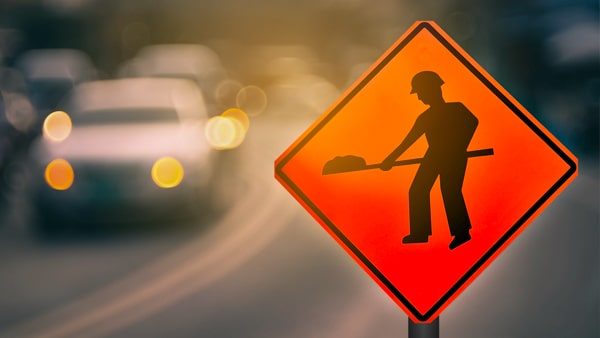
An orange diamond-shaped sign showing a worker with a shovel warns that:

This sign means that:
  1. A A volunteer cleanup area is ahead
  2. B Road workers may be in or near the roadway ahead
  3. C A playground is beside the highway
  4. D A pedestrian crossing is ahead

Correct answer: B – Road workers may be in or near the roadway ahead

Orange signs and traffic-control devices identify highway construction or maintenance areas. A worker symbol warns that road crews may be working close to moving traffic. Reduce speed, watch for changing road conditions, and follow signs or directions from flagpersons as you travel through the work zone.

Source: North Dakota Noncommercial Driver License Manual — “Signs, Signals, and Road Markings,” “Construction and Maintenance Devices”, North Dakota Noncommercial Driver License Manual — “Signs, Signals, and Road Markings,” “Work Zone Safety Tips”

Question 6

Under North Dakota law, how far before a turn must you signal continuously?

When you are planning to make a turn, you should activate your turn signals:
  1. A Only while another vehicle is following
  2. B Beginning at the edge of the intersection
  3. C For at least the final 100 feet before the turn
  4. D For the final two vehicle lengths

Correct answer: C – For at least the final 100 feet before the turn

A turn signal must be given continuously for at least the last 100 feet traveled before turning. The same minimum distance applies before moving right or left or changing lanes. Signaling communicates your intended movement, but the movement still may not begin unless it can be completed with reasonable safety.

Source: N.D.C.C. § 39-10-38.1-.2 – Turning Movements and Required Signals, North Dakota Noncommercial Driver License Manual — “Rules of the Road,” “Turning”