North Dakota DMV Practice Test 9

4.9 out of 5 (103 votes)
80% Passing score
20 Questions
4 Mistakes allowed
This North Dakota permit practice test focuses on one of the rules every new driver needs to get right: school bus safety. It sounds narrow, but it is exactly the kind of topic that shows up in the broader North Dakota Class D learner permit knowledge test — and, more importantly, it is one of those rules that matters instantly when you are actually driving near a school or through a quiet neighborhood where a bus suddenly stops and everything gets very serious.   The official North Dakota permit test is based on the North Dakota Noncommercial Driver License Manual, which covers traffic laws, road signs, signals, pavement markings, safe driving practices, alcohol and drug laws, vehicle control, emergencies, sharing the road, pedestrian safety, and other North Dakota-specific rules. Before a learner permit is issued, applicants must pass the knowledge test and a vision screening. The knowledge test can be taken at a North Dakota Driver License office or online through the KnowToDrive program. This ND DMV permit practice test gives you a focused way to review school bus stop laws while still building the kind of rule-based thinking you need for the real exam. The actual Class D knowledge test is commonly reported as 25 multiple-choice questions, with 20 correct answers needed to pass, or 80%. This practice test uses a 20-question format, so you will need 16 correct answers to pass — same 80% benchmark, just in a shorter, more concentrated setup. Expect questions about when to stop, when traffic in the opposite direction must stop, what drivers should watch for around loading and unloading zones, and what can happen when someone ignores the law. It is not just “memorize the bus rule and move on,” although, yes, memorizing the rule helps. The better approach is to recognize the situation before it becomes a mistake. You can take this North Dakota practice permit test as many times as you need. Use it as DMV driving test practice, as a quick review before the written test, or as a way to clean up one topic that tends to get overlooked until it shows up on test day — which is not the ideal time to be figuring it out.
FREE DMV Practice Test App
Study for your North Dakota permit test or driver’s license with the NextDoorDriving app. 700+ DMV questions and answers, 100% free!
Download on the App Store

Sample North Dakota Permit Test Questions

Question 1

At night, an approaching driver does not lower the vehicle’s high beams. Where should you direct your gaze?
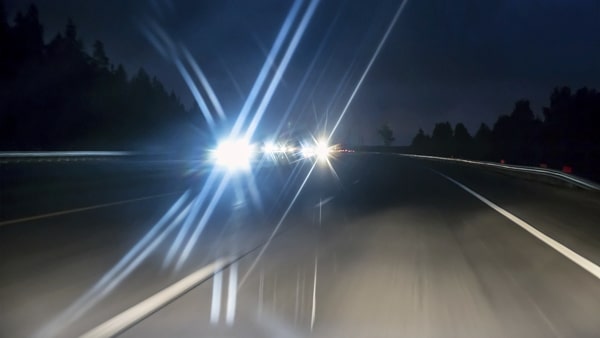
At night, if an oncoming vehicle fails to dim its high-beams, look:
  1. A Toward the roadway centerline
  2. B Toward the right edge of the road
  3. C Toward the left edge of the road
  4. D Directly at the approaching headlights

Correct answer: B – Toward the right edge of the road

Looking directly into bright headlights can temporarily reduce your ability to see. Use the right edge of the road as a visual guide until the approaching vehicle passes. Your eyes will need time to readjust after exposure to the glare.

Source: North Dakota Noncommercial Driver License Manual — “Night Driving”

Question 2

A yellow diamond sign displays a black arrow making a sharp right-angle turn. What does it warn you about?

When you see this black and yellow sign, it means:
  1. A A one-way street begins to the right
  2. B A construction detour goes to the right
  3. C The road turns sharply to the right ahead
  4. D A side road enters from the right

Correct answer: C – The road turns sharply to the right ahead

Yellow diamond signs warn of potentially hazardous conditions ahead. A right-angle arrow indicates a sharp turn rather than a gradual curve or side road. Reduce speed before entering the turn and follow any posted advisory-speed sign.

Source: North Dakota Noncommercial Driver License Manual — “Warning Signs”

Question 3

On a North Dakota road posted at 45 mph, surrounding traffic is traveling faster. What is the highest lawful speed shown by the sign?

  1. A The speed of surrounding traffic
  2. B Any speed between 45 and 50 mph
  3. C 45 mph

Correct answer: C – 45 mph

A posted speed limit is the maximum speed permitted under ideal conditions. Faster surrounding traffic does not authorize you to exceed the 45 mph limit. Existing hazards, traffic, weather, or roadway conditions may require you to drive below the posted limit.

Source: N.D.C.C. § 39-09-01(1) – Basic Rule – Penalty for Violation, N.D.C.C. § 39-09-02 – Speed Limitations, North Dakota Noncommercial Driver License Manual — “Speed Limits”

Question 4

When double solid yellow centerlines separate opposing traffic, when may you cross them?

  1. A When making a lawful left turn into a driveway or private road
  2. B Whenever the roadway appears to be one-way
  3. C Never, under any circumstances
  4. D To pass a slower vehicle

Correct answer: A – When making a lawful left turn into a driveway or private road

Double solid yellow lines prohibit passing in either direction. North Dakota permits crossing a marked no-passing centerline when turning left into or from an alley, private road, or driveway. Check for approaching traffic, signal, and make the turn only when it can be completed safely.

Source: N.D.C.C. § 39-10-15(2)–(3) – No-Passing Zones, North Dakota Noncommercial Driver License Manual — “Pavement Markings”

Question 5

Driving faster than surrounding traffic and repeatedly changing lanes to get ahead is:

  1. A A safer way to reach your destination quickly
  2. B Aggressive, high-risk driving behavior
  3. C A recommended way to reduce congestion
  4. D Permitted only on controlled-access highways

Correct answer: B – Aggressive, high-risk driving behavior

The driver manual identifies constant rushing and lane jumping to get ahead as aggressive-driving behaviors. Speeding reduces the time available to recognize and respond to hazards, while repeated lane changes create additional conflicts with other vehicles. Maintain a lawful speed and change lanes only when necessary and safe.

Source: North Dakota Noncommercial Driver License Manual — “Aggressive Driving”, North Dakota Noncommercial Driver License Manual — “Lane Changes”

Question 6

When parking uphill beside a curb, which way should you turn the front wheels?

When parking your vehicle facing uphill with a curb, you should point your front wheels:
  1. A Toward the curb
  2. B Away from the curb
  3. C Either direction
  4. D Straight ahead

Correct answer: B – Away from the curb

For uphill parking with a curb, turn the front wheels away from the curb. This differs from downhill parking, where the wheels should point toward the curb. When parking uphill without a curb, turn the wheels toward the shoulder.

Source: North Dakota Noncommercial Driver License Manual — “Parking on a Hill”