


North Dakota Road Signs Test 2

4.9 out of 5 (101 votes)
80% Passing score
20 Questions
4 Mistakes allowed
This North Dakota road signs practice test is built for one very specific job: helping you recognize the signs, signals, and markings that can show up on the official Class D knowledge test. And, honestly, that matters more than some new drivers realize at first. Road signs are not tested in a separate road-sign-only exam in North Dakota. They are folded into the same 25-question knowledge test, and the same rule applies across the whole thing: miss more than 5 questions and you do not pass. So a sign question is not filler. It counts. This practice test includes 20 multiple-choice questions focused on the road sign material drivers are expected to know before getting licensed. You will work through regulatory signs, warning signs, guide signs, traffic signals, pavement markings, railroad crossings, work-zone signs, and school or pedestrian signs. That sounds like a tidy little group of topics when it is written out like that, but on the road — and, frankly, on the test — they start to overlap. A lane marking may tell you what a sign does not. A work-zone sign may change what you thought the normal rule was. A railroad crossing sign is simple, until you have to decide what action the driver is actually supposed to take. The test is untimed, which is the better way to study this material. You can slow down, look at the sign shape, the color, the symbol, the wording, and the instruction behind it. Not just “what is this called,” but what it is telling you to do. That distinction matters on rural highways, through Fargo or Bismarck intersections, near schools, around construction, and during the kind of winter driving where a warning sign deserves your full attention, not a quick glance and a shrug. You can retake this ND DMV road signs practice test as many times as you need, and it works across devices, so the studying can be done in smaller, more manageable rounds. Use it to get familiar with the sign topics from the North Dakota driver manual, sharpen the details you keep mixing up, and walk into the ND permit test with a steadier, more practical understanding of what those signs are asking you to do.
FREE DMV Practice Test App
Study for your North Dakota permit test or driver’s license with the NextDoorDriving app. 700+ DMV questions and answers, 100% free!
Download on the App Store

Sample North Dakota Permit Test Questions

Question 1

Before moving in response to a green arrow, what must a driver do?

  1. A Check only the rearview mirror
  2. B Wait five seconds before entering the intersection
  3. C Yield to lawful traffic and pedestrians still using the intersection or crosswalk
  4. D Yield to vehicles but not to pedestrians

Correct answer: C – Yield to lawful traffic and pedestrians still using the intersection or crosswalk

A green arrow permits cautious entry only for the movement indicated by the arrow. The driver must still yield to pedestrians lawfully within an adjacent crosswalk and to other traffic lawfully using the intersection. The arrow does not erase those right-of-way duties.

Source: N.D.C.C. § 39-10-05(1)(b) – Traffic-control signal legend, North Dakota Noncommercial Driver License Manual — “Signs, Signals, and Road Markings,” “Traffic Signals”
Question 2

Before crossing a broken lane line to change lanes, what must you verify?

  1. A The movement can be made safely without interfering with traffic
  2. B You are turning left into a driveway
  3. C The vehicle ahead is disabled
  4. D You are passing on the right side of a one-way street

Correct answer: A – The movement can be made safely without interfering with traffic

North Dakota law requires a vehicle to remain within one lane and not move from it until the driver has determined that the movement can be made safely. The manual also directs drivers to check mirrors, look over the shoulder for blind spots, and signal. A broken line permits crossing, but safety remains a prerequisite.

Source: N.D.C.C. § 39-10-17(1) – Driving on roadways laned for traffic, North Dakota Noncommercial Driver License Manual — “Rules of the Road,” “Lane Changes”

Question 3

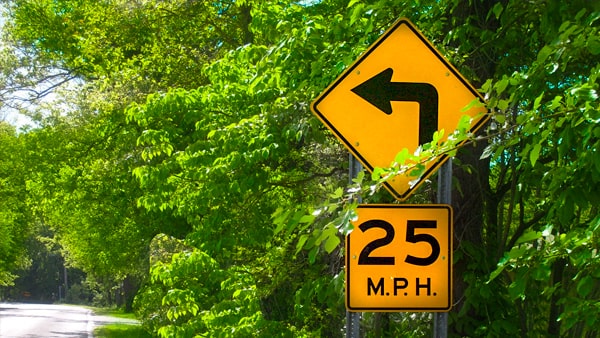
A left-curve warning sign has a 25 MPH advisory plaque below it. What does the combination mean?

This sign means:
  1. A A left curve is ahead; travel at least 25 mph
  2. B A right curve is ahead; travel at least 25 mph
  3. C A right curve is ahead; 25 mph is the maximum recommended speed
  4. D A left curve is ahead; 25 mph is the maximum recommended speed

Correct answer: D – A left curve is ahead; 25 mph is the maximum recommended speed

The curve symbol shows that the roadway bends left, while the advisory plaque gives the maximum recommended speed for negotiating the curve. It is an advisory speed rather than a minimum-speed requirement. The driver must still travel at a reasonable, prudent, and appropriate speed for the curve and existing weather or roadway conditions.

Source: N.D.C.C. § 39-09-01(1) – Basic rule - Penalty for violation, North Dakota Noncommercial Driver License Manual — “Signs, Signals, and Road Markings,” “Warning Signs”

Question 4

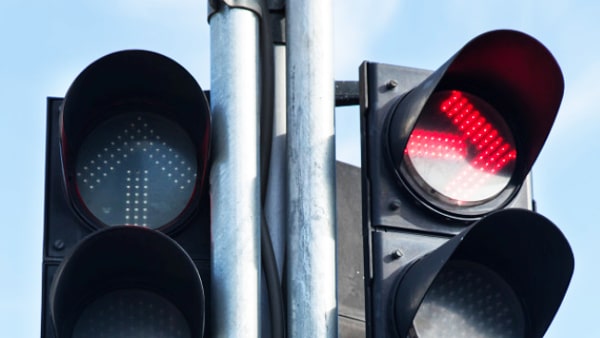
A steady red arrow points right, and a NO TURN ON RED sign is posted. When may you turn right?

A red arrow pointing to the right on a traffic light means you may:
  1. A After stopping whenever the roadway appears clear
  2. B Only after a signal permits the right turn
  3. C After slowing and checking for traffic
  4. D Whenever vehicles behind you are being delayed

Correct answer: B – Only after a signal permits the right turn

Under North Dakota law, a steady red arrow requires a stop. The state's general red-signal exception can permit a right turn after stopping unless a sign prohibits the turn. Because a NO TURN ON RED sign is posted in this situation, remain stopped until a signal permits the right turn.

Source: N.D.C.C. § 39-10-05(3)(b)-(c) – Traffic-control signal legend, North Dakota Noncommercial Driver License Manual — “Signs, Signals, and Road Markings,” “Regulatory Signs”

Question 5

What does a flashing yellow traffic signal indicate?

  1. A Traffic is merging ahead
  2. B Proceed with caution
  3. C A pedestrian crossing is ahead
  4. D Come to a complete stop

Correct answer: B – Proceed with caution

A flashing yellow light is a caution indication. A driver may proceed through the intersection or past the signal only with caution. A complete stop is required for a flashing red indication, not for a flashing yellow indication.

Source: N.D.C.C. § 39-10-07(1)(b) – Flashing signals, North Dakota Noncommercial Driver License Manual — “Signs, Signals, and Road Markings,” “Flashing Indications”

Question 6

What does a steady yellow traffic signal tell you?

  1. A Your movement is protected
  2. B Treat the signal as a yield sign
  3. C The green movement is ending and a red signal will follow
  4. D Treat the signal as a stop sign

Correct answer: C – The green movement is ending and a red signal will follow

North Dakota law defines a steady yellow signal as a warning that the related green movement is ending or that a red indication will appear immediately afterward. It is not a new green indication or a stop-sign signal. Recognize the transition and respond with appropriate caution.

Source: N.D.C.C. § 39-10-05(2)(a) – Traffic-control signal legend, North Dakota Noncommercial Driver License Manual — “Signs, Signals, and Road Markings,” “Traffic Signals”