


North Dakota DMV Sign Test 3

4.9 out of 5 (86 votes)
80% Passing score
20 Questions
4 Mistakes allowed
This ND road signs test gives you a focused way to study the signs, signals, markings, and roadway cues that North Dakota actually expects you to know for the Class D knowledge examination. Road signs are not treated as some separate bonus section that you can vaguely remember from drivers ed and hope for the best. They are part of the official 25-question knowledge test, and they count toward the same limit: miss more than 5 questions overall, and that attempt is done. This practice test includes 20 questions, with 16 correct answers needed to pass. The point is not just to spot a stop sign because it has eight sides — although, yes, you should absolutely know that without needing a dramatic pause. The test gets into the sign categories that show up in real North Dakota driving: regulatory signs, warning signs, guide signs, traffic signals, pavement markings, railroad crossings, work-zone signs, and school or pedestrian signs. Some of it feels obvious when you read it slowly. On the road, especially around construction, rural intersections, school zones, or a railroad crossing that appears with very little ceremony, “obvious” needs to become automatic. It also fits neatly into the bigger permit process. North Dakota allows a Class D instruction permit at age 14, and younger applicants have extra steps attached. Drivers under 16 need driver education before the road test, and 14- and 15-year-old drivers must complete supervised practice requirements before moving toward a restricted or regular license. While driving on a permit, the supervising driver has to be properly licensed, at least 18, experienced, and seated beside the permit holder. Also, electronic communication devices are off-limits for permit holders and licensed drivers under 18, which is one of those rules that sounds simple until someone tries to “just check one thing.” Don’t. Use this ND practice permit test as a sign-specific readiness check before the real DMV permit test, or as a cleaner review if the road sign chapter is the part of the manual you keep skimming because the pictures look familiar. Familiar is not the same as test-ready. This road signs practice test helps turn recognition into quick judgment — the kind you need in Fargo traffic, on open highways, through work zones, near schools, and anywhere North Dakota’s road signs are doing their quiet little job of telling you what comes next.
FREE DMV Practice Test App
Study for your North Dakota permit test or driver’s license with the NextDoorDriving app. 700+ DMV questions and answers, 100% free!
Download on the App Store

Sample North Dakota Permit Test Questions

Question 1

A center lane marked for two-way left turns may be used to:
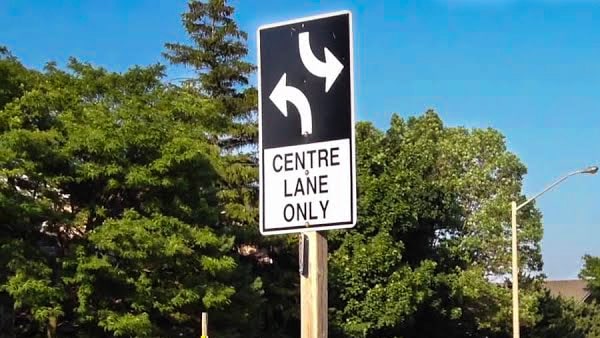
From the center lane, what maneuvers can you perform?
  1. A Prepare for a left turn from either direction
  2. B Continue straight through traffic
  3. C Pass slower vehicles
  4. D Stop or park temporarily

Correct answer: A – Prepare for a left turn from either direction

A marked two-way left-turn lane is reserved for vehicles preparing to turn left from either direction. The official lane-use markings must be obeyed. It is not a through lane, passing lane, or parking area.

Source: N.D.C.C. § 39-10-17(3) – Driving on roadways laned for traffic, North Dakota Noncommercial Driver License Manual — “Two-Way Left Turn Lane”
Question 2

A steady yellow signal warns that which indication will be displayed immediately afterward?

  1. A Flashing yellow
  2. B Steady green
  3. C Steady red
  4. D Flashing red

Correct answer: C – Steady red

North Dakota law defines steady yellow as a warning that the related green movement is ending or that a red indication will appear immediately afterward. Yellow is a transition warning, not the beginning of another green phase. Watch the signal and surrounding traffic carefully.

Source: N.D.C.C. § 39-10-05(2)(a) – Traffic-control signal legend

Question 3

What color lines generally separate lanes carrying traffic in the same direction?

  1. A Yellow
  2. B White
  3. C Red
  4. D Black

Correct answer: B – White

White pavement lines divide lanes in which traffic moves in the same direction. Depending on the location, the white line may be broken or solid. Yellow centerlines are used to separate opposing directions of travel on two-way roadways.

Source: North Dakota Noncommercial Driver License Manual — “Pavement Markings”

Question 4

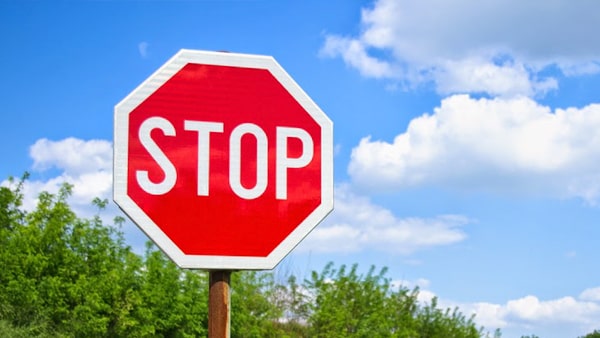
What must you do when approaching an octagonal STOP sign?

When you see this sign, you must:
  1. A Stop at the required location, then yield before entering
  2. B Slow down and proceed without stopping if the road appears clear
  3. C Stop and wait for a green signal
  4. D Stop only when another vehicle is visible

Correct answer: A – Stop at the required location, then yield before entering

Under North Dakota law, stop at the marked stop line or, if there is none, at the nearest point where approaching traffic can be seen before entering the intersection. After stopping, yield to vehicles in or approaching the intersection closely enough to create an immediate hazard. A rolling stop does not satisfy this requirement.

Source: N.D.C.C. § 39-10-24(2) – Stop signs and yield signs

Question 5

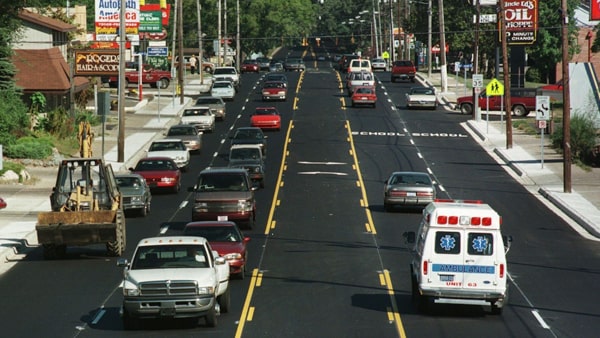
A center lane marked with left-turn arrows for traffic in both directions is intended for:

The center lane in the illustration is used for:
  1. A Regular through travel
  2. B Left-turning vehicles only
  3. C Passing vehicles only
  4. D Emergency vehicles only

Correct answer: B – Left-turning vehicles only

The markings identify a two-way left-turn lane. Drivers traveling in either direction may enter it to prepare for a left turn, but the lane is not intended for through travel or overtaking. Drivers must obey the official lane-use markings.

Source: N.D.C.C. § 39-10-17(3) – Driving on roadways laned for traffic, North Dakota Noncommercial Driver License Manual — “Two-Way Left Turn Lane”

Question 6

If a steady yellow appears after you have entered an intersection, what does the signal indicate?

  1. A An emergency vehicle is about to cross
  2. B All pedestrian movement has ended
  3. C Only right turns are permitted
  4. D The green movement is ending and red will follow immediately

Correct answer: D – The green movement is ending and red will follow immediately

North Dakota law defines steady yellow as a warning that the related green movement is ending or that a red indication will be displayed immediately afterward. Yellow is not a separate right-of-way phase. It alerts drivers to the transition from green to red.

Source: N.D.C.C. § 39-10-05(2)(a) – Traffic-control signal legend