


North Dakota Road Signs Test Simulator

4.8 out of 5 (90 votes)
80% Passing score
25 Questions
5 Mistakes allowed
This North Dakota road signs practice test gives you a focused way to study one of the areas that can quietly cost people points on the Class D knowledge test. The official exam is broader, of course. It covers traffic laws, safe driving habits, impaired-driving rules, emergency situations, sharing the road, vehicle control, and the North Dakota-specific rules tucked into the driver manual. But road signs, signals, and pavement markings are right in the middle of that material, and they are worth practicing separately before you walk into a Driver License office or take the test online through KnowToDrive. The real North Dakota permit test has 25 multiple-choice questions, with an 80% passing score, commonly listed as 20 correct answers. This ND permit test practice session uses 20 multiple-choice questions and asks you to get 16 right, so the standard stays familiar while the focus stays tighter. And yes, that narrower focus matters. Road signs are not just about knowing that red means stop or yellow means caution. You need to recognize regulatory signs, warning signs, guide signs, railroad crossings, work-zone signs, school and pedestrian signs, traffic signals, and pavement markings without having to pause and mentally debate the shape for three seconds longer than you should. Each attempt pulls from a larger question bank, so the test does not lean on one predictable set of answers. That is the useful part, really. You can run through it more than once and keep seeing different combinations, which helps you build actual recognition instead of that flimsy kind of memorization where you remember the second answer was “yield” because it was the second answer last time. Fine for a lazy quiz. Less fine for an actual permit test. Use this North Dakota practice permit test with the official Noncommercial Driver License Manual, not as a replacement for it. Applicants still need to pass the knowledge test and vision screening before a learner permit is issued, and younger drivers have extra licensing steps, including parent or guardian sponsorship, permit holding periods, supervised practice, and driver education rules for applicants under 16. There is a lot wrapped around getting licensed in North Dakota. This road signs test keeps one piece of it direct: study the signs until they look familiar for the right reasons.
FREE DMV Practice Test App
Study for your North Dakota permit test or driver’s license with the NextDoorDriving app. 700+ DMV questions and answers, 100% free!
Download on the App Store

Sample North Dakota Permit Test Questions

Question 1

At an intersection displaying a flashing yellow signal, what should you do?

  1. A Continue at the same speed without slowing
  2. B Come to a complete stop before entering
  3. C Proceed through the intersection only with caution
  4. D Wait until the signal changes to green

Correct answer: C – Proceed through the intersection only with caution

North Dakota law allows a driver to pass a flashing yellow signal only with caution. It differs from a flashing red signal, which requires a stop. A flashing yellow does not require waiting for a green signal, but it does require a cautious approach through the intersection.

Source: N.D.C.C. § 39-10-07(1)(b) – Flashing signals, North Dakota Noncommercial Driver License Manual — “Signs, Signals, and Road Markings,” “Flashing Indications”

Question 2

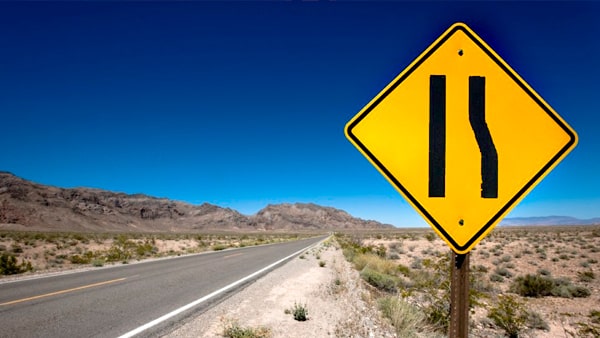
A yellow diamond sign shows the right lane tapering into the left lane. What does it warn you about?

This sign means:
  1. A The right lane ends; merge left safely
  2. B A divided highway begins ahead
  3. C A steep downgrade is ahead
  4. D Trucks may be crossing the roadway

Correct answer: A – The right lane ends; merge left safely

This warning sign indicates that the right lane will end and traffic must move left. Lane-reduction signs give drivers advance notice to move safely into the proper remaining lane. It does not announce a divided highway, hill, or truck crossing.

Source: North Dakota Noncommercial Driver License Manual — “Signs, Signals, and Road Markings,” “Warning Signs”

Question 3

Which centerline color separates traffic traveling in opposite directions?

  1. A White
  2. B Red
  3. C Black
  4. D Yellow

Correct answer: D – Yellow

Yellow centerlines are used on two-lane, two-way roads, where they separate opposing traffic. A broken or solid pattern determines when drivers may cross the line. The color identifies the direction of the traffic streams being separated.

Source: North Dakota Noncommercial Driver License Manual — “Signs, Signals, and Road Markings,” “Pavement Markings”

Question 4

When may you use the left side of a two-way roadway to pass another vehicle?

On a two-way highway, you are allowed to drive on the left half of the roadway when:
  1. A Whenever the centerline consists of two solid yellow lines
  2. B When a solid yellow line is on your side
  3. C When passing is permitted and the left side is clear far enough to pass safely
  4. D When approaching a curve that blocks your view

Correct answer: C – When passing is permitted and the left side is clear far enough to pass safely

North Dakota generally requires vehicles to travel on the right half of a two-way roadway. A lawful pass may use the left side only when it is visible and free of oncoming traffic for enough distance to complete the maneuver safely. Drivers must also obey all posted or marked no-passing zones.

Source: N.D.C.C. § 39-10-08(1)(a) – Drive on right side of roadway - Exceptions, N.D.C.C. § 39-10-13 – Limitations on overtaking on the left, N.D.C.C. § 39-10-15(1)-(2) – No-passing zones

Question 5

A yellow, diamond-shaped traffic sign usually provides what type of information?

  1. A A warning about a possible roadway hazard or condition ahead
  2. B An interstate route number
  3. C The location of a school crossing
  4. D A legally established speed limit

Correct answer: A – A warning about a possible roadway hazard or condition ahead

Warning signs alert drivers to potentially hazardous conditions ahead and generally have yellow backgrounds with black symbols or words. The familiar diamond shape is used for these roadway warnings. Route, school, and speed-limit signs use other standard shapes.

Source: North Dakota Noncommercial Driver License Manual — “Signs, Signals, and Road Markings,” “Warning Signs”

Question 6

The words NO STOPPING are painted on a curb. What restriction does this marking communicate?

  1. A Stopping at that curb is prohibited
  2. B The curb is reserved for commercial vehicles
  3. C The curb is reserved for people with disabilities

Correct answer: A – Stopping at that curb is prohibited

North Dakota law requires a statewide uniform system of traffic-control devices that conforms as closely as possible to the federal MUTCD. The MUTCD provides that curb markings used to convey parking regulations should display legible wording when no sign is present. A curb marked NO STOPPING communicates that stopping is prohibited there.

Source: N.D.C.C. § 39-13-06 – Authority to adopt manual on uniform traffic-control devices, N.D.C.C. § 39-13-07 – Uniform traffic-control devices on all streets and highways, Manual on Uniform Traffic Control Devices, 11th ed. — § 3B.18, “Curb Markings for Parking Regulations”