Ohio Temps Practice Test

4.7 out of 5 (3822 votes)
80% Passing score
20 Questions
4 Mistakes allowed
This Ohio temps practice test is aimed at the exact stage where “I know how to drive” and “I know what the BMV is going to ask me” turn out to be two different things. The official Ohio knowledge test for a Temporary Instruction Permit Identification Card — the TIPIC, because of course it has a longer name — has 40 multiple-choice questions, and you need 30 correct answers to pass. This practice test gives you 20 questions drawn around the same core material, so hitting 16 out of 20 is a strong signal that you’re working in the right range. The topics are not random trivia. They come from the same general territory as the Ohio Driver Manual Digest of Motor Vehicle Laws: traffic signs, road rules, signals, highway control devices, safe driving practices, and the responsibilities that come with holding a permit. Some of it is familiar. Some of it is the kind of detail people skim over once, feel fine about, and then suddenly wish they had reviewed more carefully. Things like who must be seated beside you while you drive on a TIPIC, when you must carry the permit, what restrictions apply by age, and how Ohio treats road sign questions as part of the main knowledge test rather than a separate little exam off in its own corner. The real process has a few timing rules worth keeping in your head, too. You can begin the Ohio TIPIC process at 15 years and 6 months. After passing the knowledge test and vision screening, you need to purchase the TIPIC within 60 days at a Deputy Registrar License Agency, or you may have to restart that part of the process. If you fail the knowledge test, Ohio makes you wait one day before retesting. In-person testing allows unlimited attempts, one per day; online testing is tighter, with two attempts in a six-month period. And then, because Ohio licensing is not just one test and a handshake, younger drivers have more to finish after the permit. Drivers under 21 need driver education, behind-the-wheel training, and 50 supervised driving hours, including 10 at night, before licensing. This Ohio BMV practice test will not replace any of that — unfortunately, no shortcut hiding here — but it does give you a clean, focused way to check whether the rule knowledge is actually sticking before the official permit test asks for it.
FREE DMV Practice Test App
Study for your Ohio permit test or driver’s license with the NextDoorDriving app. 700+ DMV questions and answers, 100% free!
Download on the App Store

Sample Ohio Permit Test Questions

Question 1

When securing an automatic-transmission vehicle on a hill, which steps should you take?

  1. A. Leave the transmission in Neutral
  2. B. Shift to Park and set the parking brake
  3. C. Rely only on the transmission’s Park setting
  4. D. Leave the engine running

Correct answer: B. – Shift to Park and set the parking brake

When parking on a hill or grade, shift an automatic transmission from Drive to Park and set the parking brake. The driver manual also directs motorists to turn the front wheels toward the curbside of the road and switch off the engine. These steps help secure the vehicle before it is left unattended.

Source: Ohio Driver Manual — Section 5, “Parking on a Hill or Grade”
Question 2

A white rectangular sign shows a black arrow bending downward to the right of a traffic island. What does it direct drivers to do?

  1. A. Prepare for the end of a divided highway
  2. B. Keep to the right of the island
  3. C. Make a sharp left turn
  4. D. Merge because the right lane ends

Correct answer: B. – Keep to the right of the island

This is a Keep Right sign. It directs traffic to travel to the right of an island, divider, median nose, or similar obstruction. It is a regulatory instruction, not a warning that a lane ends or that the divided highway is ending.

Source: Ohio Driver Manual — Section 4, “Traffic Signs”

Question 3

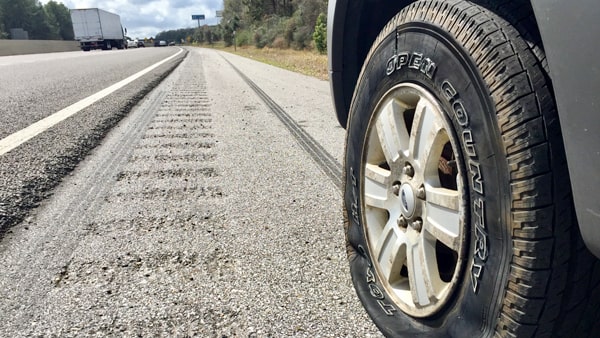
After a tire blows out on a highway, where should you stop to seek assistance?

Where should you park when you need help after your tire suddenly deflates while driving on a highway?
  1. A. In the right travel lane
  2. B. Off the traveled pavement in a safe location
  3. C. Where the vehicle is visible for 200 feet only from the front
  4. D. Where the vehicle is visible for 300 feet only from the rear

Correct answer: B. – Off the traveled pavement in a safe location

The Ohio Driver Manual instructs drivers after a tire blowout to slow gradually, pull off the road in a safe place, and activate the hazard lights. State law generally requires a vehicle stopped on a highway outside a business or residence district to be off the paved or main-traveled portion when practicable. A disabled vehicle that cannot be moved is excepted from that requirement.

Source: Ohio Rev. Code § 4511.66(A) – Prohibition against parking on highways, Ohio Driver Manual — § 10, “Vehicle Malfunctions”: “Tire Blowout” and “Vehicle Breakdown”

Question 4

How does alcohol affect the abilities needed for safe driving?

What does alcohol do to your driving skills and judgment?
  1. A. It improves vehicle control but weakens decision-making
  2. B. It weakens both driving performance and judgment
  3. C. It has no meaningful effect on either ability
  4. D. It slows physical reactions but leaves judgment unchanged

Correct answer: B. – It weakens both driving performance and judgment

Alcohol can blur vision and reduce the ability to focus or judge distance, speed, and vehicle movement. It also slows information processing and reaction time. Judgment suffers because the driver’s ability to perceive surroundings and make quick decisions is reduced.

Source: Ohio Driver Manual — § 3, “Alcohol, Drugs, and Driving”

Question 5

Your signal turns green, but stopped vehicles leave no room for you beyond the intersection. What should you do?

  1. A. Enter and wait inside the intersection
  2. B. Drive around the stopped vehicles
  3. C. Remain behind the intersection until enough space opens
  4. D. Enter because the green signal gives you priority

Correct answer: C. – Remain behind the intersection until enough space opens

Ohio law prohibits entering an intersection unless sufficient space exists on the other side for your vehicle without obstructing others. This rule applies even when a traffic signal indicates that you may proceed. Wait behind the intersection until your vehicle can pass through without becoming an obstruction.

Source: Ohio Rev. Code § 4511.712(A) – Obstructing intersection

Question 6

Which method should you use while backing a vehicle?

When backing up your car, you should:
  1. A. Watch only the rearview and side mirrors
  2. B. Look directly through the rear window, use the mirrors, and move slowly
  3. C. Rely only on the backup camera
  4. D. Look only through the driver-side window

Correct answer: B. – Look directly through the rear window, use the mirrors, and move slowly

Turn your body and look directly through the rear window while backing. Use the mirrors and backup camera as additional aids, but neither may show the entire area immediately behind the vehicle. Reverse slowly and continue checking behind you, with quick checks to the front and sides when turning.

Source: Ohio Driver Manual — § 5, “Backing Up”