


Ohio Permit Practice Test 3

4.8 out of 5 (1862 votes)
80% Passing score
20 Questions
4 Mistakes allowed
This Ohio permit practice test gives new drivers a practical way to study the rules they are actually expected to know for the BMV exam, not just the broad “be safe out there” ideas everyone already agrees with. It includes 20 questions, with an 80% passing score, so you will need at least 16 correct answers to pass. That is a useful target because it gives you a clear read on whether you understand the material well enough—or whether you are still guessing your way through parts of it, which, frankly, happens more often than people admit. A big part of this Ohio learner’s permit practice test is distracted driving, especially Ohio’s rules on mobile electronic devices. New drivers need to know that TIPIC holders are not allowed to use a mobile electronic device while driving, and the same restriction continues for drivers under 18 with a probationary license. It is one of those rules that sounds simple, almost too simple, but Ohio treats it as part of the basic safety standard for young drivers. Phones, messages, quick checks, all of it—leave it alone while the vehicle is being operated. This test also fits into the larger Ohio TIPIC process. You can begin that process at 15 years and 6 months old, but a Temporary Instruction Permit Identification Card comes with supervision rules that matter. TIPIC holders must carry the permit while driving, have the required licensed adult in the front passenger seat, make sure everyone is wearing a safety belt, and keep the number of occupants within the number of installed safety belts. Under 16, the supervising adult rules are tighter; at 16 and 17, there is more flexibility during most hours, although midnight to 6 a.m. brings stricter supervision again. For drivers under 18, moving from a TIPIC to a probationary license means holding the permit for at least six months, completing driver education, logging 50 supervised driving hours, and making sure 10 of those hours happen at night. The practice test does not replace any of that, of course. Still, it gives the legal details somewhere to land in your memory instead of floating around as half-remembered requirements. Since you can retake this Ohio temps practice test as often as needed, use it that way. Repeat it, miss a few, notice the pattern, then tighten up. That is how the material starts to stick.
FREE DMV Practice Test App
Study for your Ohio permit test or driver’s license with the NextDoorDriving app. 700+ DMV questions and answers, 100% free!
Download on the App Store

Sample Ohio Permit Test Questions

Question 1

Under Ohio law, when headlights are required, may a driver use only the parking lights for illumination?

  1. A Yes, during the first 30 minutes after sunset
  2. B No, parking lights alone are not permitted
  3. C Yes, whenever fog reduces visibility
  4. D Yes, whenever the windshield wipers are operating

Correct answer: B – No, parking lights alone are not permitted

A motor vehicle may not be operated using only its parking lights during times when legally required vehicle lighting must be displayed. Those times include sunset to sunrise, poor visibility that prevents objects from being discerned at 1,000 feet, and use of windshield wipers because of precipitation. A violation is a minor misdemeanor.

Source: Ohio Rev. Code § 4513.03 — Time for lighted lights on motor vehicles
Question 2

What should you do at a location marked by a posted NO PARKING sign?

  1. A Park there if you remain behind the wheel
  2. B Obey the restriction and any times or conditions shown on the sign
  3. C Leave the vehicle there for no more than five minutes
  4. D Park there after turning on the emergency flashers

Correct answer: B – Obey the restriction and any times or conditions shown on the sign

Drivers must obey properly placed traffic-control devices, including parking signs. A restriction may prohibit parking entirely or apply only during stated hours or under specified conditions. Read the complete sign and comply with its instructions; remaining in the vehicle or activating emergency flashers does not independently authorize parking.

Source: Ohio Rev. Code § 4511.12 — Obedience to traffic control devices, Ohio Driver Manual — § 5, “No-Parking Zones / Handicapped Spaces”

Question 3

Before leaving an unlocked car unattended on an Ohio public street, what must you do?

  1. A Leave the engine running and set the parking brake
  2. B Stop the engine, lock the ignition, remove the key, and set the parking brake
  3. C Stop the engine but set the parking brake only on a hill
  4. D Leave the engine running if you will return within five minutes

Correct answer: B – Stop the engine, lock the ignition, remove the key, and set the parking brake

Before leaving an unlocked motor vehicle unattended on a public street, the driver must stop the engine, lock the ignition, remove the key, and effectively set the parking brake. If the vehicle is on a grade, its front wheels also must be turned toward the curb or side of the highway. Limited exceptions to the engine and key requirements apply to locked vehicles, residential property, emergency vehicles, and public-safety vehicles.

Source: Ohio Rev. Code § 4511.661(A) — Unattended motor vehicles

Question 4

Which statement about icy or slippery roads is correct?

  1. A Bridges and overpasses may ice before the rest of the roadway
  2. B Shaded highway areas may ice early
  3. C Slippery pavement increases stopping distance and makes turning more difficult
  4. D All of the above

Correct answer: D – All of the above

Bridges, overpasses, and shaded areas may ice before other highway surfaces. On any slippery roadway, tires have less grip, stopping takes longer, and turning without skidding becomes more difficult. Reduce speed at the first sign of snow or ice and increase the space between your vehicle and the vehicle ahead.

Source: Ohio Driver Manual — § 7, “Winter Driving”, Ohio Driver Manual — § 8, “Slippery Roads”

Question 5

When is a driver allowed to operate a vehicle while under the influence of a drug of abuse?

  1. A Whenever the drug was legally purchased
  2. B Whenever the drug was prescribed
  3. C Never merely because the drug is legal or prescribed
  4. D Whenever the driver remains below the speed limit

Correct answer: C – Never merely because the drug is legal or prescribed

Ohio prohibits operating a vehicle while under the influence of a drug of abuse, whether alone or combined with alcohol. Prescription and over-the-counter medicines can impair vision, reaction time, or judgment. A narrow prescription exception applies to certain prohibited drug-concentration charges when the medicine was obtained and taken as directed, but it does not authorize driving while actually impaired.

Source: Ohio Rev. Code § 4511.19(A)(1)(a), (K) — Operating vehicle under the influence of alcohol or drugs - OVI, Ohio Driver Manual — § 6, “Impairing Drugs and Driving”

Question 6

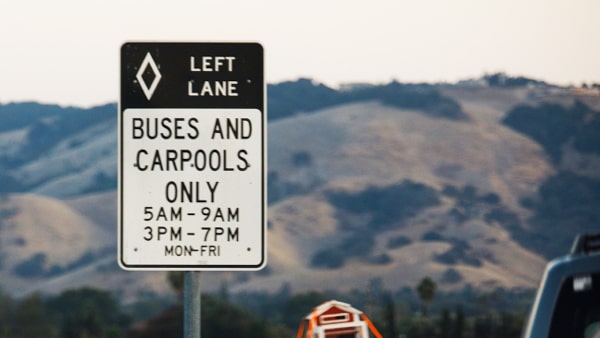
An Ohio lane-use sign states “2+ PERSONS ONLY.” When may your passenger vehicle use that lane?

You can drive in a carpool lane if:
  1. A When the vehicle carries at least two people
  2. B When the vehicle has at least two empty passenger seats
  3. C Whenever you need to pass slower traffic
  4. D Whenever traffic in the other lanes is congested

Correct answer: A – When the vehicle carries at least two people

Drivers must obey official signs that direct or restrict the use of particular lanes. A sign requiring two or more persons permits a passenger vehicle to enter only when the stated occupancy condition is met. Congestion, haste, or a desire to pass does not override the posted lane-use restriction.

Source: Ohio Rev. Code § 4511.12 — Obedience to traffic control devices, Ohio Rev. Code § 4511.33(A)(3) — Driving in marked lanes