


Ohio Permit Practice Test 4

4.8 out of 5 (1503 votes)
80% Passing score
20 Questions
4 Mistakes allowed
This Ohio temps practice test gives you 20 multiple-choice questions on child safety seats and young-passenger rules, which is a very specific slice of Ohio driving law, yes, but also one that tells you a lot about how the real BMV knowledge test works. The questions are not just asking whether you vaguely “care about safety.” They want you to recognize the rule, apply it correctly, and not talk yourself out of the obvious answer because the wording feels a little too official. To pass this Ohio permit practice test, you’ll need 16 correct answers out of 20. That 80% target is worth taking seriously before you schedule the real test, whether you plan to test online through BMV Online Services, in person at a Driver Examination Station, or at one of the select Deputy Registrar locations that offers testing. Online testing gives you two attempts in a six-month period. In-person testing is more forgiving in one sense — unlimited attempts — but only one per day, so no, it is not exactly a free-for-all. The TIPIC process is where Ohio starts stacking up the details. Applicants under 18 can take the knowledge test at 15 years and 6 months, but after passing the knowledge test and vision screening, they have 60 days to buy the TIPIC at a Deputy Registrar License Agency. A parent or guardian has to be there to co-sign. Applicants ages 18 to 20 also begin with a TIPIC and must complete the under-21 driver education package: 24 hours of classroom or online instruction, 8 hours with a licensed driver training school, and 50 supervised driving hours, including 10 at night. Adults 21 and older still use a TIPIC before the road test, although the training requirements depend on status and circumstances, especially for temporary residents. This Ohio BMV practice test keeps the main focus on child passenger safety, but it also helps with the larger skill the real exam rewards: reading carefully without rushing. Bring glasses or contacts if you need them for the vision screening, know your documents before you show up, and do not let the 60-day TIPIC deadline quietly expire. Studying with a real BMV permit practice test is simply a better move than leaning on answer dumps or “cheat sheets” that teach you almost nothing except misplaced confidence.
FREE DMV Practice Test App
Study for your Ohio permit test or driver’s license with the NextDoorDriving app. 700+ DMV questions and answers, 100% free!
Download on the App Store

Sample Ohio Permit Test Questions

Question 1

Which behavior most increases the risk of striking the rear of a vehicle that stops suddenly?

  1. A. Checking the rearview mirror regularly
  2. B. Remaining within a marked traffic lane
  3. C. Following the vehicle ahead too closely
  4. D. Reducing speed for hazardous conditions

Correct answer: C. – Following the vehicle ahead too closely

Following too closely reduces the distance available to react and stop if the vehicle ahead brakes suddenly. Drivers must maintain a reasonable and prudent space based on speed, traffic, and highway conditions. The driver manual recommends allowing a three- to four-second following interval under ordinary conditions.

Source: Ohio Rev. Code § 4511.34(A) — Space Between Moving Vehicles, Ohio Driver Manual — § 5, “Stopping the Vehicle”

Question 2

Who should check how a prescription or over-the-counter medication may affect driving?

Who is responsible for knowing how your medications affect your driving?
  1. A. The driver taking the medication
  2. B. Only the prescribing doctor
  3. C. Only the dispensing pharmacist
  4. D. The driver-license examiner

Correct answer: A. – The driver taking the medication

The Ohio Driver Manual directs drivers to check medication warning labels and ask a doctor or pharmacist about possible side effects. Prescription and over-the-counter drugs may affect alertness, reflexes, judgment, vision, or other abilities needed for safe driving. The person taking the medication must obtain this information before deciding whether to drive.

Source: Ohio Driver Manual — § 6, “Impairing Drugs and Driving”

Question 3

Which pavement marking may direct drivers into the proper lanes for turns?

  1. A. Flashing red signal indications
  2. B. Flashing yellow signal indications
  3. C. Solid white edge lines
  4. D. White lane-use arrows

Correct answer: D. – White lane-use arrows

White lane-use arrows indicate the mandatory or permitted movements from particular lanes. For example, an arrow may identify a left-turn-only lane or a lane from which either a turn or through movement is permitted. Drivers should enter the proper lane early and obey the arrows and any accompanying signs or word markings.

Source: Ohio Driver Manual — § 4, “Lane Pavement Markings”, Ohio Supplement and Federal Manual on Uniform Traffic Control Devices, 11th Edition — § 3B.23, “Lane-Use Arrows”

Question 4

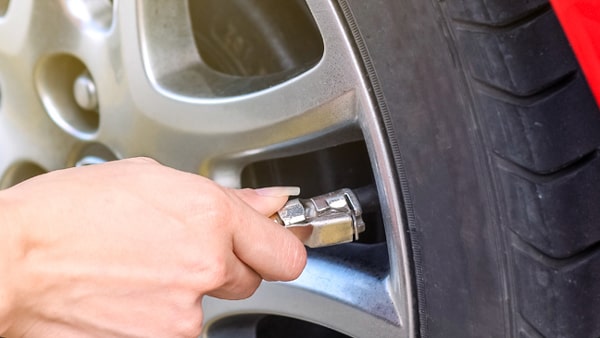
Tires that are not kept at the vehicle manufacturer's recommended pressure can:

If your tires are not inflated to the pressure recommended by the manufacturer, it may cause:
  1. A. Make tread-depth inspections unnecessary
  2. B. Improve steering and braking in every condition
  3. C. Guarantee better fuel economy
  4. D. Create tire-related safety problems

Correct answer: D. – Create tire-related safety problems

The Ohio Driver Manual warns that driving on underinflated or overinflated tires can create roadway safety issues. Maintain the pressure recommended by the vehicle manufacturer, which is commonly listed on the door jamb. Pressure should be checked with a gauge when the tires are approximately the same temperature as the surrounding air.

Source: Ohio Driver Manual — § 2, “Tire Safety”

Question 5

Speeding past surrounding traffic while making repeated unsafe lane changes is an example of:

  1. A. Efficient freeway driving
  2. B. Aggressive driving that endangers others
  3. C. A recommended way to reduce congestion
  4. D. A maneuver permitted only during daylight

Correct answer: B. – Aggressive driving that endangers others

Aggressive driving involves intentional actions that endanger people or property. The Ohio Driver Manual lists speeding and unsafe lane changes among its examples. A driver should instead maintain a lawful speed, use signals, and change lanes only after determining that the movement can be made safely.

Source: Ohio Driver Manual — § 3, “Aggressive Driving”

Question 6

How can you reduce the chance of surprising a driver behind you when you need to slow down?

  1. A. Turn and look through the rear window while braking
  2. B. Check the rearview mirror without signaling
  3. C. Signal in advance and begin slowing gradually when possible
  4. D. Keep your left foot resting on the brake pedal

Correct answer: C. – Signal in advance and begin slowing gradually when possible

Brake lights and other appropriate signals warn following traffic that you are slowing or stopping. Ohio law requires an appropriate signal before stopping or suddenly decreasing speed when there is an opportunity to signal. The driver manual also recommends signaling in advance and maintaining enough space ahead to reduce speed gradually.

Source: Ohio Rev. Code § 4511.39 — Turn and stop signals, Ohio Driver Manual — § 8, “Space Behind” and “Signaling Your Movements”