


Ohio Drivers Ed Practice Test 8

4.8 out of 5 (693 votes)
80% Passing score
20 Questions
4 Mistakes allowed
Ohio intersections deserve more respect than most new drivers give them. A four-way stop in a quiet neighborhood can feel simple, almost too simple, and then another car arrives, someone waves when they should not wave, somebody else hesitates half a second too long, and suddenly the “easy” rule is not quite as easy as it looked in the manual. This Ohio temps practice test is built around those moments, especially right-of-way decisions, intersection etiquette, and the rules that keep ordinary traffic from turning into a slow, awkward negotiation. The official Ohio permit knowledge test is the written exam applicants take to qualify for a Temporary Instruction Permit Identification Card, usually called a TIPIC. The Ohio BMV expects applicants to study the Ohio Driver Manual / Digest of Motor Vehicle Laws, because that is where the test content comes from. The real exam covers Ohio motor vehicle laws, rules of the road, traffic signs, highway traffic control devices, safe driving practices, driver responsibilities, and the practical details that show whether you actually understand what the rule means once you are behind the wheel. This Ohio driver ed practice test gives you 20 multiple-choice questions focused on intersections and right-of-way, while still keeping the broader Ohio permit test style in view. The real BMV written permit test has 40 multiple-choice questions, and passing requires a 75% score — 30 correct answers out of 40. You can miss up to 10, which sounds generous in theory, but it gets eaten up quickly if you are guessing on signs, traffic control devices, or who should go first at a stop. You can take the Ohio temps test at age 15 years and 6 months. If you fail, Ohio requires a one-day wait before retesting. In-person testing allows unlimited attempts, but only one attempt per day; online testing allows two attempts in a six-month period. So yes, practice matters. Not in a dramatic, inspirational-poster sort of way, just in the very plain sense that seeing the wording ahead of time helps. This free drivers ed practice test gives you a cleaner way to work through the material before the actual BMV written permit test, especially the intersection questions that tend to look familiar until you have to choose the one answer Ohio actually wants.
FREE DMV Practice Test App
Study for your Ohio permit test or driver’s license with the NextDoorDriving app. 700+ DMV questions and answers, 100% free!
Download on the App Store

Sample Ohio Permit Test Questions

Question 1

Under Ohio law, after stopping at a steady red light on a two-way street, which movement is generally permitted?

  1. A Proceed straight when the intersection appears clear
  2. B Turn left onto another two-way street
  3. C Turn right after yielding, unless a sign or red arrow prohibits it
  4. D Make any of these movements

Correct answer: C – Turn right after yielding, unless a sign or red arrow prohibits it

A driver facing a steady circular red signal must stop at the stop line, crosswalk, or intersection. A right turn may then be made after yielding as required at a stop sign. The turn is not permitted when a traffic control device prohibits it or the driver faces a steady red arrow without a device expressly permitting the turn.

Source: ORC § 4511.13(C)(1)–(2) – Highway traffic signal indications, Ohio Driver Manual — Section 5, “Turning on a Red Traffic Signal”
Question 2

A public safety vehicle with flashing lights and a siren is approaching from behind. What should you do?

  1. A Continue until the vehicle begins passing
  2. B Move as close as practical to the right edge, clear the intersection, and stop
  3. C Slow down but remain in your lane
  4. D Speed up and turn at the next intersection

Correct answer: B – Move as close as practical to the right edge, clear the intersection, and stop

Ohio law requires you to yield, move parallel and as close as practical to the right edge or curb, and stop clear of an intersection. Remain stopped until the public safety vehicle has passed unless a police officer directs otherwise. If you are already within an intersection, clear it before pulling over.

Source: ORC § 4511.45(A)(1) – Right-of-way of public safety or coroner's vehicle, Ohio Driver Manual — Section 9, “Emergency Vehicles (Police, Fire, Medical Vehicles)”

Question 3

What can happen when alcohol is combined with another impairing drug?

  1. A The drug may intensify alcohol’s effects or add further impairment
  2. B The substances cancel each other’s effect on driving
  3. C The drug becomes harmless while driving
  4. D Alcohol improves the body’s response to the drug

Correct answer: A – The drug may intensify alcohol’s effects or add further impairment

Alcohol and other drugs can impair vision, reaction time, judgment, and alertness. When combined, another drug may increase alcohol’s effects or produce additional impairing effects of its own. This applies even to some prescription and over-the-counter medicines, so drivers should check warnings and consult a doctor or pharmacist about side effects.

Source: Ohio Driver Manual — Section 6, “Impairing Drugs and Driving”

Question 4

At an Ohio intersection, the traffic signal is completely dark and no officer is directing traffic. What must you do?

  1. A Wait until power is restored
  2. B Wait for an officer to arrive
  3. C Stop, yield as required, and proceed as at a four-way stop
  4. D Continue without stopping if the roadway looks clear

Correct answer: C – Stop, yield as required, and proceed as at a four-way stop

A driver approaching a malfunctioning signal must stop at the marked stop line, before the crosswalk, or before entering the intersection. The driver must yield to traffic that presents an immediate hazard and proceed cautiously. The driver manual describes this procedure as treating the intersection like a four-way stop, unless a law enforcement officer is directing traffic.

Source: ORC § 4511.132(A) – Operation at intersections with malfunctioning traffic control signal lights, Ohio Driver Manual — Section 10, “Inoperable Traffic Signals”

Question 5

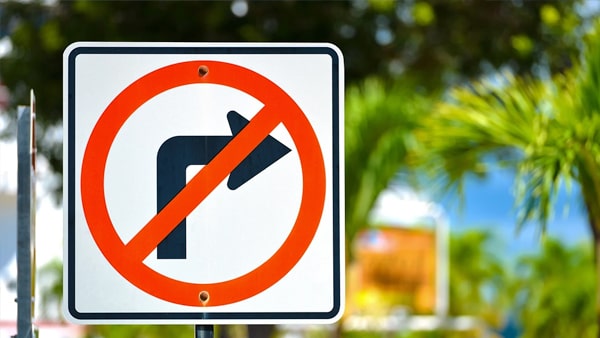
A white regulatory sign displays a right-turn arrow inside a red circle with a diagonal slash. What does it mean?

This sign means:
  1. A U-turns are prohibited
  2. B Left turns are prohibited
  3. C Right turns are prohibited
  4. D All turning movements are prohibited

Correct answer: C – Right turns are prohibited

The sign is a No Right Turn sign. A red circle and diagonal slash mean that the action pictured inside the circle is prohibited. Drivers must not turn right where this sign applies, even if another rule would ordinarily permit a right turn, such as turning after stopping at a red light.

Source: Ohio Driver Manual — Section 4, “Traffic Signs”

Question 6

Which consequences can result from an Ohio OVI conviction?

  1. A A possible jail term
  2. B A mandatory fine
  3. C A driver-license suspension
  4. D All of these consequences

Correct answer: D – All of these consequences

All three consequences may result from an OVI conviction. For a standard first offense under ORC § 4511.19(G)(1)(a), the sentence includes a three-day jail term, subject to the statute’s certified driver-intervention alternative, a fine of $565 to $1,075, and a license suspension of one to three years. Penalties increase for repeat or high-level offenses.

Source: ORC § 4511.19(G)(1)(a) – Operating vehicle under the influence of alcohol or drugs - OVI