


Ohio Driving Test Practice 9

4.8 out of 5 (659 votes)
80% Passing score
20 Questions
4 Mistakes allowed
This Ohio BMV practice test focuses on school bus rules, which deserve more attention than most new drivers give them. The rules are straightforward once they click, but Ohio can test them through situations that feel almost the same at first glance: stopped bus, flashing lights, children nearby, traffic moving in one direction or both directions, maybe a divided roadway tossed in for good measure. So yes, this is a narrow topic. It is also exactly the kind of narrow topic that can cost you a point on the Ohio permit test if you only skimmed it. This ninth Ohio permit practice test gives you 20 questions built around real school bus scenarios, including when to stop, when not to pass, and how drivers are expected to react when children are loading or unloading. The questions are not copied from the actual Ohio driving test, but they are written to feel like the real exam in style and difficulty. That distinction matters. You are practicing the way Ohio asks questions, not just memorizing a few friendly facts and hoping they show up in the same outfit later. For context, the official Ohio knowledge test has 40 questions, and passing requires a 75% score. In plain terms, that means 30 correct answers, with no more than 10 missed. On this Ohio drivers permit practice test, getting at least 16 out of 20 correct is a strong sign that the school bus material is settling in properly. And if it is not? That is where the built-in study tools do their quiet work. A hint can help when the answer feels close but not quite obvious, and the explanation after a missed question gives you the reasoning instead of leaving you with a red X and mild resentment. This practice also sits inside the larger Ohio licensing path. Drivers can begin the TIPIC process at 15 years and 6 months. If you are under 18, you must hold the TIPIC for 6 months, complete 24 hours of classroom or online driver education, finish 8 hours of behind-the-wheel training, and log 50 supervised driving hours, including 10 at night. The probationary license can begin at 16, though younger drivers still face nighttime limits, passenger restrictions, and a no-device-use rule while driving. Use this Ohio driver’s license practice test as focused preparation, not filler. School bus questions are safety questions first, test questions second, and Ohio expects you to know the difference before you are on the road alone.
FREE DMV Practice Test App
Study for your Ohio permit test or driver’s license with the NextDoorDriving app. 700+ DMV questions and answers, 100% free!
Download on the App Store

Sample Ohio Permit Test Questions

Question 1

In Ohio, what must you do before entering a public highway from a private driveway or similar place?

  1. A Sound your horn and enter before approaching traffic arrives
  2. B Place part of your vehicle in the roadway to claim a gap
  3. C Accelerate into the roadway without yielding
  4. D Yield to roadway traffic and to pedestrians on the sidewalk

Correct answer: D – Yield to roadway traffic and to pedestrians on the sidewalk

A driver entering or crossing a highway from a place other than another roadway must yield to all traffic approaching on the highway. The driver must also yield to pedestrians on the sidewalk. Enter only after there is a sufficient opening to do so without violating those right-of-way duties.

Source: Ohio Rev. Code § 4511.44(A) — Right-of-Way at Highway from Any Place Other Than Another Roadway, Ohio Rev. Code § 4511.441(A) — Right-of-Way of Pedestrian on Sidewalk
Question 2

On a two-way road, what does a solid yellow centerline separate?

  1. A A center turn lane from adjacent lanes
  2. B A bicycle lane from motor-vehicle traffic
  3. C Lanes moving in the same direction
  4. D Traffic moving in opposite directions

Correct answer: D – Traffic moving in opposite directions

A yellow centerline separates vehicles traveling in opposite directions on a two-way roadway. White lines generally separate lanes moving in the same direction. Whether passing is permitted depends on whether the yellow line on the driver's side is solid or broken and on any applicable signs or legal exceptions.

Source: Ohio Driver Manual — § 4, “Lane Pavement Markings”

Question 3

Under Ohio law, what should you do when traveling below the prevailing lawful speed and faster vehicles are behind you?

  1. A Move left to prevent other vehicles from passing
  2. B Use the available right-hand lane and allow passing when safe and reasonable
  3. C Drive on the shoulder until the vehicles pass
  4. D Stop in the travel lane to let traffic go around

Correct answer: B – Use the available right-hand lane and allow passing when safe and reasonable

A slower vehicle must use the available right-hand lane and travel far enough right to allow faster vehicles to pass when doing so is safe and reasonable. Exceptions apply when the driver is passing, preparing for a left turn, or must use another lane to follow the intended route. The law does not require a slower driver to compromise safety.

Source: Ohio Rev. Code § 4511.25(B) — Lanes of Travel Upon Roadways of Sufficient Width

Question 4

Which type of sign is normally diamond shaped?

  1. A A roadway hazard or condition warning sign
  2. B An Interstate route marker
  3. C A school crossing sign
  4. D A speed limit sign

Correct answer: A – A roadway hazard or condition warning sign

Diamond-shaped signs generally warn drivers about possible dangers or changing conditions on or near the roadway. Standard warning signs are usually yellow with black symbols or lettering. Work-zone warnings commonly use the same general shape but have an orange background.

Source: Ohio Driver Manual — § 4, “Traffic Signs” and “Work Zone Signs”

Question 5

Under Ohio law, which oncoming vehicles must you yield to before making a left turn?

  1. A Only the first two vehicles approaching
  2. B Vehicles in the intersection or close enough to be an immediate hazard
  3. C Every visible vehicle, regardless of its distance
  4. D Only vehicles entering after your signal begins changing to red

Correct answer: B – Vehicles in the intersection or close enough to be an immediate hazard

A driver turning left must yield to an oncoming vehicle that is already within the intersection. The driver must also yield when an approaching vehicle is close enough to the intersection, driveway, alley, or private road to constitute an immediate hazard. The turn may begin after those conflicting vehicles have cleared and the movement can be completed safely.

Source: Ohio Rev. Code § 4511.42(A) — Right-of-Way Rule When Turning Left

Question 6

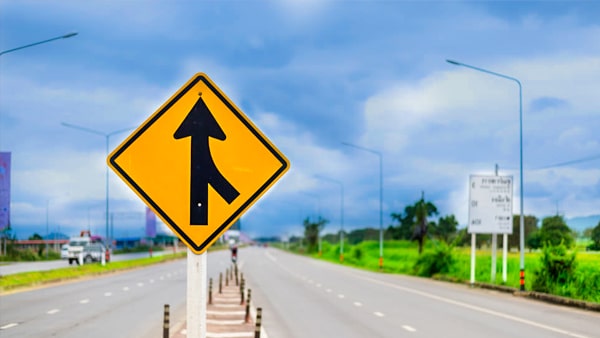
A yellow diamond sign shows one traffic line joining another from the right. What does it mean?

This sign means:
  1. A Two-way traffic begins ahead
  2. B The roadway narrows and your lane ends
  3. C Another roadway joins ahead and traffic may merge into your lane
  4. D A divided highway begins ahead

Correct answer: C – Another roadway joins ahead and traffic may merge into your lane

The Merge sign warns that lanes from separate roadways converge and merging movements may occur ahead. The Ohio Driver Manual directs drivers entering a multilane highway to find a gap, signal, use the acceleration lane, and merge with the traffic flow. Drivers on an entrance or acceleration ramp must yield to traffic already on the highway.

Source: Ohio Supplement and Federal Manual on Uniform Traffic Control Devices, 11th Edition — § 2C.45, “Merge Signs and Plaque (W4-1, W4-5, and W4-5aP)”, Ohio Driver Manual — § 4, “Right-of-Way” and § 5, “Entering a Multi-Lane Highway”