


Ohio CDL General Knowledge Practice Test (OH) 2

4.9 out of 5 (159 votes)
80% Passing score
20 Questions
4 Mistakes allowed
Welcome to the second stage of your Ohio CDL General Knowledge Practice Test. This CDL practice test is a crucial stepping stone in your path to obtaining a CDL license in 2026, be it Class A or B, along with any endorsements you seek. Our Ohio CDL practice test mirrors the real BMV test in structure and content, ensuring you are well-prepared for what lies ahead. This Ohio CDL general knowledge practice test comprises 20 carefully crafted CDL driving test questions, derived from the official CDL driver's manual-the same source the state uses for the actual CDL permit test in 2026. Our commitment to authenticity means that if it's not in the manual, it's not on our permit test. Each question is designed to challenge and enhance your understanding of critical CDL topics, ranging from vehicle inspection to communication on the road. With a format that features multiple-choice and true or false questions, this Ohio CDL practice test simulates the actual BMV test environment. This approach not only tests your knowledge but also hones your skills in identifying the correct answers through logical elimination. Achieving a score of 16 out of 20 questions is your target to pass this general knowledge practice test, which you can attempt as many times as necessary. This flexibility allows you to gain confidence and mastery over the material at your own pace. This Ohio general knowledge BMV practice test covers a broad spectrum of subjects essential for every aspiring CDL holder. Expect questions on pre-trip vehicle inspection, basic vehicle control, gear shifting, managing hills and downgrades, effective communication with other road users, speed control, and drug and alcohol awareness. Each attempt at this CDL permit practice test presents the same set of Ohio permit test questions, reinforcing your learning and ensuring thorough preparation. In conclusion, this second Ohio CDL practice test is an invaluable tool for anyone aspiring to ace the CDL General Knowledge Test in 2026. With its adherence to the official manual, realistic format, and comprehensive coverage, it is more than just a test-it's a fundamental part of your CDL training regimen!
FREE CDL Practice Test App
Pass your Ohio CDL General Knowledge test with the NextDoorDriving app. Real questions and answers—100% free and ad-free.
Download on the App Store

Sample Ohio CDL Test Questions - General Knowledge

Question 1

What should be your primary method of controlling speed on a long downgrade?

  1. A Brake whenever speed rises five mph above the posted limit
  2. B Use stab braking continuously
  3. C Use the engine's braking effect in a proper low gear
  4. D Apply only the trailer brakes

Correct answer: C – Use the engine's braking effect in a proper low gear

Select a safe speed and a proper low gear before beginning the descent. Engine braking should be the principal way of controlling speed on a long or steep downgrade. Proper service-brake applications supplement engine braking and preserve enough braking ability to slow or stop for traffic and roadway conditions.

Source: Ohio Commercial Driver License Manual — § 2.16.1, “Select a ‘Safe’ Speed”
Question 2

What happens when a commercial vehicle hydroplanes?

  1. A Its tires lose contact with the roadway and have little or no traction
  2. B Its steering wheel turns while the tires remain straight
  3. C Its brakes apply without slowing the vehicle
  4. D Its suspension rises because of water pressure

Correct answer: A – Its tires lose contact with the roadway and have little or no traction

Hydroplaning occurs when water or slush builds a layer between the tires and the roadway. The tires lose contact with the surface and have little or no traction, reducing the driver's ability to steer or brake. Worn tread, low tire pressure, standing water, and excessive speed increase the risk.

Source: Ohio Commercial Driver License Manual — § 2.6.2, “Speed and Road Surface”

Question 3

The same loading and unloading procedure applies to every class of hazardous material.

  1. A TRUE
  2. B FALSE

Correct answer: B – FALSE

Hazardous materials are not all handled in the same manner. Requirements vary according to the material's class, packaging, and hazards. For example, explosives have specific vehicle and engine precautions, while certain Class 4 and Class 5 materials must be protected from moisture and carried within a covered vehicle body.

Source: Ohio Commercial Driver License Manual — § 9.4, “Loading and Unloading”, 49 CFR § 177.835 – Class 1 (explosive) materials, 49 CFR § 177.838 – Class 4 (flammable solid) materials, Class 5 (oxidizing) materials, and Division 4.2 (self-heating and pyrophoric liquid) materials

Question 4

Before taking an unfamiliar modern truck down a long, steep grade, which gear may be necessary?

  1. A A lower gear than the truck would need to climb the grade
  2. B Always the same gear used to climb the grade
  3. C A higher gear than the truck would need to climb the grade
  4. D Neutral, with continuous service-brake pressure

Correct answer: A – A lower gear than the truck would need to climb the grade

Modern trucks may climb grades in relatively high gears because of powerful engines and efficient designs. Those same vehicles can have less friction and air resistance to hold them back while descending. A lower gear than the one needed for climbing may be necessary, depending on the vehicle and grade.

Source: Ohio Commercial Driver License Manual — § 2.16.2, “Select the Right Gear before Starting Down the Grade”

Question 5

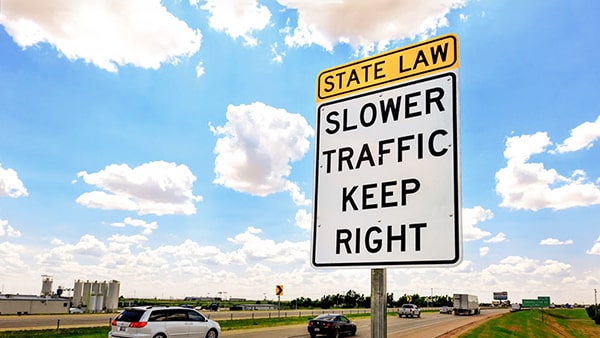
What does a SLOWER TRAFFIC KEEP RIGHT sign direct drivers to do?

This sign indicates that drivers ___________.
  1. A Use the available right lane when traveling slower than normal traffic
  2. B Remain in the right lane regardless of speed or intended turns
  3. C Pass slower vehicles on the right
  4. D Accelerate until they are traveling faster than surrounding traffic

Correct answer: A – Use the available right lane when traveling slower than normal traffic

Ohio lane rules generally require a vehicle moving below the normal speed of traffic to use the available right-hand lane or remain as close as practicable to the right edge. Exceptions include passing another vehicle and preparing for a left turn. The sign reinforces this required lane position for slower traffic.

Source: Ohio Rev. Code § 4511.25 – Lanes of travel upon roadways

Question 6

Which description correctly defines controlled braking?

  1. A Lock the wheels and hold the pedal down until the vehicle stops
  2. B Apply the brakes as hard as possible without locking the wheels
  3. C Apply full pressure until the wheels lock, then repeatedly release and reapply
  4. D Avoid using the technique on every heavy vehicle

Correct answer: B – Apply the brakes as hard as possible without locking the wheels

During controlled braking, apply the brakes as firmly as possible without locking the wheels. Keep steering movements small while braking. If the wheels lock or a larger steering correction becomes necessary, release the brakes and reapply them as soon as control permits.

Source: Ohio Commercial Driver License Manual — § 5.4.3, “Emergency Stops—Controlled Braking”