


Ohio CDL Practice Test: General Knowledge (OH) 6

5 out of 5 (81 votes)
80% Passing score
50 Questions
10 Mistakes allowed
Welcome to our Ohio CDL General Knowledge Practice Test 6, an essential tool for aspiring commercial drivers in the Buckeye State. This BMV practice test is meticulously designed to mirror the structure and content of the actual DMV test in 2026, offering a comprehensive and realistic preparation experience. Featuring a total of 50 Ohio permit test questions, the permit practice test requires a minimum score of 80% to pass, equating to correctly answering at least 40 questions. These drivers license questions span a broad spectrum of topics crucial for every commercial driver. From understanding your vehicle's equipment to effectively dealing with road emergencies, from knowing the procedures to follow in case of an accident to mastering pre-trip inspections, this Ohio BMV practice test covers it all. Additionally, it includes permit questions about hazardous materials, ensuring every driver has a fundamental understanding of these substances, even if they're not seeking a HazMat endorsement at this stage. The format of our Ohio CDL practice test is multiple-choice and true or false, replicating the style of the actual DMV general knowledge test. This setup is not only familiar but also aids in honing your skills in identifying the correct answers through a process of elimination. What makes our Ohio practice permit test unique is its dynamic nature. Every time you take the BMV test, the questions are randomized. This approach prevents memorization of the sequence, pushing you to focus on understanding the content rather than just recalling answers. Upon completing our Ohio BMV practice test, you'll receive a detailed summary of your performance. This summary highlights the questions you missed and provides the correct answers, making it an invaluable learning tool. By understanding where you went wrong, you can target your studies more effectively, ensuring a better grasp of the material and a higher chance of success in your actual BMV written permit test. Prepare with us, and you're not just practicing for an Ohio permit test in 2026; you're building a foundation for safe and knowledgeable driving on Ohio's roads!
FREE CDL Practice Test App
Pass your Ohio CDL General Knowledge test with the NextDoorDriving app. Real questions and answers—100% free and ad-free.
Download on the App Store

Sample Ohio CDL Test Questions - General Knowledge

Question 1

A yellow diamond warning sign shows a roadway dividing into two branches shaped like the letter Y. What does it warn of?
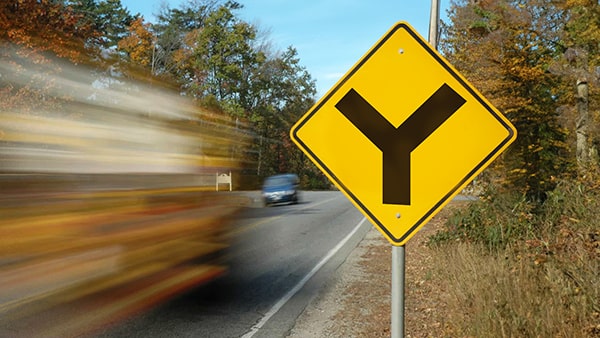
This sign warns drivers to _____________.
  1. A A T-intersection
  2. B A Y-intersection
  3. C A construction area
  4. D A dip in the roadway

Correct answer: B – A Y-intersection

This sign warns that the roadway approaches a Y-shaped intersection or division. Reduce speed and watch the road alignment, signs, markings, and surrounding traffic to determine which branch to follow. Ohio uses a uniform traffic-control system that correlates with the federally approved sign system.

Source: Manual on Uniform Traffic Control Devices for Streets and Highways, 11th ed., Rev. 1 — § 2C.47, “Intersection Warning Signs”, Ohio Rev. Code § 4511.09 – Manual for Uniform System of Traffic Control Devices

Question 2

What can happen during a rear drive-wheel braking skid while towing a trailer?

  1. A The trailer can push the towing vehicle sideways into a jackknife
  2. B The locked drive wheels gain more traction than rolling wheels
  3. C The skid prevents jackknifing
  4. D Only the front wheels slide sideways

Correct answer: A – The trailer can push the towing vehicle sideways into a jackknife

A rear drive-wheel braking skid occurs when the drive wheels lock and lose traction. The rear of the towing vehicle may slide sideways as the locked wheels try to catch up with the front wheels. When a trailer is attached, it can push the towing vehicle sideways. This movement can produce a sudden jackknife.

Source: Ohio Commercial Driver License Manual — § 2.19.1, “Drive-Wheel Skids”

Question 3

In Ohio, how long is the CDL disqualification for a first conviction of driving under the influence of alcohol or a controlled substance?

  1. A 6 months
  2. B 2 years
  3. C 1 year
  4. D 3 years

Correct answer: C – 1 year

A first qualifying conviction for driving under the influence results in a one-year commercial-driving disqualification. Ohio law applies this period to first convictions for specified alcohol- and controlled-substance offenses. The period increases to three years when the first qualifying conviction occurs while transporting hazardous materials. Later qualifying convictions can result in lifetime disqualification.

Source: Ohio Commercial Driver License Manual — § 1.3, “Driver Disqualifications”, Ohio Rev. Code § 4506.16(D)(1), (3) – Violations - Disqualification of Driver or Placement Out-of-Service

Question 4

What minimum tread depth is required in a major groove of a CMV’s front tire?

  1. A 2/32 inch
  2. B 4/32 inch
  3. C 6/32 inch
  4. D 1/4 inch

Correct answer: B – 4/32 inch

Federal equipment rules require at least 4/32 inch of tread in a major groove on a truck, truck-tractor, or bus front tire. Other tires generally require at least 2/32 inch. Measurements are not taken at tie bars, humps, or fillets. During inspection, also check for exposed belt or body-ply material, separation, cuts, and air leaks.

Source: Ohio Commercial Driver License Manual — § 2.1.3, “What to Look For—Tire Problems”, 49 CFR § 393.75(a)–(c) – Tires

Question 5

Which items must be checked when inspecting a tractor-trailer’s kingpin, apron, and coupling gap?

  1. A The kingpin is in place and is not bent, damaged, or worn
  2. B The visible apron is not bent, cracked, or broken
  3. C The trailer lies flat on the fifth-wheel skid plate with no gap
  4. D All of these items

Correct answer: D – All of these items

Inspect the kingpin to confirm that it is present and not bent, damaged, or excessively worn. The visible apron must not be bent, cracked, or broken. The trailer must rest flat on the fifth-wheel skid plate without space between the apron and fifth wheel. Damage or an improper connection can cause handling problems or separation of the tractor and trailer.

Source: Ohio Commercial Driver License Manual — § 11, “Kingpin, Apron & Gap”

Question 6

Under ideal conditions, what is the average driver’s reaction time after seeing a hazard?

  1. A About 1/2 second
  2. B About 3/4 to 1 second
  3. C About 2 seconds
  4. D About 3 seconds

Correct answer: B – About 3/4 to 1 second

The CDL manual gives an average reaction time of approximately three-quarters of a second to one second under ideal conditions. Reaction distance is how far the vehicle travels during that interval before the driver physically applies the brakes. At 55 mph, the manual estimates about 61 feet of travel during reaction time. Fatigue, impairment, and distraction can delay a driver’s response.

Source: Ohio Commercial Driver License Manual — § 2.6.1, “Stopping Distance—Reaction Distance”