


Ohio CDL Practice Test Questions and Answers (OH) 7

4.9 out of 5 (64 votes)
80% Passing score
50 Questions
10 Mistakes allowed
Welcome to the seventh Ohio CDL practice test, a crucial step in your preparation for the Commercial Driver's License permit test. This BMV practice test is designed to mirror the real CDL test, offering a comprehensive understanding of what to expect. With 50 meticulously crafted questions, your challenge is to correctly answer at least 40 to pass. These CDL permit test questions are consistent each time you take the test, allowing you to focus and improve on areas where you need more practice. Our Ohio CDL practice test draws directly from the official CDL driver's manual, the primary source for both our questions and those on the actual CDL written permit test. Rest assured, if it's not in the manual, it won't appear on your 2026 written test. This alignment ensures that you are studying the most relevant and up-to-date material. We understand the importance of practice and familiarity. That's why you can retake this Ohio CDL general knowledge practice test as many times as necessary. Repeated practice helps solidify your understanding and boosts confidence, making you thoroughly prepared for the next level of testing. Each sample BMV permit test question on our practice test has been carefully written and reviewed by seasoned driving instructors. These professionals bring years of experience in teaching and have assisted thousands in successfully obtaining their CDLs. Their expertise is reflected in the quality and relevance of our Ohio BMV test questions, ensuring that you receive the best possible preparation in 2026. As you progress through the practice test, make use of the integrated study aids. These tools are designed to assist when you encounter challenging questions, reinforcing your learning and understanding. Remember, this Ohio CDL practice test is not just about memorizing road signs, rules, and signals; it's about applying them in real-world scenarios, just as you will on the road. So, begin your practice today and take a step closer to achieving your CDL in Ohio in 2026!
FREE CDL Practice Test App
Pass your Ohio CDL General Knowledge test with the NextDoorDriving app. Real questions and answers—100% free and ad-free.
Download on the App Store

Sample Ohio CDL Test Questions - General Knowledge

Question 1

Which statements correctly describe standard hazardous-material placards on a placarded vehicle?

  1. A They are displayed on the front, rear, and both sides
  2. B Each square-on-point placard measures at least 250 mm, or 9.84 inches, on each side
  3. C They are positioned as diamonds and must be readable from four directions
  4. D All of these statements

Correct answer: D – All of these statements

A placarded vehicle generally displays placards on the front, rear, and both sides so they are visible from four directions. Standard placards are square-on-point, creating a diamond shape. Federal specifications require each side to measure at least 250 mm, or 9.84 inches. Placards must also meet the applicable design, color, durability, and display requirements.

Source: Ohio Commercial Driver License Manual — § 2.23.3, “Lists of Regulated Products—Placards”, 49 CFR § 172.504(a) – General Placarding Requirements, 49 CFR § 172.519 – General Specifications for Placards
Question 2

What occurs as a person’s blood alcohol concentration increases?

  1. A Alcohol’s effects become weaker
  2. B The person always recognizes the increasing impairment
  3. C Judgment, vision, coordination, and muscle control become increasingly impaired
  4. D The body eliminates alcohol more quickly

Correct answer: C – Judgment, vision, coordination, and muscle control become increasingly impaired

As BAC rises, alcohol affects more areas of the brain. Judgment and self-control are affected early, and the drinker may not recognize the increasing impairment. With further increases, vision, coordination, and muscle control deteriorate. These effects make safe control of a commercial vehicle increasingly unlikely.

Source: Ohio Commercial Driver License Manual — § 2.22, “Alcohol, Other Drugs, and Driving—Alcohol and the Brain”

Question 3

What does controlled braking involve?

  1. A Using the technique only when the vehicle has no ABS
  2. B Applying the brakes as hard as possible without locking the wheels
  3. C Locking the wheels, releasing the brakes, and then applying them fully again
  4. D Holding the brakes down after the wheels lock

Correct answer: B – Applying the brakes as hard as possible without locking the wheels

During controlled braking, apply the brakes as hard as possible without locking the wheels. Keep steering movements small while braking. If the wheels lock or a large steering correction becomes necessary, release the brakes and reapply them as soon as possible. Stab braking is the separate technique of fully applying the brakes, releasing them when the wheels lock, and applying them again when the wheels roll.

Source: Ohio Commercial Driver License Manual — § 5.4.3, “Emergency Stops—Controlled Braking”

Question 4

Unless a police officer directs otherwise or a qualifying public safety vehicle is responding, what must a driver do for an identified funeral procession in Ohio?

  1. A Yield only when the driver does not have an urgent reason to proceed
  2. B Proceed first when facing a green signal
  3. C Enter between procession vehicles whenever there appears to be enough space
  4. D Yield the right-of-way to each vehicle in the procession

Correct answer: D – Yield the right-of-way to each vehicle in the procession

Ohio law requires other drivers and pedestrians to yield the right-of-way to each vehicle in an identified funeral procession. After the lead vehicle lawfully enters an intersection, the remaining procession vehicles may continue through, but each procession driver must exercise due care. The stated exceptions apply to qualifying public safety vehicles and situations in which a police officer gives different directions.

Source: Ohio Rev. Code § 4511.451(A)–(B) – Right-of Way of Funeral Vehicle

Question 5

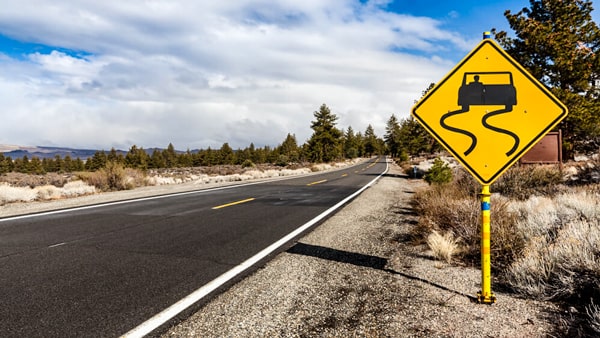
What does a Slippery When Wet warning sign indicate?

This sign warns drivers to  _________________.
  1. A The roadway may become unexpectedly slippery when wet
  2. B Driving is prohibited whenever it rains
  3. C Vehicles may become stuck on a wet shoulder
  4. D The roadway is slippery under all weather conditions

Correct answer: A – The roadway may become unexpectedly slippery when wet

The sign warns that the roadway can become unexpectedly slippery when wet. Ohio identifies yellow diamond-shaped signs as warnings of possible danger ahead. On a wet surface, reduce speed and use smooth steering and braking because reduced traction makes stopping and turning more difficult.

Source: Ohio Driver Manual — § 4, “Traffic Signs”, Ohio Commercial Driver License Manual — § 2.6.2, “Matching Speed to the Road Surface”, Manual on Uniform Traffic Control Devices, 11th ed. with Revision 1 — § 2C.30, “Surface Condition Signs (W8-5, W8-7, W8-8, W8-11, W8-13, and W8-14)”

Question 6

When might operating at the legal maximum vehicle weight still be unsafe?

  1. A When traveling through mountainous terrain
  2. B Whenever crossing any bridge
  3. C Only when the vehicle is overloaded
  4. D Whenever hazardous materials are carried

Correct answer: A – When traveling through mountainous terrain

A legal weight is not necessarily a safe operating weight under every condition. In mountainous terrain, a heavy vehicle may climb very slowly and place greater demands on its brakes while descending. The CDL manual also warns that bad weather can make operation at the legal maximum weight unsafe.

Source: Ohio Commercial Driver License Manual — § 3.2.2, “Legal Weight Limits”