Ohio BMV Permit Test (Temps) Simulator

4.5 out of 5 (6982 votes)
75% Passing score
40 Questions
10 Mistakes allowed
A good Ohio BMV permit practice test should feel close enough to the real exam that you stop treating it like a warm-up game. The official Ohio knowledge test is 40 multiple-choice questions, and you need 30 correct answers to pass, which sounds manageable until you remember that those questions can pull from traffic signs, motor vehicle laws, right-of-way rules, highway control devices, safe driving practices, and the little driver-responsibility details people tend to half-read in the manual. This Ohio temps practice test follows that same 40-question rhythm, with randomized questions so you are not just memorizing the order and congratulating yourself for recognizing what came next. It is built around the Ohio Driver Manual, the source the BMV expects applicants to study before taking the knowledge test. And, yes, road signs are included, but they are not floating off in their own separate little test for a standard Class D TIPIC. They count as part of the same overall permit test, along with laws, signs, signals, and practical driving judgment. The permit itself is the Temporary Instruction Permit Identification Card, usually shortened to TIPIC, though most people in Ohio just say “temps” and move along. You can start the process at 15 years and 6 months. After passing the knowledge test and vision screening, you have 60 days to buy the TIPIC at a Deputy Registrar License Agency, and applicants under 18 need a parent or guardian there to co-sign. That detail is easy to forget, mostly because everyone focuses on the test and then suddenly the paperwork is standing there, very much part of the process. Use this Ohio BMV permit test online the way it is meant to be used: take it more than once, notice the questions that slow you down, and go back to the manual when your answer was more guess than knowledge. If you fail the real knowledge test, Ohio requires a one-day wait before retesting, and online testing has its own attempt limits. So, no, the practice test is not just busywork. It is where you get comfortable with the format, clean up the weak spots, and walk into the Ohio temps test with a much better sense of what the BMV is actually asking you to know.
FREE DMV Practice Test App
Study for your Ohio permit test or driver’s license with the NextDoorDriving app. 700+ DMV questions and answers, 100% free!
Download on the App Store

Sample Ohio Permit Test Questions

Question 1

A large truck moves left before beginning a right turn. What should a following driver avoid doing?

  1. A Driving between the truck and the curb
  2. B Waiting behind the truck until the turn is complete
  3. C Leaving additional following distance
  4. D Stopping behind the intersection's stop line

Correct answer: A – Driving between the truck and the curb

Trucks and buses may move left before turning right because they need more room to clear the corner. Their drivers also have large blind spots along the sides of the vehicle. Never squeeze between a turning truck and the curb; remain behind the stop line and allow the large vehicle to complete its turn.

Source: Ohio Driver Manual — § 9, “Commercial Vehicles—Turning”
Question 2

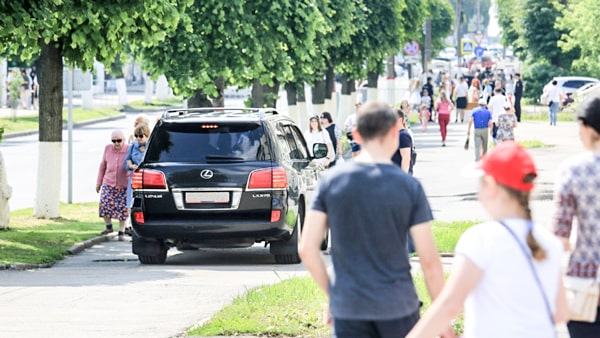
When exiting a driveway across a sidewalk, what must a driver do?

You may drive across a sidewalk to:
  1. A Sound the horn and continue without stopping
  2. B Stop before entering the sidewalk area and yield to pedestrians
  3. C Stop only when a pedestrian is directly in front of the vehicle
  4. D Drive along the sidewalk until there is an opening in traffic

Correct answer: B – Stop before entering the sidewalk area and yield to pedestrians

In a business or residence district, a driver emerging from a driveway, alley, private road, or building must stop immediately before driving onto the sidewalk area. Ohio law also requires the driver to yield the right-of-way to every pedestrian on the sidewalk. After yielding, the driver may cross the sidewalk to enter the roadway when it is safe.

Source: Ohio Rev. Code § 4511.431(A) — Stop prior to driving on sidewalk area, Ohio Rev. Code § 4511.441(A) — Right-of-way of pedestrian on sidewalk

Question 3

At an uncontrolled Ohio intersection, two vehicles arrive from different roads at approximately the same time. Who must yield?

  1. A The driver traveling faster
  2. B The driver on the left
  3. C The driver on the right
  4. D Neither driver

Correct answer: B – The driver on the left

When two vehicles approach or enter an intersection from different roads at approximately the same time, the driver on the left must yield to the vehicle on the right. This general rule may be modified at through highways or by stop signs, yield signs, traffic signals, or other applicable rules. Both drivers must still exercise care to avoid a collision.

Source: Ohio Rev. Code § 4511.41(A), (B) — Right-of-way rule at intersections

Question 4

A KEEP RIGHT sign beside a traffic island directs you to:

This white sign means:
  1. A Pass to the right of the island or obstruction
  2. B Turn right at the next intersection
  3. C Yield only to traffic approaching from the right
  4. D Move right only if you are driving below the speed limit

Correct answer: A – Pass to the right of the island or obstruction

A KEEP RIGHT sign directs traffic to pass on the right side of an island, divider, or other obstruction. It controls the path vehicles must follow at that location. It does not necessarily require a right turn at the next intersection or apply only to slower traffic.

Source: Ohio Driver Manual — § 4, “Traffic Signs”

Question 5

Why is driving at night more hazardous than driving during daylight?

  1. A Traffic laws no longer apply after sunset
  2. B Stopping distance automatically becomes shorter
  3. C Headlights limit how far ahead the driver can see
  4. D Roadway signs cannot be seen at night

Correct answer: C – Headlights limit how far ahead the driver can see

At night, a driver's view ahead is limited by the illumination provided by the vehicle's headlights. Hazards beyond the lighted area may not be visible soon enough for a normal response. Maintain a cautious and reasonable speed, keep scanning the roadway, and use the appropriate headlight beam without blinding approaching drivers.

Source: Ohio Driver Manual — § 7, “Night Driving”

Question 6

Before merging onto a freeway, how should you check for traffic in the lane you plan to enter?

When you enter a freeway, you should check traffic by using:
  1. A Use only the inside rearview mirror
  2. B Use only the outside mirror
  3. C Use the mirrors and look over your shoulder toward the merging lane
  4. D Watch only the vehicle directly ahead

Correct answer: C – Use the mirrors and look over your shoulder toward the merging lane

When entering a freeway, use the outside mirrors to identify a suitable opening in traffic and look over your shoulder toward the lane you intend to enter. The shoulder check covers blind spots that cannot be seen in the mirrors. Signal, use the acceleration lane to approach the traffic flow's speed, and merge only when a safe gap is available.

Source: Ohio Driver Manual — § 5, “Entering a Multi-Lane Highway”