


Ohio Road Signs Test

4.7 out of 5 (915 votes)
80% Passing score
10 Questions
2 Mistakes allowed
Ohio road signs deserve more attention than most permit applicants give them, mostly because they are not sitting off in their own little separate exam. For a standard Class D Temporary Instruction Permit Identification Card, or TIPIC, road sign questions are folded into the main Ohio permit knowledge test. That official test has 40 multiple-choice questions, and it covers a fairly wide spread: Ohio motor vehicle laws, rules of the road, traffic signs, highway traffic control devices, safe driving practices, and the responsibilities that come with being the person behind the wheel. So, yes, this Ohio road signs practice test is focused. Deliberately focused. It gives you 20 multiple-choice questions built around the signs you are expected to recognize on Ohio roads, including stop signs, yield signs, warning signs, school zone signs, regulatory signs, and the colors, shapes, and symbols that tell you what to do before you have time to overthink it. That is really the point. On the real Ohio BMV knowledge test, you are not just being asked whether you have seen a sign before. You are being asked whether you understand what it means well enough to make the correct driving decision. The official Ohio permit test requires a 75% score, which means at least 30 correct answers out of 40. This practice test uses a shorter 20-question format, with a passing score of 16 correct answers, so it gives you a cleaner way to drill road signs before you move into a full Ohio permit practice test. And, because this is practice, missing a question is not the end of anything. It is the useful part, frankly. After each attempt, you can review what you missed, compare it with the correct answer, and catch the small details that tend to blur together when you are trying to study too much at once. Ohio applicants can take the knowledge test at 15 years and 6 months. If you fail the official exam, you have to wait one day before testing again. In-person testing allows unlimited attempts, but only one per day; online testing allows two attempts within a six-month period. That makes a targeted Ohio road signs test a smart place to spend a little extra time before the real thing, especially if you would rather learn the signs here than donate another day to retesting.
FREE DMV Practice Test App
Study for your Ohio permit test or driver’s license with the NextDoorDriving app. 700+ DMV questions and answers, 100% free!
Download on the App Store

Sample Ohio Permit Test Questions

Question 1

A yellow diamond warning sign shows two separated roadways joining as the median ends. Which sign is this?

  1. A Lane Ends
  2. B Divided Highway Ends
  3. C Two-Way Traffic
  4. D Turn Left or Right

Correct answer: B – Divided Highway Ends

The Divided Highway Ends sign is placed in advance of the end of a physically divided roadway. It warns that the median or other physical separation will end and opposing traffic will be ahead. It is different from a lane-ending sign, which indicates a reduction in lanes traveling in the same general direction.

Source: Ohio Manual on Uniform Traffic Control Devices — § 2C.21, “Divided Highway Ends Sign (W6-2)”
Question 2

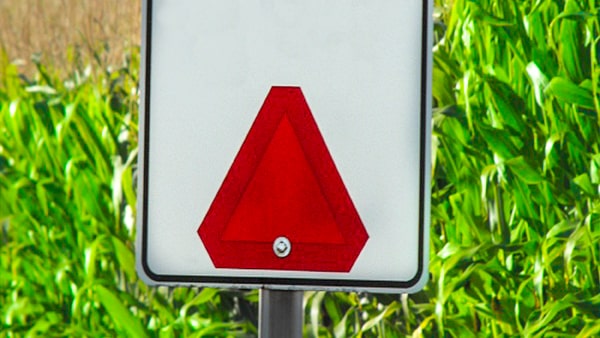
In Ohio, an orange triangle with a red border displayed on the rear of a vehicle identifies:

An orange and red sign of this shape always means:
  1. A A truck weighing less than 18,000 pounds
  2. B A vehicle with priority over other traffic
  3. C A slow-moving vehicle
  4. D An emergency-response vehicle

Correct answer: C – A slow-moving vehicle

The triangular orange-and-red emblem identifies a slow-moving vehicle. Such a vehicle generally may not be operated on a street or highway at a speed exceeding 25 mph and must display the emblem unless a statutory exception applies. The emblem must be mounted where it is visible from at least 500 feet to the rear.

Source: ORC § 4513.112(A)–(C) – Speed and emblem requirements for slow moving vehicles, Ohio Driver Manual — § 9, “Slow Moving Vehicles”

Question 3

A continuous painted median outlined by two pairs of solid double yellow lines is intended to:

  1. A Provide a lane for entering private driveways
  2. B Form a flush median island separating opposing traffic
  3. C Create a lane for beginning or completing left turns
  4. D Mark the right edge of the roadway

Correct answer: B – Form a flush median island separating opposing traffic

Two sets of double solid yellow lines may be used to form a continuous flush median island between opposing traffic streams. The area is a painted island, not a through lane or two-way left-turn lane. Any diagonal markings placed within this type of median are also yellow because the island separates opposite directions of travel.

Source: Ohio Manual on Uniform Traffic Control Devices — § 3J.03, “Islands Designated by Pavement Markings”

Question 4

In Ohio, what must you verify before crossing a broken lane line?

  1. A That the movement can be completed safely without interfering with traffic
  2. B That you are turning into a private driveway
  3. C That the vehicle ahead is disabled
  4. D That you are traveling on a one-way street

Correct answer: A – That the movement can be completed safely without interfering with traffic

A broken line can permit a lane change or, when it is a yellow centerline, a passing maneuver. The driver must first determine that moving from the lane can be done safely. A broken marking does not create an unconditional right to cross when the movement would conflict with other traffic.

Source: ORC § 4511.33(A)(1) – Driving in marked lanes, Ohio Driver Manual — § 4, “Lane Pavement Markings”

Question 5

At a stop sign with a marked stop line, where must you make the required stop?

  1. A Far enough forward to see all cross traffic
  2. B After crossing the stop line
  3. C Before reaching the stop line
  4. D At least five feet before the sign

Correct answer: C – Before reaching the stop line

A driver approaching a stop sign must stop at the clearly marked stop line. If there is no stop line, the driver stops before entering the near-side crosswalk. When neither marking exists, the driver stops at the nearest point that provides a view of traffic on the intersecting roadway.

Source: ORC § 4511.43(A) – Right-of-way rule at through highways, stop signs, yield signs

Question 6

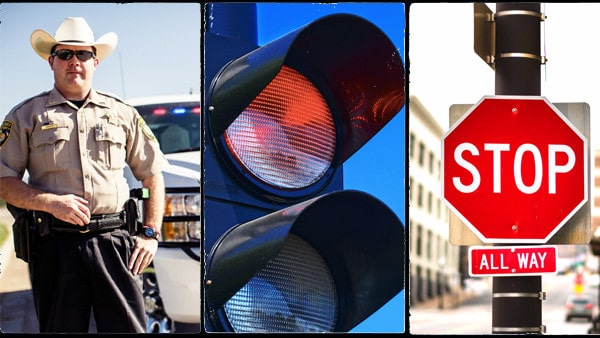
On an Ohio road, which instruction takes priority when it conflicts with the other choices?

Which of the following must you obey over the other three?
  1. A A steady red traffic signal
  2. B A police officer's direction
  3. C A stop sign
  4. D A flashing red signal

Correct answer: B – A police officer's direction

Drivers generally must obey signs and signals, but the law creates an exception when a police officer directs traffic differently. The officer's current instruction takes priority over a steady red light, flashing red light, or stop sign. Follow the specific movement indicated by the officer.

Source: ORC § 4511.12(A) – Obedience to traffic control devices