Ohio DMV Sign Test 3

4.8 out of 5 (498 votes)
80% Passing score
20 Questions
4 Mistakes allowed
A red octagon sign is pretty easy. The trouble starts a little after that, when the Ohio permit test expects you to sort out sign shape, color, wording, and meaning without pausing to mentally rebuild the whole driver manual in your head. That is the point of this Ohio road signs practice test: not to make signs feel complicated, but to make them feel automatic enough that you are not guessing your way through the real exam. For a standard Class D TIPIC, Ohio road sign questions are part of the main Ohio BMV knowledge test. They are not handled as a separate road-sign-only exam, which is a detail worth knowing before you study. The official test covers more than signs, including Ohio motor vehicle laws, rules of the road, highway traffic control devices, safe driving practices, driver responsibilities, and the material found in the Ohio Driver Manual / Digest of Motor Vehicle Laws. So this practice test narrows the focus on traffic signs, but it still fits into the bigger Ohio temps test picture. You get 20 questions here, built around the sign recognition skills Ohio expects new drivers to know before they earn a Temporary Instruction Permit Identification Card. Some questions deal with common signs you have seen for years. Others lean more on shape, color, placement, or the exact meaning of a traffic control sign, which is where a person can be almost right and still wrong. A little irritating, yes, but also fair enough; on the road, “close enough” is not really the standard. The real Ohio permit knowledge test has 40 multiple-choice questions, and you need a 75% score to pass. That means 30 correct answers out of 40, with no more than 10 missed. Applicants may test at 15 years and 6 months old. If you fail, you must wait one day before retesting. In-person testing allows unlimited attempts, one per day, while online testing allows two attempts within a six-month period. After each attempt at this BMV practice test, you can review your answers and use the explanations to catch the details you missed. Since questions come from a larger pool, repeat attempts give you fresh Ohio road sign recognition practice instead of the same tired run-through.
FREE DMV Practice Test App
Study for your Ohio permit test or driver’s license with the NextDoorDriving app. 700+ DMV questions and answers, 100% free!
Download on the App Store

Sample Ohio Permit Test Questions

Question 1

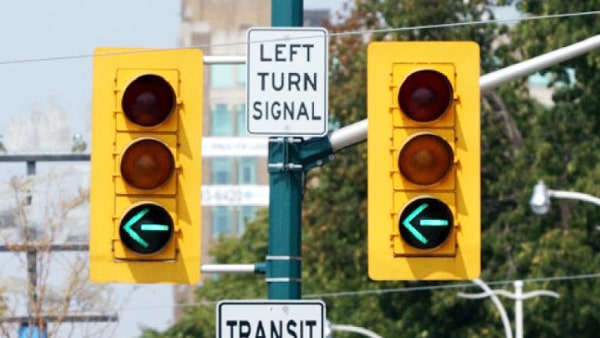
A green left-turn arrow changes to a steady circular green signal. If you still intend to turn left, you must:

  1. A Yield to pedestrians and to oncoming vehicles that present an immediate hazard
  2. B Wait until the green arrow returns
  3. C Assume the left turn remains protected from oncoming traffic
  4. D Turn without checking because the circular green gives absolute priority

Correct answer: A – Yield to pedestrians and to oncoming vehicles that present an immediate hazard

Under Ohio law, a circular green signal permits a left turn unless another traffic-control device restricts the movement. A left-turning driver must yield to pedestrians lawfully in the associated crosswalk and to oncoming vehicles close enough to create an immediate hazard. The change from an arrow to a circular green does not prohibit the turn, but the applicable yielding duties remain.

Source: ORC § 4511.13(A)(1), (2) – Highway traffic signal indications; section not applicable to railroad crossings


Question 2

What hazard does a Shoulder Drop Off warning sign identify?

What should you be most concerned about when you see this sign?
  1. A Headlights may become misaligned on the uneven roadway
  2. B A tire will be damaged if it touches the shoulder
  3. C Water on the shoulder will always cause hydroplaning
  4. D A wheel leaving the pavement may drop onto a lower shoulder and affect vehicle control

Correct answer: D – A wheel leaving the pavement may drop onto a lower shoulder and affect vehicle control

The Shoulder Drop Off sign warns of an unprotected shoulder that is substantially lower than the adjacent travel lane. Uneven surface drop-offs can contribute to serious crashes if a vehicle leaves the pavement. The driver manual advises releasing the accelerator, slowing gradually, and returning to the pavement only when it is safe.

Source: Ohio Manual on Uniform Traffic Control Devices — § 2C.29, “Shoulder Signs (W8-4, W8-9, W8-17, W8-23, and W8-25)”, Ohio Driver Manual — § 10, “Uneven Surface Drop-Offs”

Question 3

Which warning sign indicates that you are entering a roadway carrying traffic in both directions?

  1. A Two lanes becoming one
  2. B Divided highway ending
  3. C Two vertical arrows pointing in opposite directions
  4. D Two horizontal arrows pointing left and right

Correct answer: C – Two vertical arrows pointing in opposite directions

The two opposing vertical arrows identify the Two-Way Traffic sign. It warns that vehicles will travel in opposite directions on the roadway ahead. Ohio's adopted traffic-control standard permits this sign at transitions from divided or one-way roadways and as a reminder along a two-way road.

Source: Ohio Supplement and Federal Manual on Uniform Traffic Control Devices, 11th Edition — § 2C.51, “Two-Way Traffic Sign (W6-3)”

Question 4

Under Ohio law, when may you move left of center to pass on a two-lane, two-way road?

On a two-way highway, you are allowed to drive on the left half of the roadway when:
  1. A Whenever the centerline is double solid yellow
  2. B When traffic ahead is moving below the speed limit
  3. C When passing is permitted and the left side is clear for a safe distance
  4. D When a hill or curve blocks your view ahead

Correct answer: C – When passing is permitted and the left side is clear for a safe distance

Drivers normally travel on the right half of the roadway but may move left to lawfully overtake another vehicle. The left side must be clearly visible and free of oncoming traffic far enough ahead to complete the maneuver safely. When using an opposing lane, the passing vehicle must return to an authorized lane before coming within 200 feet of an approaching vehicle.

Source: Ohio Rev. Code § 4511.25(A)(1) — Lanes of Travel Upon Roadways of Sufficient Width, Ohio Rev. Code § 4511.29(A) — Driving to Left of Center of Roadway in Overtaking and Passing Traffic Proceeding in Same Direction

Question 5

What may a driver do when facing a steady green left arrow?

A green arrow pointing to the left on a traffic light means you may:
  1. A Turn left or continue straight, regardless of other signals
  2. B Stop before turning in the arrow's direction
  3. C Turn left cautiously after yielding to lawful users still in the intersection
  4. D Turn without checking because the arrow provides an absolute right-of-way

Correct answer: C – Turn left cautiously after yielding to lawful users still in the intersection

A green arrow permits a driver to enter cautiously and make the movement shown by the arrow. The driver must still yield to pedestrians lawfully in an associated crosswalk and to other traffic lawfully using the intersection. The arrow does not authorize driving straight unless another displayed signal permits that movement.

Source: Ohio Rev. Code § 4511.13(A)(2) — Highway Traffic Signal Indications; Section Not Applicable to Railroad Crossings

Question 6

What does a steady circular yellow traffic signal tell you?

  1. A The signal will remain green for through traffic
  2. B You may proceed without checking the intersection
  3. C The green movement is ending; use caution and prepare to stop
  4. D It has the same meaning as a steady red signal

Correct answer: C – The green movement is ending; use caution and prepare to stop

A steady yellow signal warns that the related green movement is ending or that a steady red signal will appear immediately afterward. Use caution and prepare to stop. The rules governing the movement being ended continue to apply while the yellow indication is displayed, so yellow is not treated as an immediate red signal.

Source: Ohio Rev. Code § 4511.13(B)(1) — Highway Traffic Signal Indications; Section Not Applicable to Railroad Crossings, Ohio Driver Manual — § 4, “Traffic Signals”