


Oklahoma Permit Practice Test

4.6 out of 5 (1952 votes)
80% Passing score
20 Questions
4 Mistakes allowed
Oklahoma gives you a fairly compact written test, but compact does not mean casual. The official Class D knowledge test has 20 multiple-choice questions, and you need 15 correct answers to pass. That is only five misses, which sounds forgiving for about two seconds, until you remember the test can pull from traffic laws, road signs, right-of-way rules, safe driving habits, pavement markings, signals, lane use, and those small state-specific details people swear they “basically know.” Sometimes they do. Sometimes they very much do not. This Oklahoma DMV practice permit test is built around that real format, so you are practicing with the same 20-question rhythm you will see on the actual written exam. The questions are not copied from the restricted state test — nobody legitimate is offering that — but they are written to reflect the kind of material Service Oklahoma expects new drivers to understand. Think road signs, work zones, school zones, emergency vehicles, license rules, and the everyday driving decisions that get less obvious once they are turned into multiple-choice wording. There are a few Oklahoma details worth treating seriously, even if they seem like footnotes at first. The online written test has a 60-minute limit and can be taken twice online before you have to test in person. A failed written test can also add a $4 fee to your account, due when your permit or license is issued. Not a disaster, obviously, but still something you would rather not collect like a souvenir. Teen drivers have more moving parts behind the test, too. Oklahoma’s graduated licensing system includes the learner permit, the 180-day holding period, 50 hours of supervised driving, 10 of those at night, and the Work Zone Safe Course before moving to an intermediate license. Adults have a different path, but they still need the written test unless it is waived through qualifying driver education. Use this Oklahoma permit test practice as a real check on what you know, not as a quick skim before test day. Read the Oklahoma Driver Manual, pay attention to the signs, and then work through the practice questions until the rules feel boring in the best possible way — familiar, steady, and not capable of surprising you at the counter.
FREE DMV Practice Test App
Study for your Oklahoma permit test or driver’s license with the NextDoorDriving app. 700+ DMV questions and answers, 100% free!
Download on the App Store

Sample Oklahoma Permit Test Questions

Question 1

You have a green light for a right turn while a pedestrian on your right enters the crosswalk on a WALK signal. Who must yield?
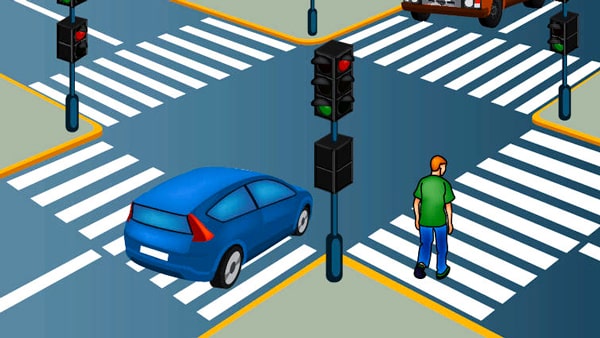
You are waiting at a red light to turn right, and a pedestrian on your right is waiting to cross the street you want to enter. Who has the right-of-way when your light turns green?
  1. A. The turning driver must yield to the pedestrian
  2. B. The driver yields only if painted crosswalk lines are present
  3. C. The pedestrian must yield because the vehicle has a green light
  4. D. Whichever road user moves second must yield

Correct answer: A. – The turning driver must yield to the pedestrian

A pedestrian facing a WALK signal may proceed and must be given the right-of-way. A driver turning on green must yield to pedestrians lawfully within the adjacent crosswalk. Wait until the pedestrian is clear of your turning path before completing the turn.

Source: 47 O.S. § 11-202(1)(a) – Traffic-Control Signal Legend, 47 O.S. § 11-203(1) – Pedestrian-Control Signals

Question 2

Compared with a lap-only belt, a properly worn lap-and-shoulder belt is:

  1. A. Less effective during low-speed travel
  2. B. Generally more protective in a collision
  3. C. Designed primarily to prevent crashes
  4. D. Useful only in heavy traffic

Correct answer: B. – Generally more protective in a collision

A lap-and-shoulder belt provides more complete restraint than a lap belt alone. Both portions should be positioned and fastened correctly for the protection the system is designed to provide. Seat belts reduce injury risk during a crash; they do not prevent the crash itself.

Source: Oklahoma Driver Manual — Ch. 3, “Mandatory Safety Requirements—Seat Belts and Child Passenger Restraints”

Question 3

If your vehicle is equipped with airbags, when should you fasten your seat belt?

  1. A. Only while traveling on freeways
  2. B. On every trip unless legally exempt
  3. C. Only when driving outside city limits
  4. D. Only at speeds above 35 mph

Correct answer: B. – On every trip unless legally exempt

Oklahoma requires the operator and covered front-seat passengers to wear properly adjusted and fastened seat belts, subject to statutory exemptions. Airbags are supplemental restraints and are not a substitute for fastening the belt. Wear the lap and shoulder portions in their intended positions whenever you travel.

Source: 47 O.S. § 12-417(A)–(C) – Operators and Front Seat Passengers Required to Wear Safety Belts - Exemptions - Assessment of Points Prohibited - Fine and Court Costs Limited – Municipal Ordinances, Oklahoma Driver Manual — Ch. 3, “Mandatory Safety Requirements—Seat Belts and Child Passenger Restraints”

Question 4

Which pavement-line color separates traffic traveling in opposite directions?

  1. A. White
  2. B. Red
  3. C. Black
  4. D. Yellow

Correct answer: D. – Yellow

Yellow lines separate traffic moving in opposite directions. They may be solid, broken, or used in combinations that communicate passing restrictions. White lines generally separate lanes carrying traffic in the same direction or mark the right edge of a roadway.

Source: Oklahoma Driver Manual — Ch. 4, “Pavement Markings”

Question 5

When towing a trailer in Oklahoma, its coupling system must be designed so the trailer:

  1. A. Cannot be driven faster than 45 mph
  2. B. Follows substantially in the towing vehicle’s path without whipping or swerving
  3. C. May be used only with special state permission
  4. D. Meets all of these conditions

Correct answer: B. – Follows substantially in the towing vehicle’s path without whipping or swerving

State law requires a trailer’s coupling device to be designed and constructed so the trailer follows substantially in the towing vehicle’s path without whipping or swerving from side to side. The statute also requires qualifying trailers to have stay chains, cables, or another approved safety device. It does not establish a universal 45-mph towing limit or permit requirement.

Source: 47 O.S. § 12-405.1 – Coupling Devices - Stay Chains, Cables or Other Safety Devices

Question 6

To identify hazards early and avoid abrupt maneuvers, how far ahead should you normally scan?

  1. A. Four to six seconds
  2. B. Six to eight seconds
  3. C. 10 to 15 seconds
  4. D. 15 to 30 seconds

Correct answer: C. – 10 to 15 seconds

Scan approximately 10 to 15 seconds ahead rather than focusing only on the vehicle in front. This broader view gives you more time to notice changing traffic, signals, stopped vehicles, and roadway hazards. Early recognition allows smoother speed or lane adjustments instead of last-second movements.

Source: Oklahoma Driver Manual — Ch. 11, “Pay Attention—Be Alert”