Oklahoma Drivers Ed Practice Test 8

4.8 out of 5 (326 votes)
80% Passing score
20 Questions
4 Mistakes allowed
Oklahoma gives you 20 questions on the current Service Oklahoma online written exam, which sounds mercifully brief until you remember that 15 of them have to be right. The test is multiple-choice, based on the Oklahoma Driver Manual, and it comes with a 60-minute limit, so there is technically time to think things through—though maybe not time to relearn every right-of-way rule from scratch while the clock sits there judging you. This Oklahoma practice permit test follows that same 20-question setup and leans into one of the areas new drivers tend to treat a little too casually: intersections. Four-way stops, left turns, who yields, who waits, who absolutely should not wave everyone through like they are directing traffic at a church potluck—it all matters. Oklahoma roads can change character fast, too. One day you are dealing with Tulsa traffic, the next you are rolling up to a quiet rural stop near Duncan or Guymon where the rules are the same but the situation feels looser, which is exactly how people start guessing. Bad plan. Very human, but still a bad plan. The real Class D knowledge test covers traffic laws, road signs, safe driving habits, and the general licensing knowledge Service Oklahoma expects you to have before moving forward. Applicants under 18 use the written test as part of the learner permit process, and a parent or guardian has to be present to verify identity before the online test begins. Adults 18 and older can apply for a first Oklahoma Class D license after passing the written, vision, and drive tests, although they can choose to get a learner permit first for practice. Tiny bureaucratic wrinkle, because of course there is one: if an adult gets a learner permit, they must hold it for 30 days before applying for the unrestricted license. The online written test can be taken twice online. After two failed attempts, you have to test in person at a Service Oklahoma location, and failed written tests add a $4 fee due when the permit or license is issued. So, honestly, a driver ed practice test is a pretty painless way to make the real thing less mysterious. You get immediate feedback, corrected answers, and image-based questions that make intersection setups easier to read. It is available online anytime, which means you can study at a normal hour—or at some deeply questionable hour when your brain insists it is finally ready to understand yielding.
FREE DMV Practice Test App
Study for your Oklahoma permit test or driver’s license with the NextDoorDriving app. 700+ DMV questions and answers, 100% free!
Download on the App Store

Sample Oklahoma Permit Test Questions

Question 1

A yellow diamond sign showing a short road entering the main road from the right means:

This sign means:
  1. A. All traffic must turn right
  2. B. A side road enters ahead
  3. C. All traffic must continue straight
  4. D. Right turns are prohibited

Correct answer: B. – A side road enters ahead

A yellow diamond sign with a short branch entering the main road warns of a side road ahead. It alerts you to an approaching intersection and the possibility of entering traffic. As a warning sign, it does not require all traffic to turn or prohibit a right turn.

Source: Oklahoma Driver Manual — Ch. 4, “Warning Signs—Black on a Yellow Background”

Question 2

Under Oklahoma law, which situation is an exception to stopping for a school bus displaying red loading signals?

The only time you do not have to stop for a school bus whose red lights are flashing and Stop arm is extended is when you:
  1. A. No children are visible near the bus
  2. B. Your vehicle is traveling behind the bus
  3. C. The bus is stopped on a different roadway of a divided highway
  4. D. The left lane appears clear enough to pass

Correct answer: C. – The bus is stopped on a different roadway of a divided highway

Under Oklahoma law, drivers meeting or overtaking a stopped school bus with red loading signals must stop and remain stopped until the signals are deactivated. A driver on a different roadway of a highway with separate roadways is exempt. Another exception applies on a controlled-access highway when the bus is in a qualifying loading zone where pedestrians may not cross. A conviction carries a fine of at least $100 plus a $100 special assessment.

Source: 47 O.S. § 11-705 – Meeting or Overtaking Stopped School Bus

Question 3

If you become too drowsy to continue driving safely, what should you do?

  1. A. Use cold air and caffeine to remain awake
  2. B. Turn up the radio and open the windows
  3. C. Leave the roadway at a safe location and sleep or rest
  4. D. Increase your speed to shorten the trip

Correct answer: C. – Leave the roadway at a safe location and sleep or rest

Drowsiness reduces the alertness needed to operate a vehicle safely. The official Oklahoma commercial manual states that the safe response is to get off the road and sleep. Cold air, loud music, and caffeine do not eliminate the need for rest. Stop at a safe location rather than continuing while sleepy.

Source: Oklahoma Commercial Driver License Manual — § 2.11.5, “Night Driving Procedures”

Question 4

Which statement about Oklahoma work zones is incorrect?

  1. A. Orange signs identify construction or maintenance areas
  2. B. A posted-speed violation may carry a doubled fine when work is underway and workers are present
  3. C. White regulatory signs are the usual warning signs for lane closures and road work ahead
  4. D. Drivers must follow directions given by work-zone flaggers

Correct answer: C. – White regulatory signs are the usual warning signs for lane closures and road work ahead

Construction and maintenance warnings use orange signs, barricades, cones, and similar traffic-control devices. White-and-black signs generally communicate regulatory requirements rather than serving as the standard road-work warning signs. A speeding fine is doubled in an active repair, maintenance, or construction zone when workers are present. Drivers must also obey flaggers directing traffic.

Source: Okla. Stat. tit. 47, § 11-806(C) – Special speed limitations, Oklahoma Driver Manual — Ch. 4, “Construction and Maintenance Signs”

Question 5

Before leaving a vehicle parked on a hill, you should set the parking brake and:

  1. A. Select Park or the appropriate low or reverse gear
  2. B. Leave the transmission in neutral
  3. C. Keep the transmission in Drive
  4. D. Leave the engine running

Correct answer: A. – Select Park or the appropriate low or reverse gear

A parked vehicle may roll if it is not properly secured. Set the parking brake and place an automatic transmission in Park; for a manual transmission, select low or reverse gear as appropriate. The Oklahoma manual also provides separate instructions for turning the front wheels depending on whether the vehicle faces uphill or downhill.

Source: Oklahoma Driver Manual — Ch. 9, “Parking and Starting on a Hill”

Question 6

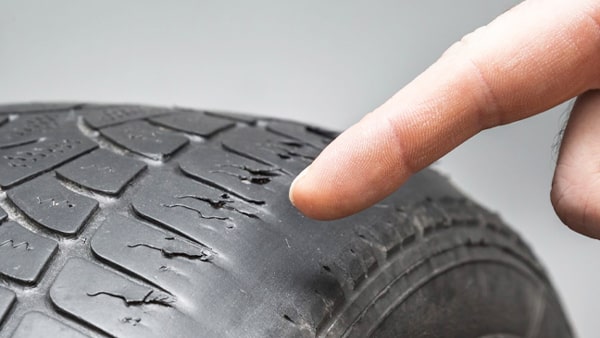
Which tire condition makes a vehicle unlawful to operate on an Oklahoma highway?

Worn or bald tires:
  1. A. A tire has exactly 4/32 inch of tread
  2. B. A tire in use has less than 2/32 inch of tread
  3. C. The tires have been rotated recently
  4. D. The tires are inflated to the vehicle manufacturer's recommendation

Correct answer: B. – A tire in use has less than 2/32 inch of tread

State law prohibits operating a vehicle when any tire in use is unsafe or has less than 2/32 inch of tread. Tread depth is measured as specified by the equipment statute. Tires should be inspected regularly and replaced before they fall below the legal minimum or otherwise become unsafe.

Source: Okla. Stat. tit. 47, § 12-405(F) – Tires and wheels - Peripheral equipment - Unsafe operating condition