


Oklahoma Driving Test Practice 9

4.8 out of 5 (301 votes)
80% Passing score
20 Questions
4 Mistakes allowed
On the Oklahoma drivers permit test, questions about school buses are not filler. They deal with moments where a driver has to know, without wobbling around mentally, when to stop, when traffic in the other direction must stop, and what to do when children are getting on or off a bus. This Oklahoma drivers practice test focuses on that exact slice of the rules, which is narrower than “all of driving,” sure, but it is also one of the areas where guessing is a rotten strategy. The official Oklahoma Class D written knowledge test is multiple choice and includes 20 questions. You need 15 correct answers to pass, so 5 misses is the limit. There is a 60-minute time limit, and the online version allows 2 attempts before you have to wait until tomorrow to try again. This Oklahoma DMV practice test keeps the same 20-question format, giving you a realistic way to work through school bus laws without burying them under every other permit topic at once. The questions here cover school buses loading or unloading children, safe stopping rules, and the kind of situations that show up on Oklahoma roads all the time — rural routes, neighborhood streets, two-lane roads, and those slightly awkward places where everyone seems to hesitate for half a second. After the test, you can review what you missed, read the explanations, and use the hints to sort out the rule instead of just memorizing the answer. There is a difference, and it matters. For younger drivers, this practice also fits into the bigger licensing picture. Oklahoma allows a learner permit at 15 with approved driver education, or at 16 without it. Before moving on, teen drivers must hold the permit for 180 days and complete 50 hours of supervised driving, including 10 at night, with a supervising driver who is at least 21 and has been licensed for at least 2 years. So this drivers permit practice test is not just a warm-up for the written exam. It is a small but important part of learning how to make the correct call when a stopped school bus, a line of traffic, and a few unpredictable kids all meet in the same place.
FREE DMV Practice Test App
Study for your Oklahoma permit test or driver’s license with the NextDoorDriving app. 700+ DMV questions and answers, 100% free!
Download on the App Store

Sample Oklahoma Permit Test Questions

Question 1

Before changing lanes to pass another vehicle in Oklahoma, how long must you signal?

  1. A. Only while the vehicle crosses the lane line
  2. B. There is no minimum distance if the lane appears clear
  3. C. Only after entering the passing lane
  4. D. For at least the last 100 feet before the lane change

Correct answer: D. – For at least the last 100 feet before the lane change

Before moving from a marked lane, the driver must first determine that the movement can be made safely and signal for at least the last 100 feet traveled. Check mirrors, blind spots, and traffic before entering the passing lane. Signal again and verify that it is safe before returning to the original lane.

Source: 47 O.S. § 11-309(2) – Driving on roadways laned for traffic, Oklahoma Driver Manual — Ch. 6, “Passing”

Question 2

Which statement best describes alcohol's effect even below the legal BAC limit?

  1. A. Judgment remains unaffected until the legal limit is reached
  2. B. Judgment and driving skill may already be impaired
  3. C. Only muscle control changes, while decisions remain reliable
  4. D. Reflexes and decision-making may temporarily improve

Correct answer: B. – Judgment and driving skill may already be impaired

The Oklahoma Driver Manual states that impairment of judgment and driving skill begins well below the legal BAC limit. A driver should not treat a BAC below 0.08 as proof that driving ability is unaffected. Alcohol may weaken decision-making before the drinker recognizes the impairment.

Source: Oklahoma Driver Manual — Ch. 12, “Criminal Evidence and Penalties”

Question 3

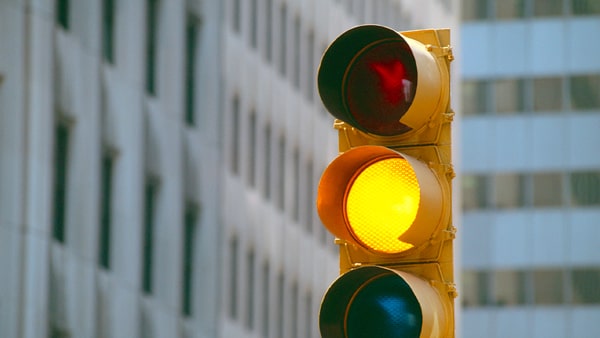
The signal changes from green to yellow as you approach an intersection. What should you do?

As you near an intersection, the traffic light changes from green to yellow. Your best action would be to:
  1. A. Accelerate to enter before the red signal appears
  2. B. Brake sharply regardless of your distance from the intersection
  3. C. Plan to stop after entering the intersection
  4. D. Stop before the intersection if you can do so safely

Correct answer: D. – Stop before the intersection if you can do so safely

A steady yellow signal warns that the related green indication is ending. Stop before entering the intersection when there is enough distance to do so safely. If stopping would be unsafe because you are already too close, continue cautiously through the intersection rather than accelerating or stopping within it.

Source: 47 O.S. § 11-202 – Traffic-control signal legend, Oklahoma Driver Manual — Ch. 4, “Traffic Signals”

Question 4

What is an effective way to manage drowsiness during a long drive?

  1. A. Turn up the radio and continue driving
  2. B. Reduce speed but continue without a break
  3. C. Stop in a safe place to rest or switch drivers
  4. D. Keep moving your eyes from side to side

Correct answer: C. – Stop in a safe place to rest or switch drivers

Fatigue slows reactions, weakens judgment, and can cause a driver to fall asleep without warning. Turning up the radio, opening a window, or trying to push through the tiredness does not restore alertness. Stop at a safe location to rest, or allow a rested person to take over the driving.

Source: Oklahoma Driver Manual — Ch. 6, “Fatigue and Drowsy Driving”

Question 5

A yellow chevron sign pointing to the right marks:

When you see this sign, it means:
  1. A. An obstruction in the center of the roadway
  2. B. Traffic entering from a road on the right
  3. C. A sharp change in the road's direction to the right
  4. D. A merging lane immediately ahead

Correct answer: C. – A sharp change in the road's direction to the right

Chevron alignment signs emphasize a sharp change in the roadway's direction. The direction of the chevron shows the direction in which the road turns. Drivers should reduce speed before the curve and follow the roadway alignment indicated by the signs.

Source: Oklahoma Driver Manual — Ch. 4, “Warning Signs—Black on a Yellow Background”

Question 6

In Oklahoma, high beams must be dimmed when you are following another vehicle within how many feet?

  1. A. 600 feet
  2. B. 1,000 feet
  3. C. 300 feet
  4. D. 200 feet

Correct answer: A. – 600 feet

When following another vehicle within 600 feet, a driver must use a beam other than the uppermost high-beam distribution. High beams must also be dimmed for an oncoming vehicle within 1,000 feet. These distances reduce glare that could interfere with another driver's vision.

Source: 47 O.S. § 12-203.2(1)–(2) – Use of distribution of light or composite beam lighting equipment