Oklahoma DMV Test Evaluation

4.6 out of 5 (2865 votes)
80% Passing score
10 Questions
2 Mistakes allowed
Oklahoma’s permit test is not trying to trick you with trivia. It is checking whether you have actually absorbed the rules Service Oklahoma expects a new driver to know before handing over a learner permit or first Class D license. That means traffic laws, road signs, pavement markings, right-of-way, work zones, school zones, and the kind of safe-driving judgment that sounds obvious until the answer choices start looking uncomfortably similar. The official Oklahoma Class D written knowledge test is based on the Oklahoma Driver Manual. The current exam has 20 multiple-choice questions, and you need 15 correct answers to pass. You get 60 minutes, which is plenty of time if you know the material and a very long hour if you are guessing your way through signs, lane rules, and who-goes-first situations. This free Oklahoma permit practice test is built as a quick readiness check before you take the real thing. It gives you 10 random questions from core Oklahoma driving topics, including road signs, traffic rules, and common permit-test scenarios. To pass this practice round, you need 8 out of 10 correct. No, that is not the exact same format as the official Service Oklahoma written test, and it should not be treated like the whole study plan. But it does tell you something useful, which is where your knowledge is solid and where it is still a little shaky in that inconvenient, “I thought I knew this” sort of way. It also helps to remember that Oklahoma driving is not one single setting. Oklahoma City traffic asks for comfort with signals, lane changes, and heavier traffic flow. Rural driving can bring narrow roads, farm equipment, livestock crossings, and long stretches where paying attention becomes its own quiet discipline. The better Oklahoma DMV practice test questions reflect that mix instead of pretending every road looks the same. You can take the official written test online through KnowTo Drive or in person at a Service Oklahoma Licensing Office or participating Licensed Operator. Online testing requires a computer with a webcam and microphone, is available in English, and allows two attempts before you have to test in person. Even after passing online, you still need to visit Service Oklahoma or a Licensed Operator for documents, vision screening, and permit or license issuance. Use this Oklahoma driver permit practice test as your first serious pass through the material. If you pass cleanly, keep practicing anyway. If you miss a few, good — that is exactly the point. Better to find the weak spots here than discover them when the official test is already underway.
FREE DMV Practice Test App
Study for your Oklahoma permit test or driver’s license with the NextDoorDriving app. 700+ DMV questions and answers, 100% free!
Download on the App Store

Sample Oklahoma Permit Test Questions

Question 1

Which practice is an example of defensive observation?

  1. A. Using one fixed following distance in every condition
  2. B. Watching only the vehicle directly ahead
  3. C. Scanning ahead, to the sides, and in the mirrors for hazards
  4. D. Looking in the mirrors instead of watching the road ahead

Correct answer: C. – Scanning ahead, to the sides, and in the mirrors for hazards

Defensive observation requires awareness of traffic and roadway conditions in several directions. Look well ahead for developing hazards while making regular checks to the sides and rear. Focusing only on the vehicle ahead can prevent you from noticing pedestrians, merging traffic, or an available escape path.

Source: Oklahoma Commercial Driver License Manual — §§ 2.4.1–2.4.2, “Seeing Ahead” and “Seeing to the Sides and Rear”
Question 2

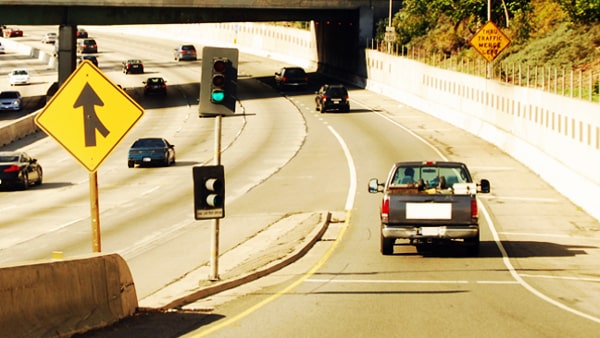
When using an acceleration lane to enter an expressway, your speed should generally be:

When entering a freeway entrance that allows you to accelerate to merge, you should drive at:
  1. A. About 10 mph slower than traffic throughout the merge
  2. B. Near the speed of expressway traffic, within legal and safe limits
  3. C. Exactly the posted maximum, regardless of conditions
  4. D. Faster than every vehicle already on the expressway

Correct answer: B. – Near the speed of expressway traffic, within legal and safe limits

Use the acceleration lane to build enough speed to merge smoothly with traffic. Select an available gap, signal, and enter only when the movement can be made safely. The Oklahoma manual also instructs expressway drivers to maintain lawful speeds appropriate for traffic and road conditions. Matching traffic does not authorize exceeding the speed limit.

Source: Oklahoma Driver Manual — Ch. 6, “Expressway Driving”

Question 3

After overtaking another vehicle, which observation indicates that you have enough clearance to return to the right lane?

After passing a car, it is safe to return to your driving lane when:
  1. A. You have signaled for exactly four seconds
  2. B. The overtaken driver flashes the headlights
  3. C. You can see both headlights of the overtaken vehicle in your inside rearview mirror
  4. D. One headlight appears in your outside mirror

Correct answer: C. – You can see both headlights of the overtaken vehicle in your inside rearview mirror

Seeing both headlights in the inside rearview mirror is the manual's practical check that you are safely clear of the overtaken vehicle. Signal and verify that the lane is clear before moving back. The passing driver remains responsible for maintaining a safe distance and not returning to the right until safely clear.

Source: Okla. Stat. tit. 47, § 11-303 – Overtaking a vehicle on the left - Signal, Oklahoma Driver Manual — Ch. 6, “Passing”

Question 4

Before changing lanes on an Oklahoma multilane highway, which condition must you verify?

Before changing lanes on a multi-lane highway you should:
  1. A. Your horn has been sounded
  2. B. Your headlights are on high beam
  3. C. Traffic behind you has reduced speed
  4. D. The lane and your blind spot are clear

Correct answer: D. – The lane and your blind spot are clear

A driver may not leave a marked lane until the movement has been determined safe and properly signaled. Check the mirrors for traffic behind and beside you, then look over the appropriate shoulder to inspect the blind spot. Signal for at least the final 100 feet before changing lanes, as required by state law.

Source: Okla. Stat. tit. 47, § 11-309(2) – Driving on roadways laned for traffic, Oklahoma Driver Manual — Ch. 6, “Changing Lanes”

Question 5

When traffic is moving lawfully and conditions do not require a lower speed, what should you avoid?

  1. A. Allowing faster traffic to pass when appropriate
  2. B. Driving so slowly that you impede normal and reasonable traffic
  3. C. Reducing speed for rain, limited visibility, or another hazard
  4. D. Complying with a posted minimum speed

Correct answer: B. – Driving so slowly that you impede normal and reasonable traffic

Oklahoma law prohibits driving at a speed so slow that it impedes normal and reasonable traffic. The rule contains important exceptions when reduced speed is necessary for safe operation or compliance with law. A driver should always slow when conditions make a higher speed unsafe, even if surrounding traffic is traveling faster.

Source: Okla. Stat. tit. 47, § 11-804 – Minimum speed regulation

Question 6

In Oklahoma, a driver without the required disability placard or license plate:

  1. A. May use a reserved space while waiting for a passenger
  2. B. May park there briefly with emergency flashers operating
  3. C. May use the adjoining access aisle instead of the space
  4. D. May not place or park a vehicle in the reserved space

Correct answer: D. – May not place or park a vehicle in the reserved space

A vehicle may not be placed or parked in a designated disability space without the required placard or license plate. Parking in the adjoining access aisle, wheelchair ramp, or loading area is prohibited even when a vehicle displays disability identification. A violation is a misdemeanor carrying a $500 fine, and the vehicle may be towed immediately.

Source: Okla. Stat. tit. 47, § 11-1007(A)–(B) – Parking areas for physically disabled persons - Violations and penalties