Oklahoma Road Signs Test

4.6 out of 5 (589 votes)
80% Passing score
10 Questions
2 Mistakes allowed
Oklahoma road signs deserve more attention than most people give them during permit test prep. They are a big part of the official Oklahoma Class D written knowledge test, mixed in with traffic laws, safe driving rules, signals, pavement markings, right-of-way, work zones, school zones, and the rest of the material pulled from the Oklahoma Driver Manual. So when you practice signs, you are not just polishing up a side category. You are studying testable material. This free Oklahoma road signs practice test gives you 20 multiple-choice questions built around the sign knowledge Oklahoma drivers are expected to have. The real Service Oklahoma written test also has 20 multiple-choice questions, with 15 correct answers required to pass, so the format should feel familiar without pretending to be the exact exam. And, honestly, that matters. Road signs can look obvious when you are scrolling through them casually, then become a little less obvious when color, shape, wording, and symbol details all start competing for attention. The questions in this Oklahoma DMV practice test focus on the signs and traffic-control clues you actually need to recognize: regulatory signs, warning signs, lane-use signs, school and work zone signs, traffic signals, pavement markings, and those shape-and-color rules that help you understand a sign before you have time to overthink it. Stop and yield signs are in the mix, of course, but so are the signs that ask for more than basic recognition. A driver should know not just what the sign is called, but what it requires next. Oklahoma gives applicants a few testing paths. The written test may be taken online through the KnowTo Drive platform, with a 60-minute limit and two online attempts before any further attempt has to happen in person. Passing online does not finish the licensing process, though. You still have to visit Service Oklahoma or a Licensed Operator for documents, vision screening, and the actual permit or license issuance, which is the part people sometimes forget until the appointment is already on the calendar. For teen drivers, the written test fits into Oklahoma’s Graduated Driver License system. A learner permit can start at 15 with approved driver education, or at 16 without it, and under-18 drivers later have supervised driving requirements and the Oklahoma Work Zone Safe Course before moving to an intermediate license. Adults 18 and older can apply through the adult Class D process and are not required to hold a learner permit before the drive test, though some choose one for practice. Use this Oklahoma practice permit test alongside the Oklahoma Driver Manual, not instead of it. Take it more than once if needed. The point is to make road sign recognition feel steady and automatic, because on the official Oklahoma DMV permit test—and on actual Oklahoma roads—you do not get much credit for “I sort of knew that one.”
FREE DMV Practice Test App
Study for your Oklahoma permit test or driver’s license with the NextDoorDriving app. 700+ DMV questions and answers, 100% free!
Download on the App Store

Sample Oklahoma Permit Test Questions

Question 1

If an intersection’s traffic signal is completely dark, what should you do?

  1. A. Wait at the intersection until power is restored
  2. B. Remain stopped until a police officer arrives
  3. C. Stop and follow the right-of-way rules for an intersection without signals
  4. D. Continue through at your normal speed

Correct answer: C. – Stop and follow the right-of-way rules for an intersection without signals

The Oklahoma manual directs drivers entering or crossing where no signal is controlling traffic to stop and yield before proceeding safely. At an intersection without operating signals, the vehicle arriving first proceeds first; simultaneous arrivals require the driver on the left to yield to the driver on the right. Continue only when the intersection is clear.

Source: Oklahoma Driver Manual — Ch. 5, “You Must Always Yield”, Oklahoma Driver Manual — Ch. 5, “Right-of-Way at Intersections”
Question 2

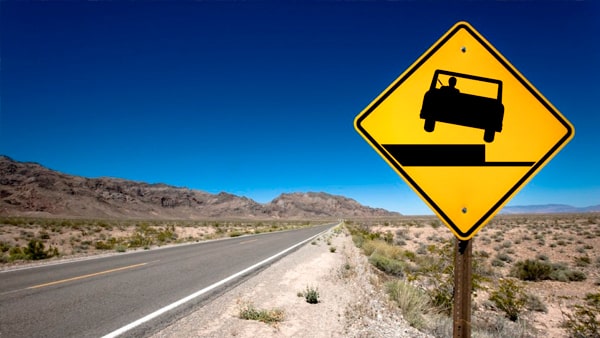
What hazard does a SHOULDER DROP-OFF warning sign identify?

What should you be most concerned about when you see this sign?
  1. A. Headlights may appear uneven because the roadway tilts
  2. B. Road debris is likely to puncture a tire
  3. C. Standing water is expected along the shoulder
  4. D. Wheels leaving the pavement may drop onto a lower shoulder

Correct answer: D. – Wheels leaving the pavement may drop onto a lower shoulder

This sign warns that the shoulder is below the pavement level. If a wheel leaves the roadway, the height difference can make an abrupt return to the pavement difficult and may contribute to loss of control. Avoid sharp steering or sudden braking while correcting your path.

Source: Oklahoma Driver Manual — Ch. 4, “Warning Signs”

Question 3

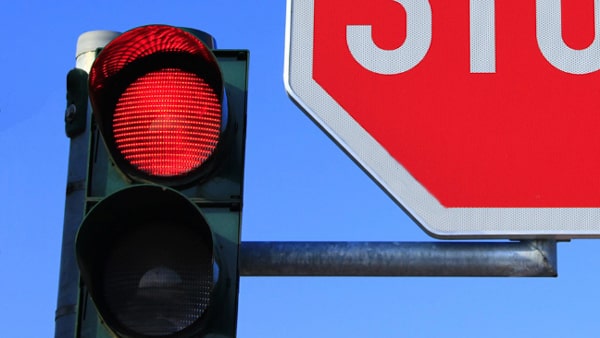
How must a driver respond to a flashing red traffic signal?

If you are approaching an intersection with a red flashing light, what should you do?
  1. A. Continue without reducing speed
  2. B. Slow and yield without stopping
  3. C. Wait until the signal displays green
  4. D. Stop, then proceed when permitted and safe

Correct answer: D. – Stop, then proceed when permitted and safe

A flashing red signal requires a complete stop before the crosswalk, marked limit line, or intersection, as applicable. After stopping, the driver must follow the right-of-way rules that apply at a stop sign. Proceed only when the movement can be made safely.

Source: 47 O.S. § 11-204(A)(1) – Flashing Signals, Oklahoma Driver Manual — Ch. 4, “Traffic Signals”

Question 4

A steady yellow arrow appears while you are preparing to turn left. What does it tell you?

  1. A. Left turns are immediately prohibited in every situation
  2. B. You should accelerate to complete the turn
  3. C. The current movement is ending, and you must be ready for the next signal
  4. D. Your turn remains protected from vehicles and pedestrians

Correct answer: C. – The current movement is ending, and you must be ready for the next signal

A steady yellow arrow warns that the related green movement is ending or that a red indication will appear immediately afterward. Do not speed up in an attempt to beat the signal. Be ready to stop and obey whichever signal is displayed next.

Source: 47 O.S. § 11-202(2)(a) – Traffic-Control Signal Legend, Oklahoma Driver Manual — Ch. 4, “Traffic Signals”

Question 5

Which colors are normally used for highway destination guide signs?

  1. A. Orange backgrounds with black lettering
  2. B. Green backgrounds with white lettering
  3. C. Yellow backgrounds with black lettering
  4. D. Red backgrounds with white lettering

Correct answer: B. – Green backgrounds with white lettering

Highway destination guide signs normally have green backgrounds with white letters, symbols, or borders. They help drivers identify routes, destinations, and exits. Orange signs generally concern temporary traffic control, while yellow signs provide warnings.

Source: Oklahoma Driver Manual — Ch. 4, “Guide Signs”

Question 6

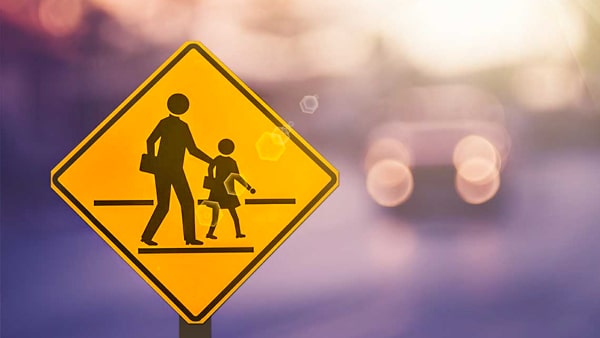
A yellow diamond sign showing a person walking warns that:

This sign means:
  1. A. Children are permitted to play in the roadway
  2. B. Pedestrians may be crossing ahead
  3. C. Pedestrians must remain on the sidewalk
  4. D. A stop sign is located ahead

Correct answer: B. – Pedestrians may be crossing ahead

The pedestrian-crossing sign warns that people may cross the roadway in the area ahead. Reduce speed as conditions require and watch both sides of the road. Be prepared to yield or stop for a pedestrian lawfully crossing.

Source: Oklahoma Driver Manual — Ch. 4, “Warning Signs”