


Oregon CDL General Knowledge Practice Test (OR) 2

4.9 out of 5 (118 votes)
80% Passing score
20 Questions
4 Mistakes allowed
As an aspiring commercial driver in Oregon, gearing up for your CDL is a critical step, and our second Oregon CDL practice test is here to help you ace the General Knowledge segment. Tailored to mirror the actual DMV written test, this practice test features 20 DMV questions covering a wide array of topics. You'll need to correctly answer at least 16 to pass, but don't worry, we're here to guide you through it. Our Oregon CDL general knowledge test practice is unique because it's updated for 2026, ensuring you're studying the most current rules and regulations. Unlike the real CDL test, our practice version isn't timed. This means you can take your time to thoroughly understand each DMV question, a vital part of your learning process. Taking your time now means you'll be quicker and more confident when it matters. The questions you'll encounter on this Oregon DMV general knowledge practice test are diverse, covering everything from vehicle inspection and basic control to more complex scenarios like gear shifting, navigating hills, and managing speed. You'll also find DMV questions about communication with other road users and important topics like drug and alcohol awareness. This broad range ensures you're well-prepared for any question the actual DMV written test throws your way. All our questions are based on the official CDL driver's manual, the same source used for the real Oregon DMV permit test. This alignment guarantees that if it's in the manual, it could be on your test, and if it's not in the manual, you won't need to worry about it here. This second Oregon CDL general knowledge practice test is a comprehensive tool designed to make you a safer, more knowledgeable driver in 2026. Whether you're aiming for a Class A or Class B license, or any endorsements, mastering this test puts you on the right track to achieving your driving goals. So, take your time, study hard, and remember, each permit test question is a stepping stone to your success on the road!
FREE CDL Practice Test App
Pass your Oregon CDL General Knowledge test with the NextDoorDriving app. Real questions and answers—100% free and ad-free.
Download on the App Store

Sample Oregon CDL Test Questions - General Knowledge

Question 1

What are the two functions of the emergency air line on a combination vehicle?

  1. A. It supplies air to the trailer air tanks
  2. B. It controls the trailer emergency brakes
  3. C. It performs both functions listed above
  4. D. It operates only the tractor parking brakes

Correct answer: C. – It performs both functions listed above

The emergency air line supplies air to the trailer air tanks and controls the emergency brakes. If pressure is lost in this line, the trailer emergency brakes come on and the tractor protection valve closes. Emergency lines are commonly identified by red hoses, couplers or other markings.

Source: Oregon Commercial Driver Manual — § 6.2.4, “Trailer Air-Lines”
Question 2

A small cardboard box is lying ahead in your lane. What should you do?

  1. A. Stop in the lane and direct traffic around it
  2. B. Strike it because cardboard cannot damage the vehicle
  3. C. Avoid it if you can do so without a sudden, unsafe maneuver
  4. D. Position the left steering tire to run over it

Correct answer: C. – Avoid it if you can do so without a sudden, unsafe maneuver

A cardboard box may be empty, but it could contain material capable of damaging tires, wheels, brake lines or other vehicle parts. Look far enough ahead to identify roadway objects early. Avoid the box when it is safe to do so without making a sudden maneuver that creates another hazard.

Source: Oregon Commercial Driver Manual — § 2.8.2, “Hazardous Roads”

Question 3

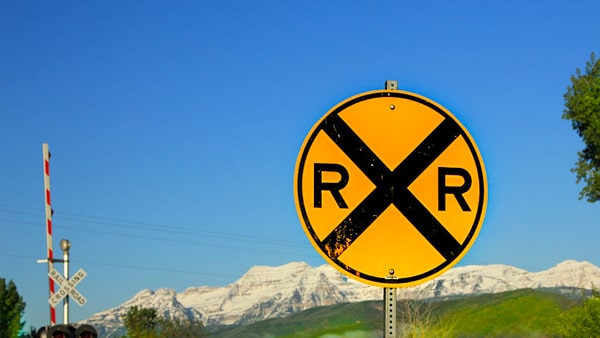
What does a round, yellow railroad advance-warning sign tell you?

These signs alert the driver _____________.
  1. A. A school zone begins ahead
  2. B. Debris may be present in the roadway
  3. C. A four-way stop is ahead
  4. D. A railroad crossing is ahead

Correct answer: D. – A railroad crossing is ahead

The sign warns that a public railroad-highway crossing is ahead. The Oregon commercial driver manual directs drivers to slow down, look and listen for a train, and be prepared to stop at the tracks. Passenger and placarded hazardous-material vehicles are among those required to stop at railroad crossings.

Source: Oregon Commercial Driver Manual — § 2.15.2, “Warning Signs and Devices”

Question 4

What is the main safety benefit of an antilock braking system?

  1. A. It permits faster driving and shorter following distances
  2. B. It prevents every type of skid
  3. C. It guarantees a shorter stopping distance
  4. D. It helps prevent wheel lockup and maintain control during braking

Correct answer: D. – It helps prevent wheel lockup and maintain control during braking

ABS detects potential wheel lockup and adjusts brake pressure to help the wheels continue rotating. This helps the driver maintain control during hard braking and may allow steering around an obstacle. ABS does not prevent power or turning skids, and it does not necessarily shorten stopping distance.

Source: Oregon Commercial Driver Manual — § 2.18.4, “How ABS Helps You”

Question 5

How far ahead should a commercial driver generally scan while driving?

  1. A. 2 to 5 seconds
  2. B. 5 to 10 seconds
  3. C. 12 to 15 seconds
  4. D. 15 to 25 seconds

Correct answer: C. – 12 to 15 seconds

Good drivers generally look at least 12 to 15 seconds ahead, measured by the distance the vehicle will travel during that time. This provides more time to respond to changing traffic or roadway conditions. Continue shifting your attention between nearby conditions and the roadway farther ahead.

Source: Oregon Commercial Driver Manual — § 2.4.1, “Seeing Ahead”

Question 6

Which choice can help reduce stress and distraction before and during a drive?

  1. A. Drink large amounts of coffee
  2. B. Eat a heavy meal before leaving
  3. C. Choose calming music and give driving your full attention
  4. D. Use the trip to make personal phone calls

Correct answer: C. – Choose calming music and give driving your full attention

The commercial driver manual recommends reducing stress before and during a trip, including listening to calming music. Give the driving task your full attention and avoid distractions such as phone conversations and eating. Realistic scheduling and accepting unavoidable delays can also reduce frustration behind the wheel.

Source: Oregon Commercial Driver Manual — § 2.10.2, “Don’t Be an Aggressive Driver”