


Oregon CDL Practice Test (OR) 2026

4.8 out of 5 (166 votes)
80% Passing score
20 Questions
4 Mistakes allowed
Embarking on the path to obtaining your Oregon Commercial Driver's License (CDL) in 2026 is a significant step toward a rewarding career in commercial driving. To aid in this pursuit, our Oregon CDL Practice Test offers a comprehensive and structured approach to preparing for the real written test. The introductory Oregon CDL practice test features 20 permit test questions, compared to the 50 questions found in the actual CDL written exam. This streamlined format enables quicker completion, providing an efficient study session, no matter your time constraints. With a requirement to correctly answer at least 16 questions, the DMV practice test provides a realistic experience of the examination process. The test encompasses a broad spectrum of subjects relevant to commercial driving, ensuring a well-rounded preparation. Sample DMV test questions range from pre-trip vehicle inspection to basic vehicle control, gear shifting, handling hills and downgrades, effective communication with other drivers, speed control, and essential drug and alcohol awareness. This diversity ensures that regardless of whether you're aiming for a Class A or Class B license, or any specific endorsements, you are adequately prepared for your Oregon general knowledge test in 2026, which is a prerequisite for all CDL classes. The source of our questions is the official CDL driver's manual, the same resource used for the actual Oregon CDL test. This ensures that our DMV practice test is closely aligned with what you'll encounter on test day. Additionally, the practice test can be taken multiple times, allowing you to build confidence and proficiency with each attempt. At the conclusion of each Oregon CDL practice test, you'll receive a detailed summary of your performance. This includes not only your score but also an explanation of the questions you answered incorrectly, with the correct answers provided for review. This feedback loop is designed to solidify your understanding and prepare you for the challenges of the real Oregon DMV permit test. As you progress through our series of permit practice tests, you'll find yourself increasingly well-equipped to tackle the actual Oregon DMV CDL test in 2026, armed with the knowledge and confidence needed to succeed.
FREE CDL Practice Test App
Pass your Oregon CDL General Knowledge test with the NextDoorDriving app. Real questions and answers—100% free and ad-free.
Download on the App Store

Sample Oregon CDL Test Questions - General Knowledge

Question 1

A reversing-curves warning sign shows the roadway bending first right and then left. What does it warn you about?
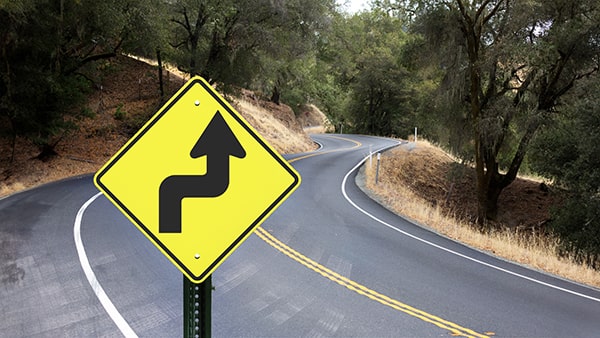
This sign warns drivers to  _____________.
  1. A. A single curve to the right
  2. B. A sharp right turn followed by a stop
  3. C. A winding road with several curves
  4. D. Two successive curves, first right and then left

Correct answer: D. – Two successive curves, first right and then left

This warning sign indicates that the road ahead curves first to the right and then to the left. The Oregon manual identifies it as a reversing-curves sign. Reduce speed as conditions require and prepare to steer through both changes in direction.

Source: 2026–2027 Oregon Driver Manual — “Signs,” “Reversing Curves”

Question 2

Before a helper guides you while backing, which hand signal is most important to establish?

  1. A. Pull forward
  2. B. Begin backing
  3. C. Turn toward me
  4. D. Stop

Correct answer: D. – Stop

Before backing, agree on hand signals that both you and the helper understand. The stop signal is the most important because it directs you to halt immediately when the path is unsafe or the helper needs to reposition. The helper should remain near the rear of the vehicle where you can see them.

Source: Oregon Commercial Driver Manual — § 2.2.4, “Backing Safely”

Question 3

What happens when a commercial vehicle hydroplanes?

  1. A. The tires lose contact with the road and have little or no traction
  2. B. The steering wheel turns even though the vehicle remains straight
  3. C. The brakes apply without the driver pressing the pedal
  4. D. The suspension lifts the vehicle above standing water

Correct answer: A. – The tires lose contact with the road and have little or no traction

Hydroplaning occurs when tires ride on water or slush instead of maintaining contact with the road. With little or no traction, steering and braking may become ineffective. Standing water, low tire pressure and worn tread increase the risk, and hydroplaning can occur at speeds as low as 30 mph when enough water is present.

Source: Oregon Commercial Driver Manual — § 2.6, “Hydroplaning”

Question 4

Before making a permitted right turn on red in Oregon, what must a driver do?

  1. A. Enter the intersection before checking cross traffic
  2. B. Stop only when a pedestrian is visible
  3. C. Slow down without making a complete stop
  4. D. Come to a complete stop, then yield before turning

Correct answer: D. – Come to a complete stop, then yield before turning

Oregon law requires a driver facing a steady red signal to stop at the designated stopping point. A permitted right turn may then be made unless a sign or officer prohibits it, but the driver must first yield to traffic and pedestrians. Merely slowing down is not sufficient.

Source: 2026–2027 Oregon Driver Manual — “Traffic Signals,” “Steady/Circular Red”, ORS 811.260(7) — Appropriate Driver Responses to Traffic Control Devices, ORS 811.360(1)(a) — Vehicle Turns Permitted at Stop Light; Proceeding Against Traffic Control Device; Improperly Proceeding at Stop Light; Penalty

Question 5

During Step 4 of the seven-step vehicle inspection, which lights should you activate before leaving the cab?

  1. A. Parking lights and the right turn signal
  2. B. High beams and brake lights
  3. C. Clearance lights and the left turn signal
  4. D. Low-beam headlights and four-way emergency flashers

Correct answer: D. – Low-beam headlights and four-way emergency flashers

Set the parking brake, turn off the engine and take the key before leaving the cab. Turn on the low-beam headlights and four-way emergency flashers, then verify that they work. The procedure later calls for turning these off and activating the parking, clearance, marker, identification and turn-signal lights.

Source: Oregon Commercial Driver Manual — § 2.1.5, “Seven-Step Inspection Method”

Question 6

What does a Two-Way Traffic Ahead warning sign mean?

This sign warns drivers to _____________.
  1. A. A two-way road crosses your road ahead
  2. B. The one-way road joins a two-way road, and you will face oncoming traffic
  3. C. The road ahead carries traffic in one direction only
  4. D. All traffic must turn at the next intersection

Correct answer: B. – The one-way road joins a two-way road, and you will face oncoming traffic

The sign warns that a one-way roadway is joining a two-way roadway. Drivers must be prepared to encounter traffic moving in the opposite direction. The Oregon manual calls this sign Two-Way Traffic Ahead and emphasizes that oncoming vehicles will be present.

Source: 2026–2027 Oregon Driver Manual — “Signs,” “Two-Way Traffic Ahead”