


Oregon DMV Practice Test

4.6 out of 5 (742 votes)
80% Passing score
20 Questions
4 Mistakes allowed
Preparing for the Oregon DMV knowledge test is mostly about knowing what Oregon actually tests, not just flipping through the Driver Manual and hoping the obvious rules are enough. The official Class C knowledge test is based on the Oregon Driver Manual and covers road signs, traffic laws, highway signs and signals, safe-driving decisions, licensing basics, and the kind of everyday rules that matter once you are out in traffic and not just reading about traffic. The real Oregon DMV knowledge test has 35 multiple-choice questions. You need 28 correct answers to pass, which is an 80% score, and the test costs $7 each time you take it. That makes a free Oregon DMV practice test a useful part of studying, especially if you want to get comfortable with the format before you test online or sit down at a DMV office computer. This Oregon DMV practice permit test helps you work through the same general areas that appear on the actual permit test: signs, signals, right-of-way rules, lane use, following distance, intersections, licensing requirements, and safe-driving judgment. Some of it will feel familiar. Some of it, less so, usually because the wording asks you to slow down and choose the rule Oregon wants, not the answer that feels casually correct. That is where practice questions do their job. They make the gaps show up early. For teen drivers, Oregon’s permit process has a few added pieces. Drivers age 15, 16, or 17 apply for a Provisional Instruction Permit, and they must pass the knowledge test, pass a vision screening, show the required identity and address documents, pay the permit fee, and get a parent or legal guardian signature. Teens who take the knowledge test online also need a proctor over age 21. Adults have fewer provisional requirements, but they still need to meet Oregon’s document, fee, vision, and testing rules when the knowledge test is required. One point worth keeping straight: Oregon does not use a separate road-sign-only test for standard Class C applicants. Road sign questions are included in the same 35-question exam, mixed in with traffic laws and safe-driving information. So it makes sense to study signs along with everything else instead of treating them like a quick visual warm-up. You can take this Oregon practice permit test as many times as you need from your phone, tablet, or computer. Use it until the format feels familiar, the weaker topics are easier to spot, and the real Oregon DMV permit test feels like something you have already practiced carefully.
FREE DMV Practice Test App
Study for your Oregon permit test or driver’s license with the NextDoorDriving app. 700+ DMV questions and answers, 100% free!
Download on the App Store

Sample Oregon Permit Test Questions

Question 1

A regulatory sign shows a right-turn arrow covered by a red circle and slash. What does it mean?
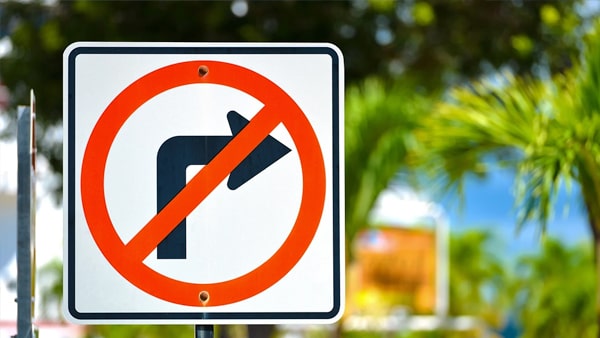
This sign means:
  1. A. No U-turn
  2. B. No left turn
  3. C. No right turn
  4. D. No turns in either direction

Correct answer: C. – No right turn

A red circle and diagonal slash over a right-turn arrow prohibits right turns. The symbol applies to the particular movement shown rather than every possible turn. Follow any other signs, signals, and pavement markings governing movements at that location.

Source: 2026-2027 Oregon Driver Manual — Signs and Traffic Signals, “No Left Turn; No Right Turn; No U Turn”

Question 2

What should a passenger-car driver do when approaching a railroad crossing without gates or flashing lights?

  1. A. Always stop, even when no stop sign or train is present
  2. B. Slow down, look and listen, and be prepared to stop
  3. C. Continue normally because every crossing has automatic signals
  4. D. Accelerate to spend less time on the tracks

Correct answer: B. – Slow down, look and listen, and be prepared to stop

Railroad-crossing signs require you to look, listen, and slow down because you may have to stop. Obey any yield or stop sign posted with the crossbuck. You must stop when a train is visible or audible and close enough to create an immediate hazard, and you may cross only when it is safe. Violating ORS 811.455 is a Class B traffic violation.

Source: ORS 811.455 – Failure to stop for railroad signal; penalty, 2026-2027 Oregon Driver Manual — Railroad Crossings, Light Rail and Street Cars, “Railroad Crossings”

Question 3

Even when traffic rules give you the right-of-way, what should you do if another driver enters your path?

  1. A. Insist on proceeding first
  2. B. Slow or stop as needed rather than insist on the right-of-way
  3. C. Always surrender the right-of-way at every intersection

Correct answer: B. – Slow or stop as needed rather than insist on the right-of-way

The Oregon Driver Manual warns defensive drivers not to assume that signs or signals will stop approaching traffic or that another driver will yield. Continue checking for unexpected actions as you enter an intersection. If another vehicle enters your path, slowing or stopping is safer than insisting on proceeding merely because you had priority.

Source: 2026-2027 Oregon Driver Manual — Turns and Intersections, “Intersections”

Question 4

Orange traffic-control signs generally indicate:

  1. A. A work zone where workers or construction equipment may be near traffic
  2. B. Services such as fuel, food, or lodging
  3. C. A permanent recreational or historic destination
  4. D. A location where every driver must immediately stop

Correct answer: A. – A work zone where workers or construction equipment may be near traffic

Work zones are identified by orange traffic-control devices. Orange signs warn drivers about temporary conditions ahead, while orange cones guide traffic away from construction areas. Workers and equipment may be close to moving vehicles, and lanes, traffic patterns, or speed limits may change within the zone.

Source: 2026-2027 Oregon Driver Manual — Sharing the Road, “Work Zones”

Question 5

In Oregon, where should you position your vehicle when approaching and making a right turn?

  1. A. Near the roadway’s center line
  2. B. Close to the left edge of the roadway
  3. C. As close as practicable to the right curb or edge
  4. D. Beyond the center of the intersection before turning

Correct answer: C. – As close as practicable to the right curb or edge

The approach and the right turn must be made as close as practicable to the right-hand curb or roadway edge. The driver manual similarly instructs drivers to get near the right curb or edge before turning. Avoid making a wide, sweeping turn unless the size or characteristics of the vehicle require additional room. Improper execution is a Class B traffic violation.

Source: ORS 811.355 – Improperly executed right turn; penalty, 2026-2027 Oregon Driver Manual — Turns and Intersections, “Right Turns”

Question 6

An emergency vehicle approaches in Oregon using a light or siren. What must you do?

  1. A. Move near and parallel to the right edge, clear of an intersection, and stop
  2. B. Enter the right lane but continue driving slowly
  3. C. Stop immediately, even if you are inside an intersection
  4. D. Accelerate until you are well ahead of the emergency vehicle

Correct answer: A. – Move near and parallel to the right edge, clear of an intersection, and stop

Yield immediately by driving as near as possible and parallel to the right-hand edge or curb, clear of any intersection. Stop there and remain stopped until the emergency vehicle or ambulance has passed, unless a police officer directs otherwise. If you are in an intersection, clear it before pulling right. Failure to yield under ORS 811.145 is a Class B traffic violation.

Source: ORS 811.145 – Failure to yield to emergency vehicle or ambulance; penalty, 2026-2027 Oregon Driver Manual — Sharing the Road, “Emergency Vehicles”