Oregon DMV Practice Test 2

4.8 out of 5 (506 votes)
80% Passing score
20 Questions
4 Mistakes allowed
Before you take the Oregon DMV knowledge test, it helps to understand what the exam is actually built around. This is the Class C knowledge test, the standard test for an Oregon instruction permit or noncommercial driver license, and it comes straight from the Oregon Driver Manual. So the questions are not random trivia dressed up in DMV clothing. They cover the things Oregon expects drivers to know before they get on the road: traffic laws, road signs, safe driving practices, and the kind of rules that matter when the pavement is wet, visibility is poor, or everyone at an intersection seems to think they arrived first. The official Oregon DMV permit test has 35 multiple-choice questions. You need 28 correct answers to pass, which means an 80% score. Road signs are part of that same knowledge test, not a separate little warm-up, so your Oregon DMV practice test should cover both signs and general driving rules together. That is where a practice test earns its keep. It gets you used to the wording, the pacing, and the slightly fussy details that are easy to skim past when you are only reading the manual. There are a few licensing details worth keeping straight, too. Teens ages 15, 16, and 17 apply for a Provisional Instruction Permit, and they need more than just a passing test score. Oregon also requires a parent or legal guardian signature, proof of identity and address, a vision test, Social Security number information or certification that one was not assigned, the required fees, and a photo. Teen applicants can test online or at a DMV office, but online testing requires a proctor over age 21. Adults have a slightly different path. They may apply for an instruction permit, or in some cases move directly toward a driver license, but anyone who wants to practice driving before the drive test needs an instruction permit first. The Oregon knowledge test costs $7 each time you take it. If you test online, Oregon allows two attempts in 24 hours and up to four total online attempts before later tries must happen at a DMV office. Retakes are available, sure, but relying on them is not much of a plan. A free Oregon DMV practice test gives you a better way to spot weak areas before they turn into extra fees, extra scheduling, and an extra trip you really did not need. New Oregon residents may not always have to take the knowledge test. Oregon may waive the knowledge and drive tests for drivers surrendering a license from another U.S. state, D.C., a U.S. territory, the U.S. Department of State, Canada, Germany, Japan, South Korea, or Taiwan, as long as the license has not been expired for more than one year. Other applicants may still need to test. Use this Oregon DMV practice test as a serious study tool, not a shortcut. Take it more than once, review what you miss, and keep the Oregon Driver Manual close by when a rule feels half-remembered. That is usually where the real studying starts.

FREE DMV Practice Test App
Study for your Oregon permit test or driver’s license with the NextDoorDriving app. 700+ DMV questions and answers, 100% free!
Download on the App Store

Sample Oregon Permit Test Questions

Question 1

At an Oregon location where a U-turn is permitted, which lane should you normally use to begin it on a multilane road?

  1. A. A shared center turn lane in every situation
  2. B. The far-left lane available for your direction
  3. C. The far-right lane
  4. D. Any lane with an opening in traffic

Correct answer: B. – The far-left lane available for your direction

Begin a permitted U-turn from the far-left lane rather than crossing several lanes from the right. Signal and make certain the maneuver can be completed safely. U-turns are generally prohibited at signal-controlled intersections unless posted otherwise, between intersections within a city, and where required sight distance is unavailable.

Source: ORS 811.335 – Unlawful or unsignaled turn; penalty, ORS 811.340(1)(a) – Improperly executed left turn; penalty, ORS 811.365 – Illegal U-turn; penalty

Question 2

How should you respond when an approaching vehicle’s high beams create glare at night?

  1. A. Look directly at the approaching headlights
  2. B. Look slightly right toward the road edge or fog line
  3. C. Focus on the centerline immediately beside the other vehicle
  4. D. Leave your own high beams on until the vehicle passes

Correct answer: B. – Look slightly right toward the road edge or fog line

Avoid looking directly into bright oncoming headlights. Look slightly to the right and use the road edge or fog line as a visual reference while continuing to monitor your path. You must also dim your own high beams when an oncoming vehicle is within 500 feet.

Source: ORS 811.515(6)(a) – Unlawful use or failure to use lights; exemptions, Oregon Driver Manual — Safe and Responsible Driving, “Night Driving”

Question 3

A chevron sign pointing to the right marks:

When you see this sign, it means:
  1. A. An object blocking the roadway
  2. B. Traffic entering from a side road
  3. C. A sharp curve or change in direction to the right
  4. D. A freeway merge ahead

Correct answer: C. – A sharp curve or change in direction to the right

A chevron identifies a sharp curve or change in the road’s direction at the sign. The direction of the chevron shows which way the roadway bends. Several chevrons may be installed in sequence to help drivers follow the alignment of a curve.

Source: Oregon Driver Manual — Signs and Traffic Signals, “Chevron”

Question 4

On an Oregon highway with two lanes in your direction, you approach a vehicle stopped on the right shoulder with hazard lights flashing. What should you do?

  1. A. Remain in the right lane and accelerate past it
  2. B. Move to the nonadjacent lane if safe, or slow to at least 5 mph below the limit
  3. C. Stop in your lane until the vehicle begins moving
  4. D. Maintain speed and sound your horn while passing

Correct answer: B. – Move to the nonadjacent lane if safe, or slow to at least 5 mph below the limit

When approaching a stopped vehicle displaying hazard lights on a highway with at least two lanes in your direction, change to a lane that is not adjacent to it when the lane change can be made safely. Alternatively, reduce your speed to at least 5 mph below the speed limit. Failure to maintain the required distance is a Class B traffic violation.

Source: ORS 811.147(1)(a), (3) – Failure to maintain safe distance from motor vehicle; penalty

Question 5

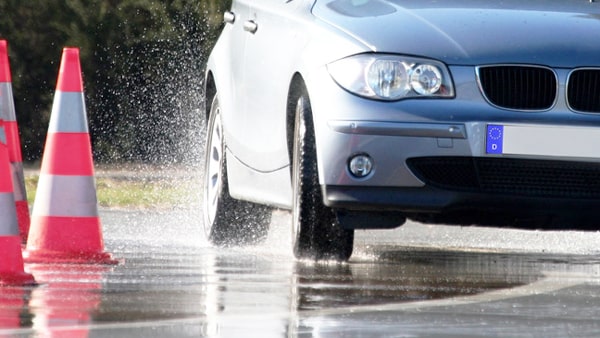
Why can pavement become especially slippery when a rain shower begins?

The road surface is most slippery:
  1. A. Rain immediately freezes on every road
  2. B. Tires gain more traction on wet pavement
  3. C. Rainwater can mix with oil and dirt on the road
  4. D. Only deep puddles make pavement slippery

Correct answer: C. – Rainwater can mix with oil and dirt on the road

Rain reduces visibility and increases the distance needed to stop. Even a summer shower can make pavement slippery when water mixes with oil and dirt on the road. Slow down, allow more following distance, and apply the brakes sooner and more gently than you would on dry pavement.

Source: 2026–2027 Oregon Driver Manual — Safe and Responsible Driving, “Rain”

Question 6

Under Oregon law, when are you prohibited from passing a vehicle stopped ahead?

  1. A. When it is signaling for a left turn
  2. B. When both vehicles are on a multilane one-way street
  3. C. When it stopped at an intersection crosswalk for a pedestrian
  4. D. When it is preparing to parallel park

Correct answer: C. – When it stopped at an intersection crosswalk for a pedestrian

A driver approaching from behind may not pass a vehicle stopped at a marked or unmarked crosswalk at an intersection to permit a pedestrian to cross. The prohibition applies even if another lane appears open. Passing the stopped vehicle in this situation is a Class B traffic violation.

Source: ORS § 811.020 – Passing stopped vehicle at crosswalk; penalty