


Oregon DMV Permit Practice Test 4

4.8 out of 5 (356 votes)
80% Passing score
20 Questions
4 Mistakes allowed
Oregon’s DMV knowledge test pulls from the Oregon Driver Manual, which means the questions are not limited to obvious road signs or the basic “who goes first” situations most people remember from driver’s ed. It gets into traffic laws, safe-driving judgment, signs, and the smaller rules that are easy to skim past when you are studying too quickly. This Oregon DMV practice permit test is built for that exact kind of preparation, with 20 multiple-choice questions that help you check what you actually know before you pay the fee, show up, and find out the harder way. The official Oregon Class C knowledge test has 35 multiple-choice questions, and you need 28 correct answers to pass. That is an 80% score, so there is some breathing room, but not enough to treat the test like a casual guessing exercise. This shorter practice DMV permit test uses a 20-question format with a passing score of 16, giving you a clean, manageable way to review without making the whole study session feel like paperwork with a progress bar attached. There is also a special focus here on child safety seats, which is worth taking seriously. Securing young passengers correctly is one of those topics that feels simple in conversation and then becomes much more exact once you are dealing with actual rules, ages, sizes, placement, and proper use. The questions and explanations are designed to help those details stick, not just flash a correct answer and move on. After each question, you get immediate feedback, including an explanation of why the answer is right, which is usually where the real learning happens — quietly, a little irritatingly, but effectively. The test has been reviewed by experienced driving instructors, so the wording stays tied to real Oregon driving knowledge rather than drifting into random trivia. It can help teens preparing for an Oregon Provisional Instruction Permit, adults applying for an instruction permit or driver license, and drivers who just need a refresher before renewing, transferring, or getting back into the licensing process. Some new Oregon residents may have the knowledge test waived if they surrender a qualifying license from another state, U.S. territory, Canada, Germany, Japan, South Korea, or Taiwan, but many first-time applicants and drivers with long-expired or non-qualifying licenses still need to test. Take it once, see what falls apart, review the Oregon Driver Manual, and take it again. That is not fancy advice, admittedly, but it is the kind that works.
FREE DMV Practice Test App
Study for your Oregon permit test or driver’s license with the NextDoorDriving app. 700+ DMV questions and answers, 100% free!
Download on the App Store

Sample Oregon Permit Test Questions

Question 1

Under Oregon law, which statement about double parking is correct?
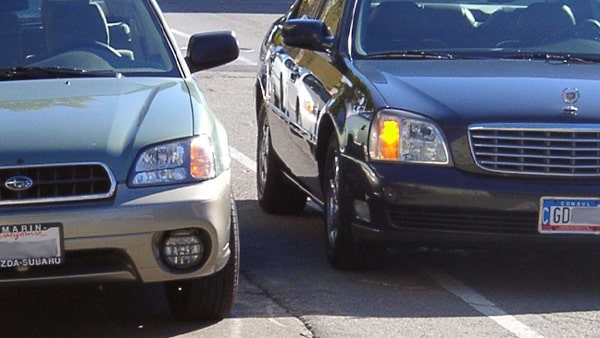
Which of the following is true about double parking?
  1. A. It is prohibited except when a specific statutory exemption applies
  2. B. It is permitted whenever the driver remains inside
  3. C. It is permitted while making a delivery
  4. D. It is permitted if the curbside vehicle can still leave

Correct answer: A. – It is prohibited except when a specific statutory exemption applies

Stopping or parking on the roadway side of a vehicle already stopped or parked at the curb is prohibited. Applicable exemptions are narrow and include an unavoidably disabled vehicle and certain utility emergency responses; ordinary deliveries are not included. Illegal stopping, standing, or parking is a Class D traffic violation.

Source: ORS 811.550(3) – Places where stopping, standing and parking prohibited, ORS 811.555(1), (5) – Illegal stopping, standing or parking; affirmative defense; penalty, ORS 811.560(7), (11), (12) – Exemptions from prohibitions on stopping, standing or parking
Question 2

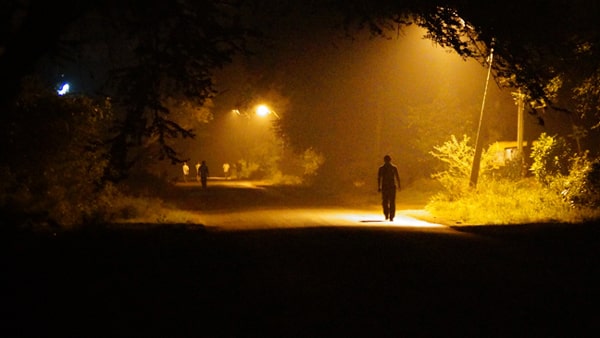
At night on a poorly lit road, you should select a speed that allows you to:

When driving in traffic at night on a dimly lit street, you should:
  1. A. Stop within the distance you can see ahead
  2. B. Use high beams regardless of nearby traffic
  3. C. Keep the instrument-panel lights at maximum brightness
  4. D. Use hazard lights while moving with traffic

Correct answer: A. – Stop within the distance you can see ahead

Poor lighting makes hazards and unlighted road users harder to see. Drive slowly enough that you can stop within the distance visible ahead. When following another vehicle closely enough for headlight glare to affect its driver, use low beams rather than high beams.

Source: Oregon Commercial Driver Manual — § 2.11.3, “Roadway Factors: Poor Lighting”, 2026–2027 Oregon Driver Manual — Safe and Responsible Driving, “Using Lights” and “Night Driving”

Question 3

Which of these is NOT an effect of drinking alcohol?

  1. A. Slower reactions to hazards
  2. B. Impaired judgment
  3. C. Reduced alertness
  4. D. Improved concentration and decision-making

Correct answer: D. – Improved concentration and decision-making

Oregon’s commercial driver manual states that alcohol affects judgment, vision, coordination, and reaction time. It can also reduce alertness and interfere with a driver’s ability to recognize impairment. Alcohol does not improve concentration or decision-making, even when the person feels more confident.

Source: Oregon Commercial Driver Manual — § 2.22.1, “Alcohol and Driving”

Question 4

Under Oregon law, what must you do when a traffic signal turns green?

  1. A. Wait five seconds before entering the intersection
  2. B. Enter immediately before cross traffic begins moving
  3. C. Yield to vehicles already within the intersection
  4. D. Stop again before proceeding through the intersection

Correct answer: C. – Yield to vehicles already within the intersection

A driver facing a green signal may proceed straight or turn unless a sign prohibits the movement. The driver must yield to vehicles that are already within the intersection when the green signal appears. Check that the path is clear before proceeding.

Source: ORS 811.260(1) – Appropriate driver responses to traffic control devices

Question 5

A white rectangular sign showing a black arrow passing to the right of an obstruction means:

  1. A. Divided highway ends
  2. B. Keep right
  3. C. Sharp left turn ahead
  4. D. Right lane ends ahead

Correct answer: B. – Keep right

A Keep Right sign indicates that a traffic island, median, or other obstruction divides the road ahead. Drivers must travel to the right of the obstruction. It is a regulatory sign that directs traffic movement rather than merely warning of a curve or lane reduction.

Source: 2026–2027 Oregon Driver Manual — Signs and Traffic Signals, “Keep Right”

Question 6

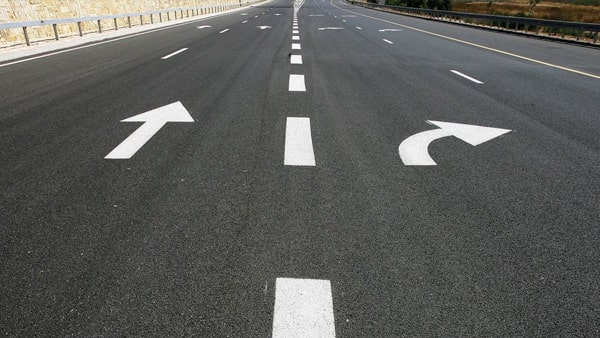
What does a broken white line between traffic lanes indicate?

A broken white center line on the roadway means:
  1. A. Turns are prohibited from both lanes
  2. B. Drivers must reduce speed before crossing
  3. C. Passing and lane changes are prohibited
  4. D. The lanes travel in the same direction, and crossing is permitted with caution

Correct answer: D. – The lanes travel in the same direction, and crossing is permitted with caution

A broken white line separates lanes of traffic moving in the same direction. You may cross it with caution when changing lanes. Before moving over, signal, check the mirrors, and glance over the appropriate shoulder for vehicles in the blind spot.

Source: 2026–2027 Oregon Driver Manual — Lane Travel, “White Markings: Broken White Line” and “Changing Lanes”